

Tuesday, October 27, 2026
Science
No Result
View All Result
  • Login
  • HOME
  • SCIENCE NEWS
  • CONTACT US
  • HOME
  • SCIENCE NEWS
  • CONTACT US
No Result
View All Result
Scienmag
No Result
View All Result
Home Science News Medicine

Mass spectrometry assay tracks myeloma M-protein in blood without sequencing

October 27, 2026
in Medicine
Ophelia Keating
By Ophelia Keating Scienmag Editorial Profile - Health Services Research
Reading Time: 3 mins read
0
Mass spectrometry assay tracks myeloma M-protein in blood without sequencing

Mass spectrometry assay tracks myeloma M-protein in blood without sequencing

65
SHARES
587
VIEWS
Share on FacebookShare on Twitter
ADVERTISEMENT

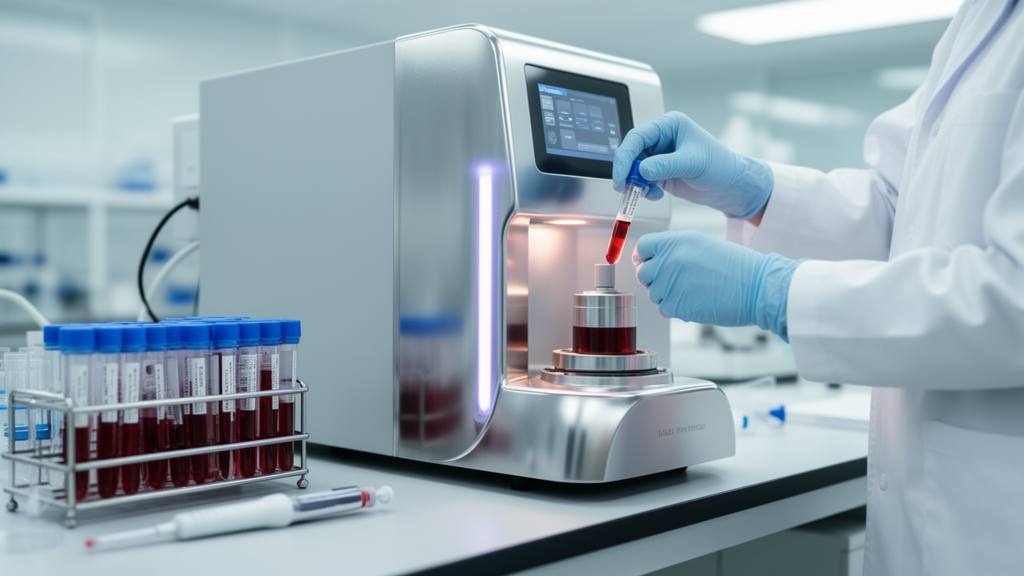
Researchers have developed a blood-based mass spectrometry assay, called MyeloTrak, that can identify patient-specific M-protein peptides in multiple myeloma without requiring bone marrow RNA or full-length antibody sequencing. The work, published in Clinical Proteomics, addresses a growing need in myeloma care: as therapies drive disease burden below the detection limits of conventional assays, clinicians need sensitive ways to monitor residual disease, and the current gold standard, bone marrow-based minimal residual disease assessment, is invasive enough to make frequent longitudinal monitoring difficult.

MyeloTrak is a bottom-up proteomics approach that detects clonotypic peptides, the unique sequences that mark a patient’s malignant antibody, directly in plasma. What distinguishes it from most existing proteomic methods is that its discovery workflow does not depend on prior sequencing. Instead, the assay leverages intrinsic biological signatures of M-proteins to select candidate clonotypic peptides from the enormous polyclonal background of circulating immunoglobulins.

To validate the peptide-selection strategy, the team used monoclonal antibody-spiked samples and a patient cohort, benchmarking the selected peptides against known antibody and bone marrow RNA sequences. In these experiments, clonotypic peptides were enriched approximately 1,000-fold from the polyclonal background, allowing confident identification in 23 patients across diverse M-protein levels and isotypes.

Sensitivity was tested in serial dilution experiments using monoclonal antibody-spiked samples. Selected clonotypic peptides remained detectable, with isotope dot-product values of at least 0.9, at concentrations of 1 to 4 mg/L. The authors note that these dilution findings come from spiked samples, so they represent analytical performance under controlled conditions rather than results from patient plasma alone.

Longitudinal tracking was carried out in 19 patients. Trends in the clonotypic peptide measurements were generally concordant with conventional assays, supporting the feasibility of using plasma-based monitoring to follow residual M-protein over time. However, four patients exhibited discordant trajectories between the new assay and conventional methods, a limitation the authors report explicitly rather than resolve.

The study is an early-stage validation of a discovery workflow rather than a demonstration of clinical utility. The cohort was modest in size, the spiked-sample dilution experiments do not by themselves establish performance in unmodified patient samples, and the discordant trajectories observed in four of the 19 tracked patients indicate that the relationship between clonotypic peptide levels and conventional disease measures requires further investigation. The published version is also an early-release, peer-reviewed accepted manuscript that is subject to further edits before the final version of record.

Nevertheless, the authors argue that the approach significantly reduces the complexity of blood-based residual M-protein monitoring. By removing the need for bone marrow RNA or full-length immunoglobulin sequencing, MyeloTrak could make it more practical to track residual disease repeatedly over time through simple blood draws, complementing rather than replacing existing bone marrow-based assessment.

Subject of Research: A sequencing-independent mass spectrometry assay for blood-based residual M-protein monitoring in multiple myeloma

Article Title: MyeloTrak: a sequencing-independent mass spectrometry assay for blood-based residual M-protein monitoring in multiple myeloma

Article References: Kong, P.-H., Hsu, T.-L., Huang, Y.-C., Tsai, C.-K., Yeh, C.-M., Shiue, Y.-L., Duen-Ya Jea, J., Yen, L., Liao, C.-C., & Liu, C.-J. (2026). MyeloTrak: a sequencing-independent mass spectrometry assay for blood-based residual M-protein monitoring in multiple myeloma. Clinical Proteomics. https://doi.org/10.1186/s12014-026-09646-9

Image Credits: AI Generated

DOI: 10.1186/s12014-026-09646-9

Keywords: multiple myeloma, mass spectrometry, clonotypic peptides, M-protein, minimal residual disease, plasma proteomics, liquid biopsy, disease monitoring, Clinical Proteomics, MyeloTrak, sequencing-independent, mass

Cite Scienmag News

Ophelia Keating. (October 27, 2026). Mass spectrometry assay tracks myeloma M-protein in blood without sequencing. Scienmag. https://scienmag.com/mass-spectrometry-assay-tracks-myeloma-m-protein-in-blood-without-sequencing/


Ophelia Keating. "Mass spectrometry assay tracks myeloma M-protein in blood without sequencing." Scienmag, 27 October 2026, https://scienmag.com/mass-spectrometry-assay-tracks-myeloma-m-protein-in-blood-without-sequencing/. Accessed 27 October 2026.

Ophelia Keating. "Mass spectrometry assay tracks myeloma M-protein in blood without sequencing." Scienmag. October 27, 2026. https://scienmag.com/mass-spectrometry-assay-tracks-myeloma-m-protein-in-blood-without-sequencing/

Tags: blood-based minimal residual disease monitoringclinical proteomicsclinical validation of MyeloTrak assayclonotypic peptidesdetection of residual disease in plasmadisease monitoringhigh-sensitivity blood assay for multiple myelomainnovative proteliquid biopsylongitudinal disease monitoring in myelomaM proteinmassmass spectrometryMass spectrometry assay for myeloma M-protein detectionminimal residual diseasemonoclonal antibody peptide enrichmentMultiple MyelomaMyeloTraknon-invasive multiple myeloma biomarkerspatient-specific M-protein identification without sequencingplasma proteomicsproteomics workflow for myeloma trackingproteomics-based detection of clonotypic peptidessequencing-independent
Share26Tweet16
Previous Post

Research report: Investigation of gear design parameters for soft-gear-driven self-propelled colonoscopy robot

Next Post

Children’s education-linked genetic scores differ in ties to mental health within families

Related Posts

Research report: Investigation of gear design parameters for soft-gear-driven self-propelled colonoscopy robot
Medicine

Research report: Investigation of gear design parameters for soft-gear-driven self-propelled colonoscopy robot

October 27, 2026
Mid-pregnancy metabolites linked to children’s growth patterns up to age three
Medicine

Mid-pregnancy metabolites linked to children’s growth patterns up to age three

October 27, 2026
Deep learning maps a path toward smarter aneurysm surgery planning
Medicine

Deep learning maps a path toward smarter aneurysm surgery planning

October 27, 2026
CYP17A1 Mutations Linked to Steroid Defects in Polycystic Ovary Syndrome Study
Medicine

CYP17A1 Mutations Linked to Steroid Defects in Polycystic Ovary Syndrome Study

October 27, 2026
Lyme Disease Rates in Europe Far Exceed Surveillance Figures, Landmark Study Finds
Medicine

Lyme Disease Rates in Europe Far Exceed Surveillance Figures, Landmark Study Finds

October 27, 2026
How the oral exposome shapes diseases of teeth, gums and oral mucosa
Medicine

How the oral exposome shapes diseases of teeth, gums and oral mucosa

October 27, 2026
Next Post
Children’s education-linked genetic scores differ in ties to mental health within families

Children's education-linked genetic scores differ in ties to mental health within families

  • Mothers who receive childcare support from maternal grandparents show more optimized

    Mothers who receive childcare support from maternal grandparents show more parental warmth, finds NTU Singapore study

    27656 shares
    Share 11059 Tweet 6912
  • University of Seville Breaks 120-Year-Old Mystery, Revises a Key Einstein Concept

    1061 shares
    Share 424 Tweet 265
  • Bee body mass, pathogens and local climate influence heat tolerance

    682 shares
    Share 273 Tweet 171
  • Researchers record first-ever images and data of a shark experiencing a boat strike

    546 shares
    Share 218 Tweet 137
  • Groundbreaking Clinical Trial Reveals Lubiprostone Enhances Kidney Function

    531 shares
    Share 212 Tweet 133
Science

Embark on a thrilling journey of discovery with Scienmag.com—your ultimate source for cutting-edge breakthroughs. Immerse yourself in a world where curiosity knows no limits and tomorrow’s possibilities become today’s reality!

RECENT NEWS

  • Children’s education-linked genetic scores differ in ties to mental health within families
  • Mass spectrometry assay tracks myeloma M-protein in blood without sequencing
  • Research report: Investigation of gear design parameters for soft-gear-driven self-propelled colonoscopy robot
  • Citric acid treatment and iron doping tune nickel catalysts for CO2 methanation

Categories

  • Agriculture
  • Anthropology
  • Archaeology
  • Athmospheric
  • Biology
  • Biotechnology
  • Blog
  • Bussines
  • Cancer
  • Chemistry
  • Climate
  • Earth Science
  • Editorial Policy
  • Marine
  • Mathematics
  • Medicine
  • Pediatry
  • Policy
  • Psychology & Psychiatry
  • Science Education
  • Science News
  • Social Science
  • Space
  • Technology and Engineering

Subscribe to Blog via Email

Enter your email address to subscribe to this blog and receive notifications of new posts by email.

Join 5,151 other subscribers

© 2025 Scienmag - Science Magazine

Welcome Back!

Login to your account below

Forgotten Password?

Retrieve your password

Please enter your username or email address to reset your password.

Log In
No Result
View All Result
  • HOME
  • SCIENCE NEWS
  • CONTACT US

© 2025 Scienmag - Science Magazine

Discover more from Science

Subscribe now to keep reading and get access to the full archive.

Continue reading