


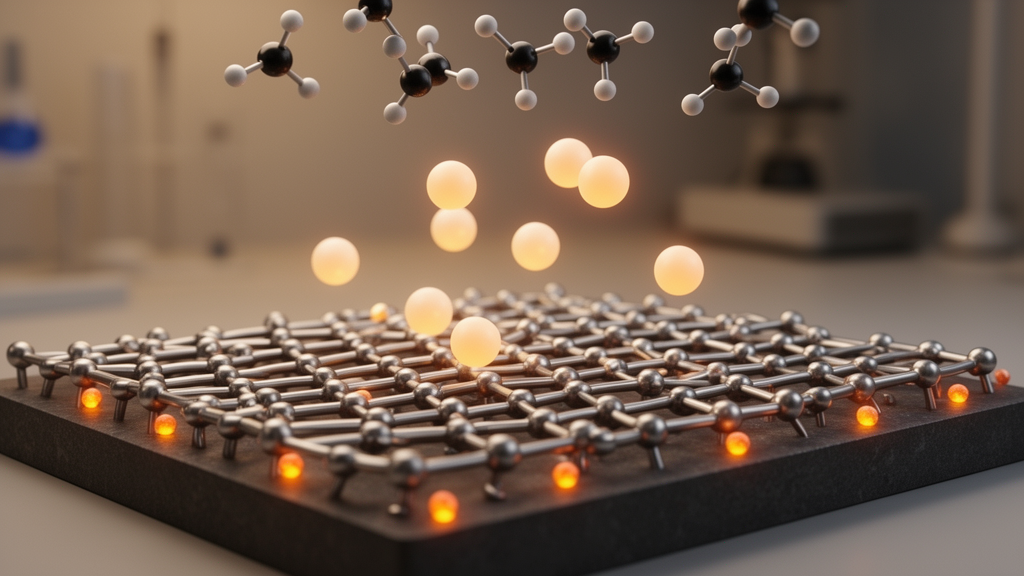
Turning carbon dioxide into methane with renewable hydrogen is an attractive way to store energy in a form that fits existing gas infrastructure, but the reaction needs catalysts that are cheap, fast, and highly selective. A new study in Advanced Composites and Hybrid Materials reports a head-to-head comparison of two independent ways to engineer the surface of a non-precious nickel catalyst supported on a calcium-aluminum layered double oxide, a platform the authors call NCL.
The two modification routes were deliberately kept separate. Treating the catalyst with citric acid, yielding the material labeled C-NCL, increased the dispersion of nickel particles and modified the environment of the nickel-support interface. Iron doping, yielding Fe-NCL, acted differently: it predominantly altered the catalyst’s reducibility, defect-related properties, and the distribution of surface basic sites. Because both routes were applied to the same fixed Ni/CaAl-LDO platform, the study could attribute each change to a specific strategy rather than to a mixture of effects.
The performance results were reported with careful caveats. C-NCL achieved 66.6% CO2 conversion with 96.5% methane selectivity at 400 °C. At 350 °C, however, C-NCL reached 44.9% CO2 conversion, which was lower than several reference catalysts.
Kinetic measurements clarified how each modification changes the reaction barrier. Using differential measurements at 5 mg of catalyst loading, the team determined apparent activation energies of 94.6, 53.6, and 72.6 kJ mol−1 for NCL, C-NCL, and Fe-NCL, respectively. Both routes lowered the apparent kinetic barrier relative to the unmodified catalyst, with the largest decrease for the citric-acid-treated material. The authors note these are apparent values obtained under specific measurement conditions, not definitive mechanistic constants.
Spectroscopy during the reaction added mechanistic texture. In-situ diffuse reflectance infrared Fourier transform spectroscopy detected carbonate- and formate-related surface species together with methane formation. The authors state that this is consistent with formate involvement in the pathway but does not establish its kinetic dominance, and they add that a carbon monoxide-mediated contribution cannot be excluded.
The broader significance lies in the comparison itself. Rather than claiming a single best catalyst, the study maps which lever each modification pulls: citric acid treatment reshapes the nickel-support interface and nickel dispersion, while iron doping tunes reducibility and basic site chemistry.
As with any laboratory catalysis study, the reported conversions and selectivities come from specific test conditions, and the authors themselves caution against over-reading the productivity figures. The value of the work is the strategy-resolved comparison on a fixed platform, which offers a clearer basis for future catalyst design than single-material claims.
Subject of Research: Surface engineering of nickel-loaded calcium-aluminum layered double oxide catalysts for carbon dioxide methanation
Article Title: Comparative surface engineering of nickel-loaded calcium-aluminum layered double oxide for enhanced methanation: citric acid treatment versus Fe doping
Article References: Cho, M.-S., Vikrant, K., & Kim, K.-H. (2026). Comparative surface engineering of nickel-loaded calcium-aluminum layered double oxide for enhanced methanation: citric acid treatment versus Fe doping. Advanced Composites and Hybrid Materials. https://doi.org/10.1007/s42114-026-02113-x
Image Credits: AI Generated
DOI: 10.1007/s42114-026-02113-x
Keywords: CO2 methanation, Sabatier reaction, nickel catalyst, layered double oxide, citric acid treatment, iron doping, methane selectivity, activation energy, catalyst support, synthetic natural gas, Comparative, surface
Cite Scienmag News
Denise Maddox. (October 27, 2026). Citric acid treatment and iron doping tune nickel catalysts for CO2 methanation. Scienmag. https://scienmag.com/citric-acid-treatment-and-iron-doping-tune-nickel-catalysts-for-co2-methanation/
Denise Maddox. "Citric acid treatment and iron doping tune nickel catalysts for CO2 methanation." Scienmag, 27 October 2026, https://scienmag.com/citric-acid-treatment-and-iron-doping-tune-nickel-catalysts-for-co2-methanation/. Accessed 27 October 2026.
Denise Maddox. "Citric acid treatment and iron doping tune nickel catalysts for CO2 methanation." Scienmag. October 27, 2026. https://scienmag.com/citric-acid-treatment-and-iron-doping-tune-nickel-catalysts-for-co2-methanation/


