

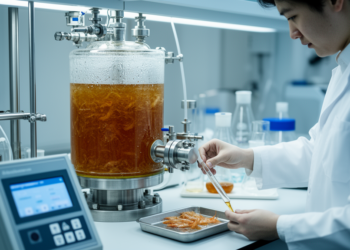
Shrimp-shell liquefaction reaches 42.35% under optimized laboratory conditions
A laboratory response-surface and kinetic study found an optimized shrimp-shell liquefaction rate of 42.35% under mixed-polyol conditions, with an estimated ...
A laboratory response-surface and kinetic study found an optimized shrimp-shell liquefaction rate of 42.35% under mixed-polyol conditions, with an estimated ...

New experiments show that adding 8 percent of 5–10 mm nut coke to sinter raises its reduction index and lowers ...
A new study shows that doping zinc oxide nanoparticles with silver simultaneously increases their hardness and elastic moduli while boosting ...
A simple change of solvent during hypophosphite phosphating lets researchers selectively grow Ni5P4 or Ni2P4O12 on carbon cloth, tuning sodium-storage ...
Controlled creep experiments on single snow samples reveal two distinct temperature regimes of snow viscoplasticity, with a stronger temperature sensitivity ...
A multi-analytical study shows that guano-derived taranakite transforms into the rare cave mineral francoanellite at low activation energy, driven by ...
Experiments and machine learning reveal that grain boundary sliding governs the exceptional room-temperature ductility of an ultrafine-grained Mg–Li alloy, while ...
Researchers in Vietnam used liquid-phase synthesis and aluminum doping to boost the room-temperature ionic conductivity of low-temperature argyrodite Li7PS6 to ...
Researchers in India have shown that a five-element niobium-vanadium-titanium-aluminum-zirconium high-entropy alloy absorbs hydrogen at reactor-relevant temperatures without forming brittle hydrides, ...
Thai researchers have developed solvent-free titanium(IV) macroinitiators that enable greener, microwave-accelerated production of high molecular weight biodegradable polycaprolactone.

Embark on a thrilling journey of discovery with Scienmag.com—your ultimate source for cutting-edge breakthroughs. Immerse yourself in a world where curiosity knows no limits and tomorrow’s possibilities become today’s reality!