


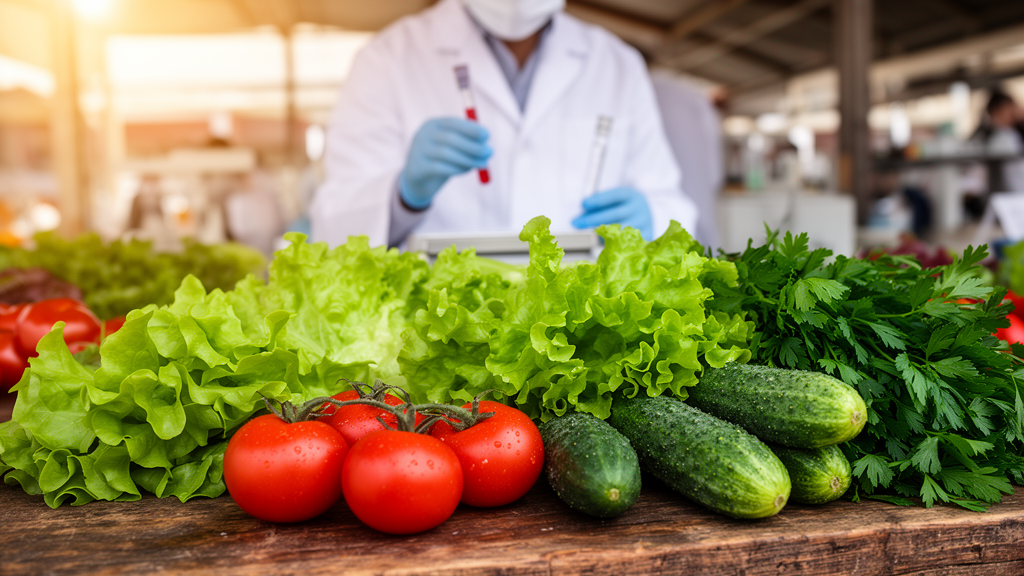
Arugula, purslane, parsley, dill, green onion, cress and lettuce — vegetables typically eaten raw — collected from local producers in Konya Province, Turkey, carried measurable loads of nitrates, toxic trace elements and pesticide residues, according to a study published in Environmental Monitoring and Assessment. The researchers sampled 294 vegetable lots in two sampling campaigns, one in August 2021 during summer and one in March 2022 during winter, and analysed them for lead, cadmium, arsenic, mercury and tin, nitrate content, and 31 pesticide active substances.
The survey revealed clear seasonal contrasts in mean concentrations. Summer samples showed higher mean lead (0.050 mg/kg) and arsenic (0.054 mg/kg), while winter vegetables carried higher mean nitrate (2446.88 mg/kg) and cadmium (0.011 mg/kg). Fixed-effects factorial analysis found these differences between seasons and vegetable types to be statistically significant (p < 0.05). Pesticide residues were detected in 68% of summer samples and 48% of winter samples, with the detected active substances dominated by insecticides (38.1% in summer, 47% in winter) and fungicides (33.3% in summer, 53% in winter).
Several findings raised compliance concerns. Acetamiprid exceeded maximum residue limits across multiple commodities, including summer parsley, arugula, green onions and cress, as well as winter purslane and dill. Banned agrochemicals, including chlorpyrifos and acetochlor, were also detected in isolated samples, indicating that substances no longer authorised still reach the food chain in the study region.
Yet the study’s most consequential result concerns what mattered more than season. When the authors applied nested variance decomposition, producer-level practices accounted for the vast majority of variation in contamination — 58.46% to 99.93% for pesticides and 34.50% to 90.56% for heavy metals and nitrate. Under this analysis, season was statistically non-significant (p > 0.05) as an isolated variance component. In other words, which farm a vegetable came from predicted its contamination profile far better than whether it was harvested in summer or winter.
Principal component analysis corroborated these distributions, isolating cress, arugula, purslane and winter dill based on their residue loadings. The authors conclude that agricultural practices among individual producers are the primary driver of contamination risks in these raw-consumed vegetables.
The combination of nitrate levels, trace elements such as lead, cadmium, arsenic, mercury and tin, and multiple pesticide classes — including substances whose use is banned — paints a picture of contamination shaped mainly at the level of individual growing operations rather than by broad seasonal patterns.
The study is limited to one province and two sampling seasons, and the reported values are mean concentrations across vegetable types, so the results should not be generalised to other regions or years. These variance findings indicate that contamination in the sampled vegetables differed mainly from one producer to another rather than between the two sampling seasons.
Subject of Research: Pesticide residues, nitrate and heavy metal contamination of raw-consumed green vegetables in Konya Province, Turkey
Article Title: Determination of pesticide residues, nitrate, and some heavy metal in green vegetables from Turkey’s Konya Province
Article References: Küçükapan, F. F., & Nizamlıoğlu, N. M. (2026). Determination of pesticide residues, nitrate, and some heavy metal in green vegetables from Turkey’s Konya Province. Environmental Monitoring and Assessment, 198(11), Article 1260. https://doi.org/10.1007/s10661-026-16108-0
Image Credits: AI Generated
DOI: 10.1007/s10661-026-16108-0
Keywords: pesticide residues, nitrate, heavy metals, Konya, green vegetables, acetamiprid, chlorpyrifos, food safety, seasonal variation, producer practices, Turkey, maximum residue limits
Cite Scienmag News
Violet Maxwell. (October 27, 2026). Pesticides, Nitrate and Heavy Metals Found in Raw-Eaten Vegetables from Konya. Scienmag. https://scienmag.com/pesticides-nitrate-and-heavy-metals-found-in-raw-eaten-vegetables-from-konya/
Violet Maxwell. "Pesticides, Nitrate and Heavy Metals Found in Raw-Eaten Vegetables from Konya." Scienmag, 27 October 2026, https://scienmag.com/pesticides-nitrate-and-heavy-metals-found-in-raw-eaten-vegetables-from-konya/. Accessed 27 October 2026.
Violet Maxwell. "Pesticides, Nitrate and Heavy Metals Found in Raw-Eaten Vegetables from Konya." Scienmag. October 27, 2026. https://scienmag.com/pesticides-nitrate-and-heavy-metals-found-in-raw-eaten-vegetables-from-konya/


