


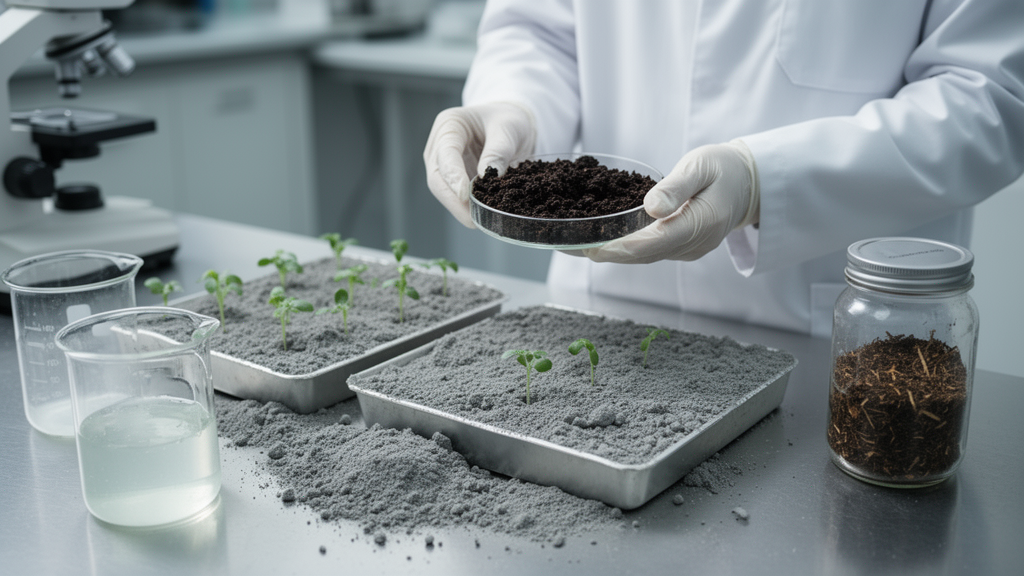
Manure and chia seed mucilage can reorganize the physical structure of lunar and martian regolith simulants within days, according to a laboratory study published in Frontiers in Soil Science. Researchers at the University of Basilicata, the University of Naples Federico II and the Council for Agricultural Research and Economics in Italy mixed two organic inputs into commercial simulants that mimic the surface materials of the Moon and Mars, then measured how well the treated particles resisted falling apart during a standardized wet-sieving disturbance. The work addresses a practical problem for future space agriculture: before plants can grow in regolith-based substrates inside bioregenerative life-support systems, those substrates need physical properties that survive irrigation, drainage and handling in contained habitats.
The team, led by Rosangela Addesso with colleagues including Antonio Giandonato Caporale and Mariana Amato, tested two contrasting materials. The first was a commercial horse and swine monogastric manure applied at 30 percent by weight, which the authors describe as a model of the organic solids that might be produced and processed within a closed habitat, rather than a direct analog of human excrement. The second was a polysaccharide-rich mucilage extracted from chia (Salvia hispanica L.) seeds, applied at 0.2, 0.5 and 1 percent by weight. These were mixed into two simulants: LHS-1, an analog of lunar highlands material, and MMS-1, a fine-grade Mojave Mars simulant. Both are dominated by sand-sized particles and contain very little organic carbon, with LHS-1 at 0.1 grams per kilogram and MMS-1 at 0.2 grams per kilogram.
Each simulant and amendment combination was incubated for one, seven and thirty days at 25 degrees Celsius, prepared in triplicate, and then analyzed by wet sieving through a stack of sieves with mesh sizes of 1.0, 0.5, 0.2 and 0.1 millimeters. Aggregate stability was expressed as the percentage of the initial dry mass retained in four size classes: larger than 1 millimeter, 0.5 to 1 millimeter, 0.2 to 0.5 millimeter and 0.1 to 0.2 millimeter. The fraction retained on the 1-millimeter sieve was treated as an operational water-stable macroaggregate fraction, because it represented the largest particle assemblages that stayed intact through the procedure. The researchers used a nonparametric factorial analysis of variance based on the Aligned Rank Transform, since the data did not meet the assumptions required for a conventional ANOVA.
The results showed that manure and mucilage act in distinctly different ways. Manure increased the proportion of material retained in the largest, greater-than-1-millimeter water-stable fraction, consistent with particulate organic matter acting as a nucleus and binding agent for larger structural units. Chia mucilage, by contrast, produced concentration- and size-class-dependent responses within the tested range. Higher mucilage concentrations generally favored larger particle aggregates, while the lowest and intermediate concentrations proved more effective in some intermediate size fractions. On the 0.2-millimeter sieve, the 0.2 and 0.5 percent mucilage treatments produced the highest stability values, whereas manure and the 1 percent mucilage treatment produced the lowest. On the 0.5-millimeter sieve, the pattern reversed, with the 0.5 and 1 percent mucilage treatments associated with higher stability and manure showing the lowest values.
The two simulants themselves behaved very differently. LHS-1 showed greater retention in the greater-than-1-millimeter class, while MMS-1 stabilized the intermediate fractions more effectively. Simulant type was the largest source of variance in every size fraction, and the researchers attribute this to differences in mineralogy and surface properties: MMS-1 is dominated by plagioclases and amorphous phases with reactive finer fractions including smectites and clinoptilolite, whereas LHS-1 consists primarily of plagioclase-anorthite and amorphous or short-range ordered phases with minor amounts of smectites, hematite, chlorite and kaolinite. The authors caution that the greater macroaggregate formation observed in LHS-1 is specific to the material tested and should not be extrapolated to authentic lunar highlands regolith.
Timing mattered as much as chemistry. Aggregate stability increased from day 1 to day 7 and then remained relatively stable through day 30, indicating that most of the structural reorganization happened soon after the amendments were added. The authors interpret this rapid response as evidence for fast physicochemical processes, including polymer hydration, adsorption, particle coating and the formation of bridges between mineral grains, rather than slower biological processes. They note that microbial colonization over longer time scales, through extracellular polymeric substances and biofilms, could reinforce these effects, but that this was not directly assessed in the experiment.
Chemical analysis of the retained fractions added a compositional dimension to the findings. The fraction retained on the 1-millimeter sieve generally showed higher contents of carbon, nitrogen, hydrogen and sulfur than the smaller size fractions across both simulants and incubation times. Elemental concentrations in the unamended and mucilage-treated samples fell below the instrumental limit of quantification, so only manure-amended data were reported. The authors suggest that the constituents of the manure amendment were not distributed evenly among the aggregate size classes, and that the elemental composition of the retained fractions is consistent with a relatively greater association of amendment-derived components with the larger structural classes.
A separate bonding experiment examined how seed mucilage behaves at the seed-substrate interface. Hydrated chia seeds and rocket salad (Eruca sativa L.) seeds were placed on positively charged nylon membrane strips, allowed to extrude their mucilage capsules, covered with simulant finer than 0.5 millimeters, and then held under running water for five seconds. Chia seeds retained significantly more simulant mass than rocket seeds under both simulant conditions, and more LHS-1 than MMS-1 remained associated with the seeds after water-flow exposure. The researchers suggest that mucilage capsules can attach mineral particles tightly enough to resist short-term disturbance, creating a more cohesive seed-substrate interface at the germination microsite.
The authors frame the comparison between the two inputs as complementary strategies rather than competing options. Manure is a heterogeneous, nutrient-rich organic amendment whose particulate matter appears to seed larger structural units, while chia mucilage is a rapidly hydrating polysaccharide binder whose negatively charged carboxylic groups can bond to mineral surfaces through hydrogen bonding, electrostatic attraction, ligand exchange or cation bridging. Because the effect of organic matter depends on its physical and chemical form, processed organic residues and biologically produced polymers may offer different, potentially complementary routes to conditioning regolith-based growth substrates while limiting reliance on resources shipped from Earth.
Several limitations deserve emphasis. The study was conducted entirely in an Earth-based laboratory, and regolith simulants reproduce only specific mineralogical, chemical and physical properties of real planetary materials, so the results are indicative of interaction mechanisms rather than of substrate performance on the Moon or Mars. The greater-than-1-millimeter fraction may contain both newly associated particles and initial 1-to-2-millimeter particles, since the simulants were sieved to less than 2 millimeters before the experiment, so it cannot be read exclusively as de novo macroaggregate formation. The 30 percent manure rate reflects an experimental framework from previous studies rather than an operational recommendation, and the authors note that producing and handling that much organic material would be a logistical constraint in resource-limited habitats. Crop performance, hydraulic and mechanical properties, microbial activity and the effects of repeated wetting-drying cycles were not assessed, and the authors state that these must be tested before any application to bioregenerative life-support systems.
Subject of Research: The effects of manure and chia seed mucilage on water-stable aggregation in lunar and martian regolith simulants
Article Title: Manure and chia mucilage as structure-forming agents in lunar and martian regolith simulants: a bio-based approach to substrate conditioning
Article References: Addesso, R., Caporale, A. G., Adamo, P., Labella, R., Bochicchio, R., Rossi, R., & Amato, M. (2026). Manure and chia mucilage as structure-forming agents in lunar and martian regolith simulants: a bio-based approach to substrate conditioning. Frontiers in Soil Science, 6, Article 1999715. https://doi.org/10.3389/fsoil.2026.1999715
Image Credits: AI Generated
DOI: 10.3389/fsoil.2026.1999715
Keywords: regolith simulants, space agriculture, aggregate stability, chia mucilage, manure, LHS-1, MMS-1, wet sieving, bioregenerative life-support systems, organic amendments, seed mucilage, soil structure
Cite Scienmag News
Alan Morgan. (October 27, 2026). Manure and chia mucilage reshape lunar and martian regolith simulants in lab tests. Scienmag. https://scienmag.com/manure-and-chia-mucilage-reshape-lunar-and-martian-regolith-simulants-in-lab-tests/
Alan Morgan. "Manure and chia mucilage reshape lunar and martian regolith simulants in lab tests." Scienmag, 27 October 2026, https://scienmag.com/manure-and-chia-mucilage-reshape-lunar-and-martian-regolith-simulants-in-lab-tests/. Accessed 27 October 2026.
Alan Morgan. "Manure and chia mucilage reshape lunar and martian regolith simulants in lab tests." Scienmag. October 27, 2026. https://scienmag.com/manure-and-chia-mucilage-reshape-lunar-and-martian-regolith-simulants-in-lab-tests/


