


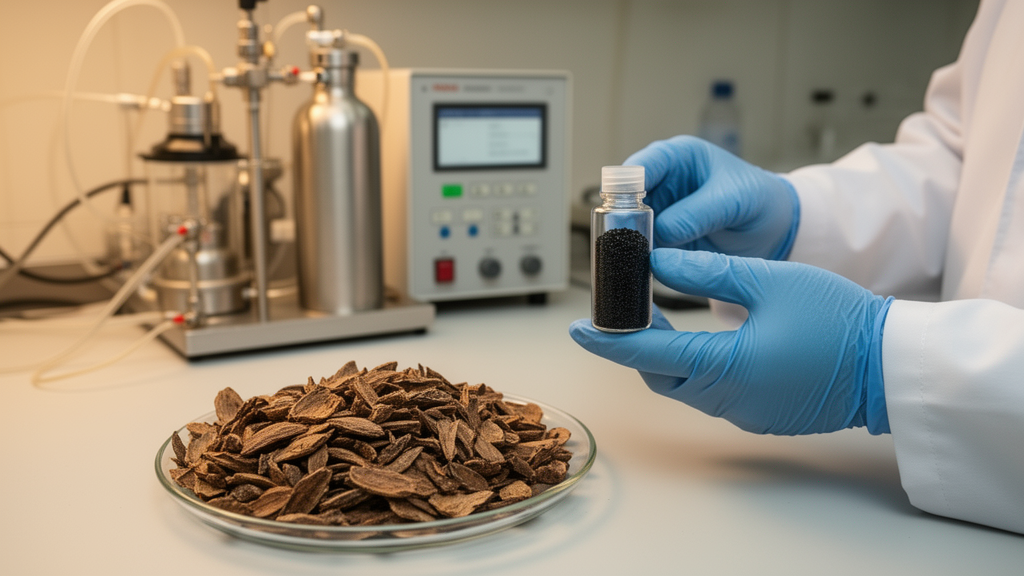
Researchers have converted palmyrah kernel shell waste into a nitrogen-doped activated carbon that captures carbon dioxide with high capacity at ordinary pressures, according to a study published in Environmental Science and Pollution Research. The material, made from the discarded shells of the palmyrah fruit, achieved an adsorption of 174.3 milligrams of CO2 per gram of material at 25 degrees Celsius and 242.9 milligrams per gram at 0 degrees Celsius, with desorption values of 174.6 and 242.6 milligrams per gram at the same temperatures. Because the starting material is agricultural waste, the authors argue that the approach could reduce the carbon footprint of the capture process itself.
The synthesis followed a two-step route. First, melamine was used as the nitrogen source, mixed with the palmyrah kernel shell biomass at varying biomass-to-melamine ratios to control how much nitrogen entered the carbon framework. The team then characterized the products with a battery of analytical techniques: CHNS elemental analysis, Fourier-transform infrared spectroscopy, BET surface area measurements, X-ray photoelectron spectroscopy, scanning electron microscopy with energy-dispersive X-ray mapping, and thermogravimetric analysis, covering elemental composition, functional groups, porosity, chemical states, surface morphology, elemental distribution and thermal stability.
The spectroscopic results confirmed that the doping strategy worked as intended. X-ray photoelectron spectroscopy of the nitrogen 1s region, deconvoluted into its components, showed three nitrogen configurations embedded in the carbon lattice: pyridinic, pyrrolic and graphitic nitrogen. Meanwhile, SEM-EDX elemental mapping showed that the nitrogen and other elements were distributed relatively uniformly throughout the carbon matrix rather than clustering at the surface.
Adsorption and desorption behavior was quantified with a thermogravimetric weighing method, and volumetric measurements were used to evaluate how capture performance depends on pressure. Kinetic analysis showed that the pseudo-second-order model described the uptake process, and thermodynamic parameters were calculated to characterize the temperature dependence of adsorption.
One of the study’s more counterintuitive findings concerns the relationship between nitrogen loading and performance: the lower the nitrogen content in the material, the more efficient the CO2 capture proved to be. Practical durability also looked promising. Repeated adsorption-desorption cycling established that the material remains stable beyond 20 cycles, a basic but essential requirement for any adsorbent considered for real capture duty, since materials that degrade or lose capacity quickly are of limited industrial value.
The broader significance of the work lies in pairing a waste-derived precursor with a capture application. The authors frame this as carbon-based carbon capture enabled by waste biomass, meaning the sorbent itself comes from a renewable, low-cost source rather than from fossil-derived precursors.
As with any laboratory-scale adsorption study, the reported capacities were measured under controlled conditions, at ambient pressure and at two temperatures, rather than in an industrial flue gas environment, and the selectivity and cycling results come from the characterization methods described rather than from pilot-scale testing.
Subject of Research: Nitrogen-doped activated carbon synthesized from palmyrah kernel shell biomass for carbon dioxide capture
Article Title: Nitrogen-doped activated carbon from palmyrah kernel shell biomass for efficient CO2 capture
Article References: Ilamurugan, V., & Baquir Mohammed, J. A. (2026). Nitrogen-doped activated carbon from palmyrah kernel shell biomass for efficient CO2 capture. Environmental Science and Pollution Research. https://doi.org/10.1007/s11356-026-38332-4
Image Credits: AI Generated
DOI: 10.1007/s11356-026-38332-4
Keywords: CO2 capture, activated carbon, nitrogen doping, palmyrah kernel shell, biomass, adsorption, KOH activation, XPS, carbon capture materials, waste valorization, pseudo-second-order kinetics, CO2/N2 selectivity
Cite Scienmag News
Violet Maxwell. (October 27, 2026). Waste palmyrah kernel shells turned into nitrogen-doped carbon that grabs CO2 efficiently. Scienmag. https://scienmag.com/waste-palmyrah-kernel-shells-turned-into-nitrogen-doped-carbon-that-grabs-co2-efficiently/
Violet Maxwell. "Waste palmyrah kernel shells turned into nitrogen-doped carbon that grabs CO2 efficiently." Scienmag, 27 October 2026, https://scienmag.com/waste-palmyrah-kernel-shells-turned-into-nitrogen-doped-carbon-that-grabs-co2-efficiently/. Accessed 27 October 2026.
Violet Maxwell. "Waste palmyrah kernel shells turned into nitrogen-doped carbon that grabs CO2 efficiently." Scienmag. October 27, 2026. https://scienmag.com/waste-palmyrah-kernel-shells-turned-into-nitrogen-doped-carbon-that-grabs-co2-efficiently/


