

Tuesday, October 27, 2026
Science
No Result
View All Result
  • Login
  • HOME
  • SCIENCE NEWS
  • CONTACT US
  • HOME
  • SCIENCE NEWS
  • CONTACT US
No Result
View All Result
Scienmag
No Result
View All Result
Home Science News Earth Science

Reservoirs and Flood Detention Basins Can Share Flood Storage Equivalently, Study Shows

October 27, 2026
in Earth Science
Violet Maxwell
By Violet Maxwell Scienmag Editorial Profile - Natural Hazards
Reading Time: 3 mins read
0
Reservoirs and Flood Detention Basins Can Share Flood Storage Equivalently, Study Shows

Reservoirs and Flood Detention Basins Can Share Flood Storage Equivalently, Study Shows

65
SHARES
587
VIEWS
Share on FacebookShare on Twitter
ADVERTISEMENT

When extreme floods threaten a river basin, engineers often rely on two kinds of infrastructure working together: a large reservoir that can hold back floodwater behind a dam, and a flood detention basin, a designated area that can be deliberately flooded to protect downstream cities. A new study in Water Resources Management examines how the storage capacity of these two structures can be treated as equivalent, so that a reservoir and a flood detention basin can be operated as a coordinated group rather than as separate assets.

The research, led by Zhengyu Wang, Dedi Liu, Zhengyu Mu and Yuling Zhang, focuses on a concept the authors call equivalent flood control storage. The idea is to quantify how much flood storage in a flood detention basin corresponds to a given amount of storage in a reservoir, expressed through an equivalent ratio. According to the abstract, the derived equivalent flood control storage is independent of the detention basin’s operation rules and of the inherent characteristics of individual flood events, which makes it a general tool for planning joint operations.

The researchers drove their analysis with four representative design flood events, which are standardized flood hydrographs used in engineering to test how flood control systems would perform under defined conditions.

Within that framework, the team investigated how several factors influence the equivalent ratio. These include the operation period of the flood detention basin, the magnitude of the flood as characterized by its exceedance frequency, the shape of the upstream reservoir inflow hydrograph, and the amount of flood control storage in the downstream detention basin that has already been used before the operation begins.

The results point to a consistent pattern. An earlier-started and shorter-duration operation period for the flood detention basin generally contributes to a larger equivalent ratio, as does a lower pre-utilized flood control storage in the basin. In other words, when the detention basin is activated promptly and retains more of its capacity, a given volume of detention storage counts for more in the equivalent relationship with the reservoir.

Flood characteristics matter as well. The study reports that flood events with larger magnitude, and inflow hydrographs with a delayed peak, also tend to produce a larger equivalent ratio. This means the relationship between reservoir storage and detention basin storage is not fixed but shifts with the nature of the flood being managed and with how the inflow to the upstream reservoir unfolds over time.

For flood control managers, the practical significance lies in the derived equivalent flood control storage itself. Because it does not depend on the detention basin’s specific operation rules or on the details of a particular flood event, it can be used to support the flood control operation of reservoir and flood detention basin groups more broadly, helping operators decide how to allocate storage between the two structures during joint flood control operations.

Joint flood control operation of a reservoir and a flood detention basin plays a critical role in mitigating extreme flood disasters, the authors note in the abstract. Improving the flood control efficiency of a coupled reservoir and flood detention basin group requires precisely this kind of quantification, so that the two components can be compared on a common basis when planning how to absorb a severe flood.

The findings are reported as a modeling and analysis study based on design flood events for a single case study group, and the abstract does not report real-time operational trials.

Subject of Research: Quantifying equivalent flood control storage between a reservoir and a flood detention basin

Article Title: Equivalent Flood Control Storage Relationship Between a Reservoir and a Flood Detention Basin

Article References: Wang, Z., Liu, D., Mu, Z., & Zhang, Y. (2026). Equivalent Flood Control Storage Relationship Between a Reservoir and a Flood Detention Basin. Water Resources Management, 40(14), Article 545. https://doi.org/10.1007/s11269-026-04901-y

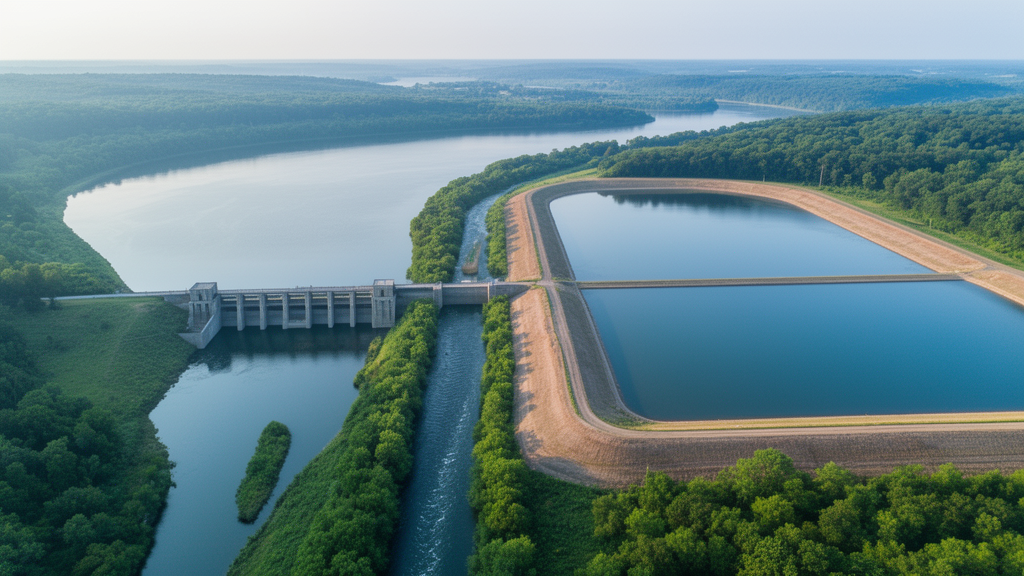
Image Credits: AI Generated

DOI: 10.1007/s11269-026-04901-y

Keywords: flood control, reservoir operation, flood detention basin, equivalent storage, Three Gorges Reservoir, Jingjiang, design flood, flood risk management, water resources, hydrology, Equivalent, Flood

Cite Scienmag News

Violet Maxwell. (October 27, 2026). Reservoirs and Flood Detention Basins Can Share Flood Storage Equivalently, Study Shows. Scienmag. https://scienmag.com/reservoirs-and-flood-detention-basins-can-share-flood-storage-equivalently-study-shows/


Violet Maxwell. "Reservoirs and Flood Detention Basins Can Share Flood Storage Equivalently, Study Shows." Scienmag, 27 October 2026, https://scienmag.com/reservoirs-and-flood-detention-basins-can-share-flood-storage-equivalently-study-shows/. Accessed 27 October 2026.

Violet Maxwell. "Reservoirs and Flood Detention Basins Can Share Flood Storage Equivalently, Study Shows." Scienmag. October 27, 2026. https://scienmag.com/reservoirs-and-flood-detention-basins-can-share-flood-storage-equivalently-study-shows/

Tags: design floodequivalentequivalent flood storage conceptequivalent storagefloodflood controlFlood control infrastructureflood detention basinflood detention basin designflood event standardizationflood hydrograph analysisflood management planningflood risk managementflood storage capacity quantificationhydrologyintegrated flood risk mitigationJingjiangjoint operation of flood control assetsreservoir and flood detention basin coordinationreservoir operationreservoir-detention basin synergyThree Gorges Reservoirwater resourceswater resources management
Share26Tweet16
Previous Post

Positive attitudes toward physical activity tied to well-being in cancer patients

Next Post

Chronic Steroid Use Before Pancreatic Surgery Linked to Higher Mortality Risk

Related Posts

JUICE spacecraft probes ion composition of Earth’s plasmasphere during flyby
Earth Science

JUICE spacecraft probes ion composition of Earth’s plasmasphere during flyby

October 27, 2026
Research report: Small waterways in boreal forests: How artificial waterways influence benthic macroinvertebrate communities
Earth Science

Research report: Small waterways in boreal forests: How artificial waterways influence benthic macroinvertebrate communities

October 27, 2026
Storm-Shape Test Gives Three Different Answers to One Question, Study Finds
Earth Science

Storm-Shape Test Gives Three Different Answers to One Question, Study Finds

October 27, 2026
PLOS Water and UNU-INWEH Launch Open-Access Collection on Global Water Bankruptcy Solutions
Earth Science

PLOS Water and UNU-INWEH Launch Open-Access Collection on Global Water Bankruptcy Solutions

October 27, 2026
Rapid warming could trigger self-sustained Antarctic ice retreat below known thresholds, model study finds
Earth Science

Rapid warming could trigger self-sustained Antarctic ice retreat below known thresholds, model study finds

October 27, 2026
New 220-year daily record reconstructs European winds back to 1806
Earth Science

New 220-year daily record reconstructs European winds back to 1806

October 27, 2026
Next Post
Chronic Steroid Use Before Pancreatic Surgery Linked to Higher Mortality Risk

Chronic Steroid Use Before Pancreatic Surgery Linked to Higher Mortality Risk

  • Mothers who receive childcare support from maternal grandparents show more optimized

    Mothers who receive childcare support from maternal grandparents show more parental warmth, finds NTU Singapore study

    27656 shares
    Share 11059 Tweet 6912
  • University of Seville Breaks 120-Year-Old Mystery, Revises a Key Einstein Concept

    1061 shares
    Share 424 Tweet 265
  • Bee body mass, pathogens and local climate influence heat tolerance

    682 shares
    Share 273 Tweet 171
  • Researchers record first-ever images and data of a shark experiencing a boat strike

    546 shares
    Share 218 Tweet 137
  • Groundbreaking Clinical Trial Reveals Lubiprostone Enhances Kidney Function

    531 shares
    Share 212 Tweet 133
Science

Embark on a thrilling journey of discovery with Scienmag.com—your ultimate source for cutting-edge breakthroughs. Immerse yourself in a world where curiosity knows no limits and tomorrow’s possibilities become today’s reality!

RECENT NEWS

  • Chronic Steroid Use Before Pancreatic Surgery Linked to Higher Mortality Risk
  • Reservoirs and Flood Detention Basins Can Share Flood Storage Equivalently, Study Shows
  • Positive attitudes toward physical activity tied to well-being in cancer patients
  • Scientists can predict ciprofloxacin resistance in Klebsiella pneumoniae from genome data

Categories

  • Agriculture
  • Anthropology
  • Archaeology
  • Athmospheric
  • Biology
  • Biotechnology
  • Blog
  • Bussines
  • Cancer
  • Chemistry
  • Climate
  • Earth Science
  • Editorial Policy
  • Marine
  • Mathematics
  • Medicine
  • Pediatry
  • Policy
  • Psychology & Psychiatry
  • Science Education
  • Science News
  • Social Science
  • Space
  • Technology and Engineering

Subscribe to Blog via Email

Enter your email address to subscribe to this blog and receive notifications of new posts by email.

Join 5,151 other subscribers

© 2025 Scienmag - Science Magazine

Welcome Back!

Login to your account below

Forgotten Password?

Retrieve your password

Please enter your username or email address to reset your password.

Log In
No Result
View All Result
  • HOME
  • SCIENCE NEWS
  • CONTACT US

© 2025 Scienmag - Science Magazine

Discover more from Science

Subscribe now to keep reading and get access to the full archive.

Continue reading