


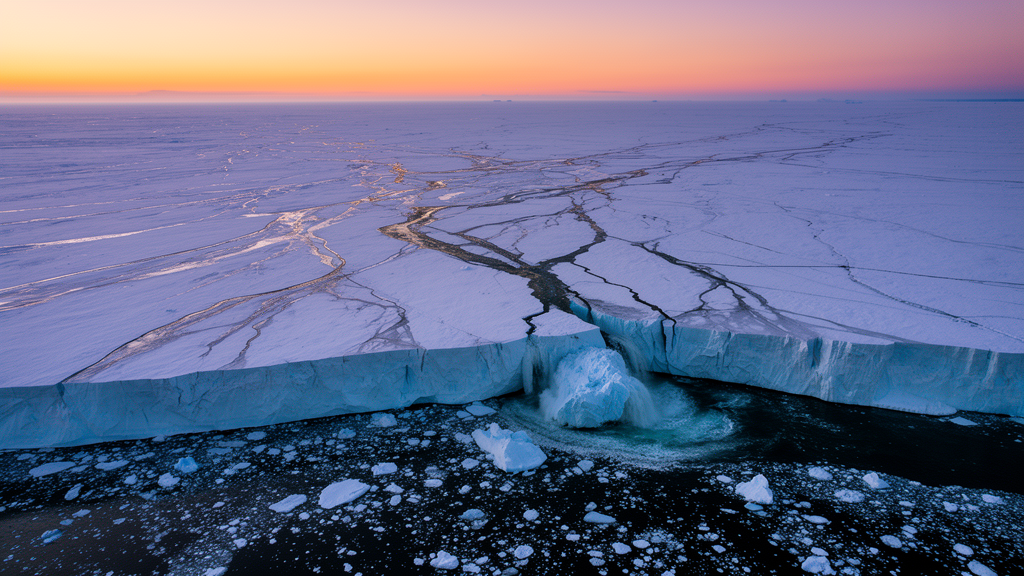
Parts of the Antarctic Ice Sheet may be far more vulnerable to rapid warming than previous equilibrium studies suggested, according to a new modelling study published in Nature Geoscience. The research, led by Jan Swierczek-Jereczek and colleagues, shows that when warming happens faster than the solid Earth can respond, some Antarctic ice basins can tip into self-sustained retreat before the classical instability threshold is ever reached. The finding could lower the critical global warming level for certain basins by up to 0.5 kelvin, depending on the viscosity of the underlying mantle.
Previous equilibrium ice-sheet simulations had suggested that the Antarctic Ice Sheet, expected to be the largest contributor to sea-level rise over the coming centuries, is vulnerable to crossing a bifurcation point associated with this instability. The new work adds a different question: can the instability be triggered by the rate of warming itself, rather than by the level of warming alone?
This mechanism is known as rate-induced tipping. In the Antarctic context, it arises from a race between two processes with very different timescales. Rapid atmospheric and oceanic warming drives ice retreat quickly, while the slow uplift of bedrock in response to unloading, a process known as glacial isostatic adjustment, normally acts as a stabilising brake. When the ice thins and retreats, the reduced load allows the bedrock to rise, which helps keep the grounding line on stable, prograde slopes. But if the forcing outpaces the bedrock response, the stabilising effect is weakened, grounding lines can reach retrograde bed slopes more readily, and self-sustained retreat can begin below the bifurcation threshold.
To test this, the team coupled the Yelmo ice-sheet model to FastIsostasy, a regional glacial isostatic adjustment model that accounts for lateral variability in lithospheric thickness and upper-mantle viscosity. Yelmo is a thermo-mechanically coupled three-dimensional ice-sheet model that uses a depth-integrated velocity approximation to solve ice dynamics. The simulations were performed on a regular grid covering Antarctica at a horizontal resolution of 16 kilometres, with ten vertically scaled layers. The model applies a Glen flow law with an exponent of three, includes a tidal partial melt parameterisation at the grounding zone, a von Mises-type calving criterion, basal hydrology from a local energy balance with a fixed till drainage rate, and basal friction following a regularized Coulomb law. The basal friction coefficient field was inferred by inversion of present-day ice thickness and velocity, yielding root-mean-square errors of 114 metres in ice surface elevation and 96 metres per year in ice velocity, both within the range of ISMIP6 models.
The forcing was constructed by converting a global mean temperature anomaly into a regional atmospheric anomaly using a fixed factor of 1.8, as assessed for Antarctica in the Polar Amplification Model Intercomparison Project, added uniformly to the 2023 climatology from the Regional Atmospheric Climate Model RACMO2.3. Precipitation anomalies were scaled at 5 percent per kelvin, and Southern Ocean warming was taken as about 25 percent of the regional atmospheric warming, based on an ensemble of long-term CMIP5 and CMIP6 simulations, before being converted into sub-shelf melting via a quadratic non-local law. By sampling uncertainty in mantle viscosity across their ensemble, the researchers could assess how the structure of the solid Earth controls the risk of rate-induced tipping.
The results reveal a striking geographic contrast. The West Antarctic Ice Sheet, although subject to a bifurcation, is unlikely to experience rate-induced tipping because of the low mantle viscosity beneath the region. Low viscosity means the bedrock responds comparatively quickly to ice loss, so the stabilising uplift keeps pace with retreat and the classical bifurcation threshold remains the relevant limit. In contrast, the Recovery and Aurora subglacial basins are likely to undergo rate-induced tipping even under warming rates lower than those observed today. In these basins, the combination of rapid forcing and slower solid-Earth feedback allows self-sustained retreat to begin well before the equilibrium threshold is crossed.
Depending on mantle viscosity, the mechanism can reduce the critical global mean temperature anomaly by up to 0.5 kelvin, with important implications for the long-term evolution of the Earth system. The authors also quantified the sea-level consequences of the modelled collapses. In quasi-equilibrium experiments, the autonomous collapse of individual basins lasts from about 5,000 years for the West Antarctic Ice Sheet to about 12,000 years for the Recovery basin, with the timescale set largely by bathymetry. The West Antarctic bathymetry presents a very open shape, strong retrograde slopes and few large pinning points, whereas the Recovery basin features narrow ocean channels with large pinning points. The resulting mean autonomous sea-level rise rates range from 0.1 millimetres per year for the Recovery basin to 0.5 millimetres per year for the West Antarctic Ice Sheet, with maximum rates from 0.4 to 1.8 millimetres per year, showing considerable heterogeneity among basins.
These autonomous rates represent lower bounds, because in realistic warming scenarios the global mean temperature typically increases monotonically until the year 2300. To estimate upper bounds, the team analysed a step experiment with a global mean temperature anomaly of 9 kelvin. In that case, mean and maximum sea-level rise rates typically increased by more than an order of magnitude. The largest values arose for the West Antarctic Ice Sheet, which reached a mean rate of 25.2 millimetres per year, about half of the reconstructed rates associated with meltwater pulse 1A. The Recovery and Aurora basins, both subject to rate-induced tipping, showed maximum rates of up to 5.7 and 2.8 millimetres per year respectively. For comparison, the average Antarctic contribution to sea-level rise over the 1992 to 2017 period was only 0.4 millimetres per year.
The authors are careful to stress that these bounds are conservative and indicative rather than a final assessment. They are derived from extreme scenarios, namely zero versus infinite forcing rate, and are intrinsically linked to model limitations. Ice-ocean interactions largely determine the evolution of marine-based regions, yet their representation in numerical ice-sheet models remains to be substantially improved. FastIsostasy itself has limitations: it underestimates the peripheral forebulge, ignores the rotational feedback, parameterises the depth dependence of viscosity and relies on a Maxwell rheology. The authors note that the use of a Burgers rheology is the only increase in complexity that could alter the timescale separation between ice retreat and the solid-Earth response, and they leave investigating this to future work.
Even with these caveats, the study carries a clear message for how the Antarctic Ice Sheet should be assessed. The total sea-level rise associated with a bifurcation is the relevant metric for long-term impacts, such as equilibrium coastline positions, but the rate of sea-level rise is more informative for designing efficient adaptation strategies. The finding that Recovery and Aurora may be vulnerable to rate-induced tipping at warming rates already below those observed today suggests that the pace of climate change, not only its magnitude, is a decisive factor for the stability of Antarctic marine-based ice. The reduced output data needed to reproduce the paper’s figures, along with the source code of Yelmo and FastIsostasy, have been made openly available, allowing other researchers to test how sensitive these conclusions are to the choices of model structure and Earth-structure parameters.
Subject of Research: Rate-induced tipping of Antarctic marine-based ice under rapid warming and slow solid-Earth feedbacks
Article Title: Antarctic marine-based ice destabilized when warming outpaces solid-Earth feedbacks
Article References: Swierczek-Jereczek, J., Blasco, J., Robinson, A., Alvarez-Solas, J., & Montoya, M. (2026). Antarctic marine-based ice destabilized when warming outpaces solid-Earth feedbacks. Nature Geoscience. https://doi.org/10.1038/s41561-026-02117-8
Image Credits: AI Generated
DOI: 10.1038/s41561-026-02117-8
Keywords: Antarctic Ice Sheet, marine ice-sheet instability, rate-induced tipping, glacial isostatic adjustment, mantle viscosity, sea-level rise, Recovery basin, Aurora basin, West Antarctic Ice Sheet, ice-sheet modelling, grounding line, bifurcation threshold
Cite Scienmag News
Violet Maxwell. (October 27, 2026). Rapid warming could trigger self-sustained Antarctic ice retreat below known thresholds, model study finds. Scienmag. https://scienmag.com/rapid-warming-could-trigger-self-sustained-antarctic-ice-retreat-below-known-thresholds-model-study-finds/
Violet Maxwell. "Rapid warming could trigger self-sustained Antarctic ice retreat below known thresholds, model study finds." Scienmag, 27 October 2026, https://scienmag.com/rapid-warming-could-trigger-self-sustained-antarctic-ice-retreat-below-known-thresholds-model-study-finds/. Accessed 27 October 2026.
Violet Maxwell. "Rapid warming could trigger self-sustained Antarctic ice retreat below known thresholds, model study finds." Scienmag. October 27, 2026. https://scienmag.com/rapid-warming-could-trigger-self-sustained-antarctic-ice-retreat-below-known-thresholds-model-study-finds/


