Climate change and the overuse of water rank as the gravest threats to Spain’s freshwater ecosystems, while pollution falls surprisingly low on the list, according to a new assessment that asked academics and river basin managers to prioritize the dangers facing the country’s rivers, lakes and groundwater. The study, published in Frontiers in Water, identified and ranked 30 distinct threats through a deliberative process combining an online survey of Spanish water researchers with in-depth interviews at one of the country’s most heavily exploited river basins.
The research team, led by Ariadna Gabarda-Mallorquí of the Catalan Institute for Water Research, set out to determine whether the threats that experts consider most important actually match the issues that water authorities monitor and manage. Spain served as the case study because it embodies a long-standing conflict between water use and ecosystem health, with a stark divide between its dry Mediterranean and humid Atlantic ecoregions, compounded by strong interannual climate variability. A large part of Mediterranean Spain is semi-arid and hosts some of the most demanding agricultural and tourism sectors in Europe, while the country is among the most heavily hydrologically regulated in the world.
To build the threat list, the researchers followed a three-stage process of documentation, screening and assessment. They first drew on a bibliographic review inspired by a global framework of freshwater threats, then added threats identified in the Significant Issues Overviews of all 17 Spanish River Basin Management Plans, which capture issues perceived by citizens during public consultations under the European Water Framework Directive. A panel of academics from the H2OSEG research project then screened the list through two rounds of discussion, settling on 30 threats ranging from cropland expansion and dam density to salt pollution, emerging contaminants and marine intrusion into groundwater.
The assessment stage gathered perceptions from two professional perspectives. An online survey administered from May to July 2025 collected 104 complete and valid responses from Spanish water academics, who rated each threat separately for the Mediterranean and Atlantic ecoregions on a 1-to-5 scale, where 1 meant not at all important and 5 meant extremely important. In parallel, the researchers conducted semi-structured interviews with managers at the Júcar River Basin Authority, one of the most overexploited regions in Spain, exploring whether each threat was considered relevant to the basin’s management plan and included in its monitoring schemes, and whether the associated data were publicly available.
The results placed climate change firmly at the top. For the Mediterranean ecoregion, temperature and potential evapotranspiration received the highest average score of 4.6, followed closely by precipitation patterns at 4.5. Groundwater withdrawal ranked third at 4.4, urban land uses matched it, and desertification and surface water withdrawal followed at 4.3. For the Atlantic ecoregion, precipitation patterns led at 4.1, with temperature and evapotranspiration, riparian forest alteration and urban land uses close behind. Overall, the Mediterranean threats averaged 3.9 and the Atlantic threats 3.5, both corresponding to a rating of slightly important on the survey scale, with relatively low variability among respondents.
The rankings revealed a striking pattern: threats related to water quantity dominated, while pollution threats ranked low. Among academics, only nitrogen pollution scored prominently in the Mediterranean ranking at 4.2, while phosphorus, metal, organic and thermal pollution, along with emerging contaminants, all fell to the lower half of the list. The researchers suggest this may reflect the broad legislative body at regional, national and European scales aimed at ensuring water quality, including revised European directives on urban wastewater treatment, surface water environmental quality and drinking water, which experts may perceive as keeping pollution under control relative to the more acute problem of water scarcity.
The Júcar River Basin managers’ ranking overlapped with the academics on climate change, with temperature, evapotranspiration and precipitation patterns all receiving the maximum importance score of 5, alongside urban land uses, cropland, non-native species, dam density and marine intrusion into groundwater. But the discrepancies were telling. The managers gave their lowest scores to emerging and priority contaminants, sediment deficit, desertification and forest cover, while academics had ranked groundwater withdrawal and surface water withdrawal among their top concerns. The study’s authors note that future water availability is generally assumed to be stationary in most Spanish river basin management plans, and that desertification is not yet a matter of concern in any of them, in contrast to the experts’ demand-side warnings.
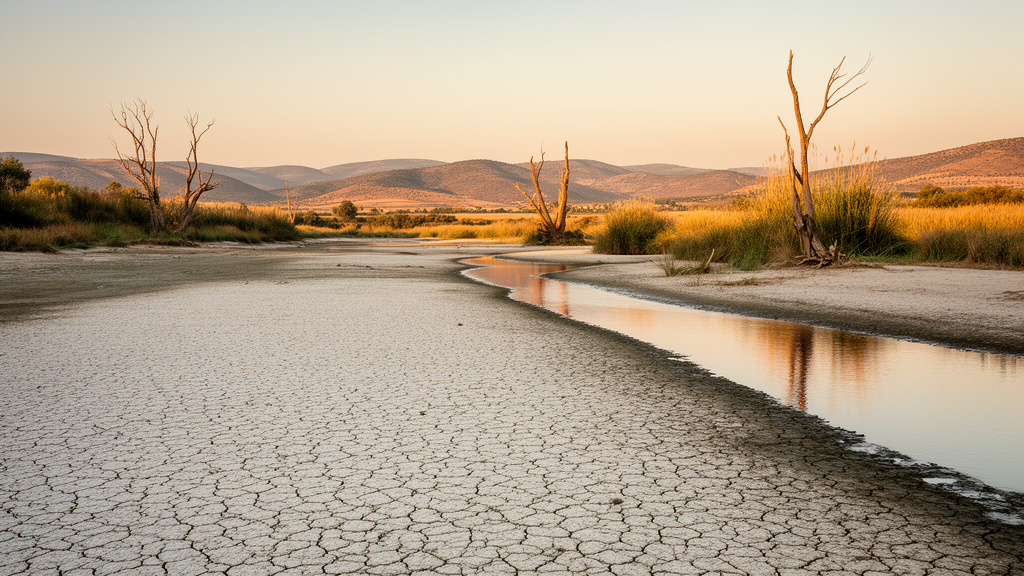
The authors connect these expert perceptions to recent events that have shaped Spanish public opinion. A prolonged drought affected extensive regions, most severely in northeastern Spain from 2021 to 2024, leaving reservoir levels below 15 percent for long periods after rainfall dropped by roughly 200 millimetres per year relative to the long-term average of 400 to 700 millimetres. Emergency declarations brought restrictions on human consumption before abundant rainfall reversed the emergency by mid-2024. Storm Gloria in January 2020 caused historic waves of up to 7 metres on the Mediterranean coast, and in late October 2024 an upper-level cut-off low, known in Spain as a DANA, caused catastrophic flooding and hundreds of casualties in Valencia and surrounding areas.
The study’s authors argue that the discrepancies between academic and managerial priorities reveal a significant tension within the Integrated Water Resources Management framework, which calls for coordinated management of water, land and related resources but can be constrained in practice by sectoral management priorities. They contend that filling this gap requires new mechanisms to integrate academic perspectives into the adaptive decision-making of river basin authorities, and that the survey-and-interview approach may serve as a pioneering example of knowledge co-creation, complementing the citizen consultations already embedded in Spanish river basin planning.
The researchers are careful to note the limitations of their exercise. The survey was anonymous, so potential bias in respondents’ scientific backgrounds could not be analysed, and the low ranking of pollution threats might partly reflect the composition of the sample, particularly since some potential respondents with chemical backgrounds declined to participate because of the generality of the issues. The snowball sampling strategy, in which initial participants distributed the questionnaire among colleagues, introduces selection bias and limits generalizability. Data collection also took place right after an exceptionally severe drought, which could have heightened the perceived urgency of climate-driven and quantity-related threats. The choice of the Júcar basin as the managerial case study means the findings should not be automatically generalized to all 17 Spanish river basin authorities, although the authors note that the basin authority has historically been recognized as a pioneer in participatory and drought management planning in Spain.
Subject of Research: Prioritization of threats to freshwater ecosystems and water security in Spain based on expert surveys and river basin manager interviews
Article Title: Assessing threats to freshwater ecosystems: implications for water security management in Spain
Article References: Gabarda-Mallorquí, A., Gou-Villalobos, À., Batalla, R. J., Durán, C., García, C., Rico, A., & Sabater, S. (2026). Assessing threats to freshwater ecosystems: implications for water security management in Spain. Frontiers in Water, 8, Article 1953157. https://doi.org/10.3389/frwa.2026.1953157
Image Credits: AI Generated
DOI: 10.3389/frwa.2026.1953157
Keywords: freshwater ecosystems, water security, Spain, climate change, water scarcity, pollution, river basin management, Integrated Water Resources Management, groundwater withdrawal, desertification, Water Framework Directive, Júcar River Basin
Cite Scienmag News
Sloane Callahan. (October 27, 2026). Climate change and water overuse top expert ranking of threats to Spain’s freshwater ecosystems. Scienmag. https://scienmag.com/climate-change-and-water-overuse-top-expert-ranking-of-threats-to-spains-freshwater-ecosystems/
Sloane Callahan. "Climate change and water overuse top expert ranking of threats to Spain’s freshwater ecosystems." Scienmag, 27 October 2026, https://scienmag.com/climate-change-and-water-overuse-top-expert-ranking-of-threats-to-spains-freshwater-ecosystems/. Accessed 27 October 2026.
Sloane Callahan. "Climate change and water overuse top expert ranking of threats to Spain’s freshwater ecosystems." Scienmag. October 27, 2026. https://scienmag.com/climate-change-and-water-overuse-top-expert-ranking-of-threats-to-spains-freshwater-ecosystems/