


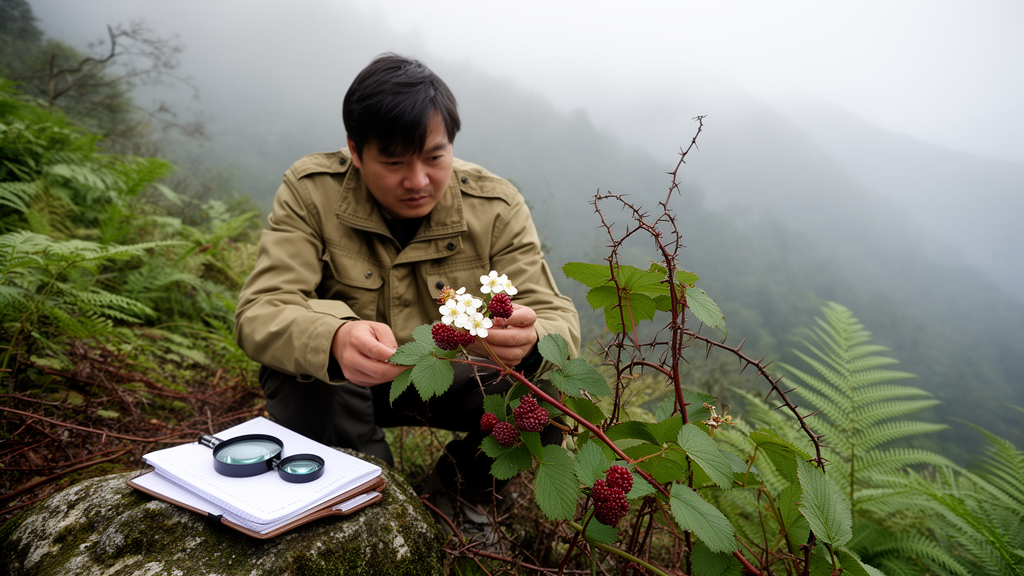
Botanists surveying brambles in the mountains of southwestern China have described a species that had been hiding in plain sight for decades. The plant, now formally named Rubus phantasmaticus, is an evergreen shrub of Rubus subg. Malachobatus, a group of scrambling, simple-leaved brambles that includes many of Asia’s wild raspberries and blackberries. The name, derived from the Greek word for ghost, was chosen deliberately: the species had persisted unrecognized among known taxa, misidentified much like a ghost among the living, according to the authors, Q. P. Wang, X. Y. Dai and Huan C. Wang.
The story of the discovery stretches back to 1989, when a specimen was collected in Qinghe Village, Leibo County, in Sichuan Province. The late Chinese botanist L. T. Lu examined that specimen and annotated it on the herbarium label as a new variety of R. chrysobotrys, a species from the Gaoligong Mountains of northwestern Yunnan. That proposed variety was only validly published in 2024 as R. chrysobotrys var. glandulosus. But when the authors of the new study re-examined the plant during fieldwork and herbarium research, both its morphology and its DNA told a different story, one that required the taxon to be pulled out of R. chrysobotrys altogether and recognized as a species in its own right.
To settle the question, the team combined comprehensive morphological comparisons with molecular phylogenetic analyses based on two independent datasets: nuclear ribosomal ITS sequences and complete plastid genomes. The morphological work drew on field observations of wild populations together with herbarium specimens from the Yunnan University herbarium and digital images from online databases including JSTOR Global Plants, the Chinese Virtual Herbarium, GBIF and the Plant Photo Bank of China. Characters assessed ranged from plant habit and indumentum to leaf shape, stipule and bract form, calyx division, petal color, and the numbers of stamens and pistils.
The genetic sampling covered 41 taxa, including five outgroup species from the related genera Geum, Fallugia and Rosa. Most sequence data came from GenBank, but 12 species were newly collected in the field, with vouchers deposited at Yunnan University. Fresh leaf material was dried in silica gel, DNA was extracted with a modified CTAB protocol, and libraries were sequenced on an Illumina NovaSeq 6000 platform. Plastomes and nuclear ribosomal DNA were assembled de novo from the genome-skimming data, and the resulting matrices were aligned, trimmed and analyzed under both maximum likelihood and Bayesian inference frameworks.
The plastome dataset ultimately comprised 42 sequences, 37 of them ingroup accessions representing 33 Rubus taxa, with a final aligned matrix of 151,743 base pairs containing nearly 10,000 parsimony-informative sites. The ITS dataset comprised 39 sequences representing 26 Rubus taxa, with a final matrix of 618 base pairs. Both analyses recovered Rubus as a strongly supported monophyletic group, and both placed the new species firmly inside R. subg. Malachobatus.
Within that subgenus, the two datasets converged on the same closest relative. In the plastome tree, R. phantasmaticus fell within a strongly supported clade belonging to R. subg. Malachobatus and formed a moderately supported subclade with R. hypopitys, with posterior probability 0.85 and bootstrap support of 80. In the ITS tree, R. phantasmaticus grouped with R. hypopitys, R. lasiotrichos and R. pinnatisepalus in a well-supported subclade with posterior probability 0.99 and bootstrap support of 96. Crucially, R. chrysobotrys landed in a different, more distant clade in the ITS analysis, directly contradicting the earlier treatment of the plant as a variety of that species.
The morphological evidence pointed the same way. The differences between R. phantasmaticus and R. chrysobotrys extend well beyond the presence or absence of glandular hairs, the feature that had given the old variety its name. The new species has a persistently densely villous lower leaf surface, whereas R. chrysobotrys is densely tomentose when young, with the tomentum gradually deciduous and leaving only sparse long hairs at maturity. The leaf margins of R. phantasmaticus are shallowly 5- to 7-lobed with triangular lobe apices, while those of R. chrysobotrys are undivided or undulate with rounded lobes. The stipules differ in division pattern, and the calyx surfaces differ in hair type. Geographically the two are disjunct: R. chrysobotrys is restricted to the Gaoligong Mountains, far from the range of the new species.
The closest living relative, R. hypopitys, presents a different kind of contrast. The two species share cordate to suborbicular leaves with shallowly lobed margins, palmately divided stipules, outer sepals with laciniate apices, erect fruiting calyces and petals shorter than the sepals. But R. hypopitys is a dwarf subshrub with subprostrate stems, while R. phantasmaticus is an arching shrub up to two meters tall. The new species bears glandular hairs throughout the plant, where its relative is eglandular, and its flowers are arranged in narrow cymose panicles or subracemes with three or more flowers, rather than the two or three flowers of R. hypopitys borne in terminal corymbs or solitarily in the leaf axils. The two species are geographically adjacent but do not overlap: R. hypopitys occurs on the Yunnan Plateau and in the southern Hengduan Mountains at elevations of 2,700 to 3,000 meters in cool, dry montane pine forests, whereas R. phantasmaticus inhabits warm, humid slopes, forest edges and thickets at 1,000 to 2,300 meters in the transitional zone among the Guizhou Plateau, the Yunnan Plateau and the Sichuan Basin.
The plastomes themselves added technical texture to the picture. The complete plastomes of R. phantasmaticus, R. hypopitys and R. chrysobotrys all show the typical circular quadripartite structure, and their lengths range from 156,221 base pairs in the new species to 156,304 in R. chrysobotrys. Each encodes 132 genes, including 87 protein-coding genes, 37 tRNA genes and eight rRNA genes, and overall GC content is conserved at 37.2 percent across the three species. Gene order and structural features are highly consistent with other reported Rubus plastomes, with no significant gene losses, inversions or rearrangements detected.
The formal description rests on a type specimen collected in July 2025 in Wenshan County, Yunnan Province, at an elevation of roughly 2,281 meters, with additional specimens examined from Guizhou, Hubei, Sichuan and Yunnan. The species flowers from July to August and fruits from September to October, producing red aggregate fruits. One nomenclatural wrinkle remained: elevating Lu’s variety directly as R. glandulosus would have been the most straightforward option, but that name had already been used by Bellardi in 1793 for a European Rubus species and was therefore unavailable, prompting the authors to coin the evocative epithet phantasmaticus instead. The description also highlights how much remains unresolved within the subgenus. Although R. subg. Malachobatus, as currently circumscribed with roughly 120 to 130 species, more than 100 of them in China, is now a well-supported monophyletic group, its internal classification remains poorly understood, and the sectional placement of the new species cannot yet be reliably determined. For a genus long notorious for the difficulty of its species limits, the ghost of the Chinese mountains is a reminder of how much diversity still waits to be formally recognized.
Subject of Research: Description and phylogenetic placement of a new bramble species, Rubus phantasmaticus, from southwestern China
Article Title: Rubus phantasmaticus ( Rosaceae ), an overlooked new species of R. subg. Malachobatus from southwestern China
Article References: Wang, Q.-P., Dai, X.-Y., Yang, F., Wang, T.-T., Zhou, Q., & Wang, H.-C. (2026). Rubus phantasmaticus (Rosaceae), an overlooked new species of R. subg. Malachobatus from southwestern China. PhytoKeys, 281, 1–21. https://doi.org/10.3897/phytokeys.281.204346
Image Credits: AI Generated
DOI: 10.3897/phytokeys.281.204346
Keywords: Rubus phantasmaticus, Rosaceae, new species, taxonomy, phylogenetics, plastome, ITS, subg. Malachobatus, southwestern China, brambles, species delimitation, herbarium specimens
Cite Scienmag News
Margaret Porter. (October 27, 2026). Ghost of the brambles: botanists name a long-overlooked raspberry relative from southwestern China. Scienmag. https://scienmag.com/ghost-of-the-brambles-botanists-name-a-long-overlooked-raspberry-relative-from-southwestern-china/
Margaret Porter. "Ghost of the brambles: botanists name a long-overlooked raspberry relative from southwestern China." Scienmag, 27 October 2026, https://scienmag.com/ghost-of-the-brambles-botanists-name-a-long-overlooked-raspberry-relative-from-southwestern-china/. Accessed 27 October 2026.
Margaret Porter. "Ghost of the brambles: botanists name a long-overlooked raspberry relative from southwestern China." Scienmag. October 27, 2026. https://scienmag.com/ghost-of-the-brambles-botanists-name-a-long-overlooked-raspberry-relative-from-southwestern-china/


