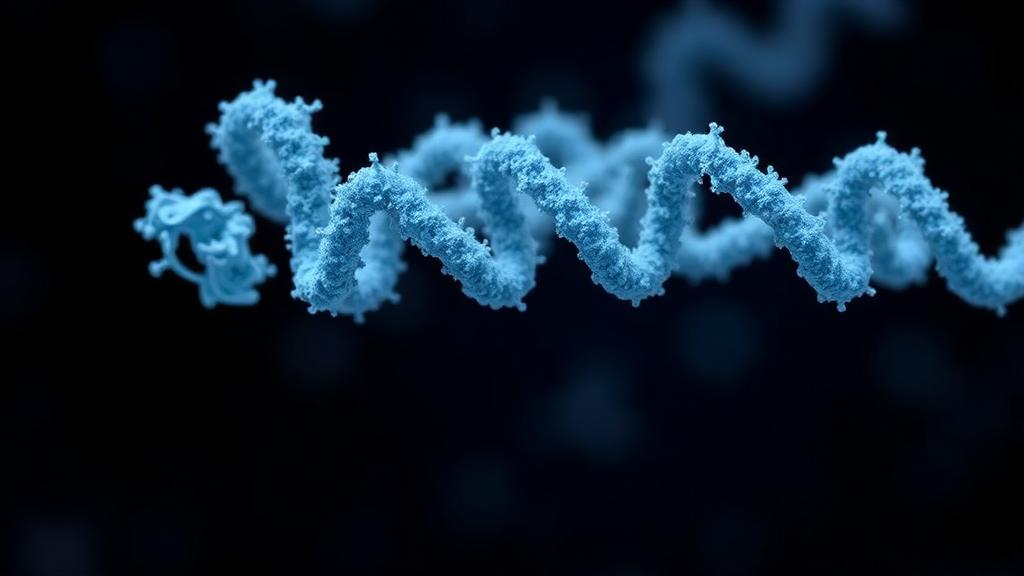
Not every protein in the cell folds into a tidy, well-defined three-dimensional shape. A large and biologically crucial class of proteins, known as intrinsically disordered proteins and regions, remains flexible and structureless under normal physiological conditions, and that very flexibility is what allows them to switch gene activity on and off, mediate cellular stress responses, and enable molecular recognition between proteins. These floppy stretches of the protein chain are also implicated in some of medicine’s most daunting diseases, including cancer, cardiovascular disease, and neurodegenerative conditions such as Alzheimer’s and Parkinson’s. Yet their lack of stable structure makes them notoriously difficult to characterise computationally, because most prediction tools were built around the assumption that a protein’s function flows from a fixed architecture. A new study published in Current Computer Science by Deepak Chaurasiya of the Indian Institute of Information Technology, Allahabad, describes a method that closes part of that gap, and it does so with striking computational economy.
The method, named IDP-T5CKNN, is described in the paper “IDP-T5CKNN: A Protein Language Model for Prediction of Intrinsically Disordered Proteins.” Its central design decision is to avoid training a deep neural network from scratch. Instead, it borrows the representational power of an existing protein language model called ProtT5-XL-UniRef50, a model that has already learned the statistical grammar of protein sequences from enormous databases. When a protein’s amino acid sequence is passed through this language model, each residue in the chain is converted into a 1,024-dimensional numerical vector. These embeddings capture the biochemical context of each residue within its surrounding sequence, effectively encoding how a given amino acid behaves in the company of its neighbours, which turns out to be a powerful signal for whether that residue tends to be ordered or disordered.
Once the embeddings are generated, they are normalised and handed to a K-Nearest Neighbour classifier, one of the simplest algorithms in machine learning. The classifier uses cosine similarity to compare each query residue against a training library of residues with known disorder annotations. A residue is then predicted as disordered or ordered based on the majority label among its five most similar training counterparts. The elegance of this arrangement lies in what it does not require: no iterative training, no back-propagation, and no GPU hardware. Where state-of-the-art deep learning predictors demand substantial computational resources and extensive training time, IDP-T5CKNN can run on modest hardware, and its predictions can be traced directly back to the specific training residues that most influenced them. That transparency gives researchers a clear, interpretable basis for interrogating outputs, a quality that is often missing from black-box neural networks.
The performance claims rest on rigorous testing against two independent blind datasets. The first, MXD494, contains 494 proteins and nearly 200,000 residues, providing a broad and demanding benchmark. On this dataset, IDP-T5CKNN achieved the highest Matthews Correlation Coefficient of 0.5459 and a Balanced Accuracy of 0.7906, outperforming all 23 other disorder predictors tested. Among the tools it surpassed were established deep learning approaches such as IDP-Fusion, which scored an MCC of 0.47, DeepIDP-2L at 0.452, and SPOT-Disorder at 0.457. For a lightweight classifier built on top of a frozen language model to beat purpose-built deep networks on a standard benchmark is the study’s most striking result, and it suggests that the quality of the input representation matters as much as the sophistication of the classifier that consumes it.
Equally important is how the method achieved its lead. Many high-specificity disorder predictors fall into a subtle trap: they correctly identify ordered regions but systematically miss the disordered ones that matter most biologically, inflating their apparent accuracy while quietly discarding the very signals researchers need. IDP-T5CKNN maintained a sensible balance between sensitivity and specificity, scoring 0.7209 and 0.8602 respectively on the MXD494 dataset. That balance means the tool is not merely good at confirming what is already easy to predict; it reliably flags the flexible regions that experimental biologists most want to find. On the second blind dataset, fiDPnn Test176, which covers 176 proteins, the method remained competitive with the best available neural network predictors, recording an MCC of 0.3942 and a Balanced Accuracy of 0.7163.
The significance of this work extends beyond a single leaderboard result. Intrinsically disordered proteins are deeply enmeshed in cellular regulation, and their dysfunction is linked to a wide range of serious diseases. In cancer, disordered regions often govern signalling pathways that control cell division and death. In neurodegeneration, proteins with prominent disordered segments are prone to aberrant interactions and aggregation, processes central to conditions such as Alzheimer’s and Parkinson’s disease. Accurate computational prediction of which residues are disordered therefore serves as a first step for experimentalists, helping them prioritise which proteins and regions to study, design experiments, and interpret the growing volume of genomic data in which disordered proteins are heavily represented.
The study is candid about its limitations, which lends credibility to its claims. Because IDP-T5CKNN stores the entire training embedding matrix in memory and must compute similarities against it at prediction time, its inference cost scales linearly with the number of training residues. At the scale of whole proteomes, that linear growth could become a practical constraint, limiting how the method is deployed on very large protein databases. The ProtT5 embeddings it relies on also represent static sequence context rather than the dynamic structural changes that disordered regions undergo under different biological conditions, an inherent limitation of the underlying language model. Furthermore, the method does not currently incorporate evolutionary information such as position-specific scoring matrices, features that have proved useful in related prediction tasks and could add complementary signal.
The author outlines three directions for future development, each addressing one of these constraints. The first is to integrate approximate nearest neighbour search algorithms, which would dramatically reduce the computational burden of similarity searches and make the framework more scalable across very large protein databases. The second is to combine the current embedding-based features with physicochemical and evolutionary descriptors, potentially pushing predictive accuracy higher by fusing learned representations with hand-crafted biochemical knowledge. The third is perhaps the most biologically ambitious: expanding the method to classify disordered regions into functionally distinct subtypes, such as molecular recognition features and phase-separating regions. These subtypes carry out distinct roles in the cell, from short linear motifs that bind partner proteins to the sticky segments that drive liquid-liquid phase separation in membraneless organelles, and each would benefit from dedicated prediction tools.
What makes IDP-T5CKNN a notable data point in the broader conversation about artificial intelligence in biology is its challenge to the assumption that bigger models always win. Protein language models have transformed computational biology by learning rich representations of sequence context, but the prevailing instinct has been to stack increasingly complex neural architectures on top of them. This study demonstrates that a simple, interpretable classifier, given an excellent representation, can match or exceed those complex systems on a demanding benchmark while running on ordinary hardware. For research groups without access to GPU clusters, particularly in resource-limited settings, that difference is not a technical footnote; it determines whether such tools are usable at all.
The research was conducted and led by corresponding author Dr. Deepak Chaurasiya of the Biomedical Informatics Lab, Department of Applied Sciences, Indian Institute of Information Technology, Allahabad, Prayagraj, India, and published in Current Computer Science. As disordered proteins continue to move from the margins of structural biology to the centre of drug discovery and disease research, tools like this one, which combine the pattern-recognition power of language models with the transparency and efficiency of classical algorithms, are likely to play an expanding role. The open question for the field is whether the next generation of predictors will follow the path of ever-larger networks or embrace this study’s quieter lesson: that representation, balance, and interpretability can matter more than raw model size.
Subject of Research: A protein language model-based computational method for predicting intrinsically disordered protein regions
Article Title: A protein language model for prediction of intrinsically disordered proteins
Article References: A protein language model for prediction of intrinsically disordered proteins. (n.d.). Original publication
Image Credits: AI Generated
DOI: Not provided
Keywords: protein language model, intrinsically disordered proteins, IDP-T5CKNN, ProtT5, K-nearest neighbour, computational biology, machine learning, cancer, neurodegenerative disease, protein structure prediction, Current Computer Science, IIIT Allahabad
Cite Scienmag News
Blake Davidson. (October 14, 2026). Lightweight AI Tool Outsmarts Deep Learning at Spotting Disordered Proteins. Scienmag. https://scienmag.com/lightweight-ai-tool-outsmarts-deep-learning-at-spotting-disordered-proteins/
Blake Davidson. "Lightweight AI Tool Outsmarts Deep Learning at Spotting Disordered Proteins." Scienmag, 14 October 2026, https://scienmag.com/lightweight-ai-tool-outsmarts-deep-learning-at-spotting-disordered-proteins/. Accessed 14 October 2026.
Blake Davidson. "Lightweight AI Tool Outsmarts Deep Learning at Spotting Disordered Proteins." Scienmag. October 14, 2026. https://scienmag.com/lightweight-ai-tool-outsmarts-deep-learning-at-spotting-disordered-proteins/