


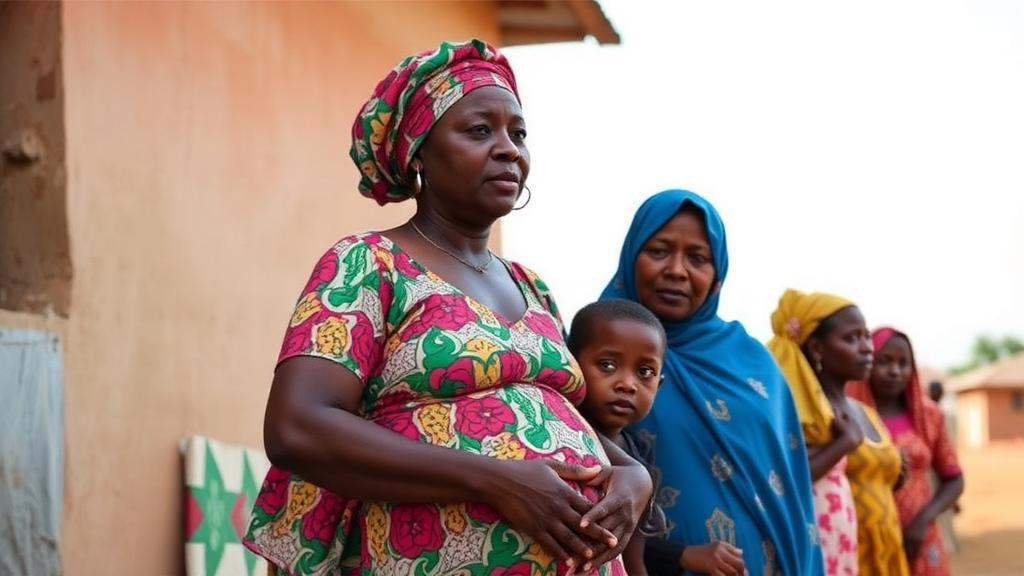
Nigeria has long stood out as one of the world’s demographic giants with one of the world’s highest birth rates. A new analysis of more than two decades of national survey data confirms what many demographers have suspected but rarely been able to document so cleanly: the country’s fertility is finally bending downward, though it remains stubbornly, extraordinarily high by global standards. The study, published in the Journal of Population Research, tracked completed fertility among Nigerian women who had finished their childbearing years, offering a rare full-lifetime view of family size rather than a snapshot of women still in the middle of their reproductive lives.
The research team, led by Uche Charlie Isiugo-Abanihe of the University of Ibadan and Chukwuechefulam Kingsley Imo of Adekunle Ajasin University, pooled data from five rounds of the Nigeria Demographic and Health Surveys conducted between 2003 and 2024. Their weighted sample comprised 9,227 married women aged 45 to 49, the age window demographers use to measure completed fertility because these women are essentially at the end of their reproductive careers. By counting the children these women ever had, the researchers could capture the full arc of family building across a generation, immune to the distortions that arise when younger women’s unfinished fertility is projected forward.
The headline finding is a modest but meaningful decline. Completed fertility among these older Nigerian women fell from an average of 7.0 children per woman in 2003 to 5.8 children in 2024. That drop of more than one child per woman over two decades is significant for a country where three decades of population policies and programmes had produced frustratingly little visible movement. Yet it also underscores how far Nigeria remains from the replacement level of roughly 2.1 children per woman that prevails in most of the world, and how much momentum the country’s population growth still carries.
The authors grounded their analysis in three classic theoretical frameworks of demographic research. John Bongaarts’ proximate determinants framework explains how biological and behavioural factors, such as the age at which women enter union, the age at which they begin childbearing, and their use of contraception, translate social change into fertility outcomes. Richard Easterlin’s supply-demand framework asks how the supply of children, the demand for them, and the costs of regulating fertility interact. And John Caldwell’s wealth flows theory holds that fertility declines when the intergenerational flow of money and support reverses, from children supporting parents to parents investing in fewer children. Together, these lenses let the researchers interpret not just what changed in Nigeria, but why.
The statistical machinery behind the study combined descriptive trend analysis with multivariable binary logistic regression conducted in Stata 15, a design that let the authors isolate the independent effect of each social characteristic on the odds that a woman ended her reproductive life with a large family. The results were strikingly patterned. Education emerged as a central dividing line: women with more schooling completed substantially smaller families than women with little or none. Household wealth traced a similar gradient, with better-off women bearing fewer children over their lifetimes than the poorest. Religion, couples’ own fertility desires, age at first birth, age at first marriage and geographic region all left their statistical fingerprints on the outcome as well.
Geography mattered enormously. The North-central and North-east zones of Nigeria showed disproportionately high completed fertility compared with the rest of the country, a pattern consistent with the well-documented north-south divide in Nigerian social indicators. Northern regions have historically lower female school enrolment, earlier marriage and weaker access to modern family planning, and the new analysis suggests those differences accumulate over a woman’s lifetime into very different family sizes. The regional heterogeneity is a warning that national averages conceal two very different fertility regimes operating within a single country, and that policies calibrated to the national mean will miss the mark in at least one of them.
The study also took an unusual methodological decision by including childless women in its measure of completed fertility. Many analyses of later-life fertility quietly exclude women who never had children, but the researchers argued that their omission would bias the picture of family building in Nigeria. By counting them, the study captures the full distribution of reproductive outcomes, from women who bore no children to those who bore ten or more, and situates the average where it truly belongs.
Interpreted through the study’s theoretical scaffolding, the downward trend tells a coherent story. Rising female schooling and improving household wealth shrink the demand for large families and lower the barriers to fertility control, exactly as Easterlin’s supply-demand model predicts. The same changes signal, in Caldwell’s terms, a transition from upward to downward intergenerational wealth flows, in which parents increasingly invest concentrated resources in fewer children rather than relying on many children as economic assets. And the mechanism through which these forces act, in Bongaarts’ vocabulary, is visible in the proximate determinants: women are marrying later, delaying the onset of childbearing and using contraception more. Each pathway chips away at the cumulative exposure that once produced seven-child families.
But the analysis also identifies powerful brakes on the transition. Pronatalist religious norms continue to sustain a high demand for children in some sub-populations, and the persistence of these norms helps explain why the decline has been modest rather than dramatic. The findings on couples’ fertility desires add a further nuance: when husbands and wives disagree about how many children to have, or when both partners want many, achieved family size tends to follow. This is where the authors’ policy recommendations take on a distinctive gender dimension, since engaging men, not only women, in conversations about family size emerges as a necessary strategy for shifting norms.
The policy implications the authors draw are pointed. They call for prioritising girls’ education, women’s economic empowerment, delayed marriage and expanded family planning services, combined with male-engagement programmes and regionally tailored strategies that acknowledge the sharply different social landscapes of northern and southern Nigeria. Accelerating the fertility transition, they note, is directly aligned with the Sustainable Development Goals on health and gender equality, SDG 3 and SDG 5. With Nigeria projected to remain one of the main engines of global population growth in the coming decades, the slow, uneven decline documented here is more than an academic curiosity. It is an early signal that the world’s most stubborn high-fertility region may finally be turning, and that the levers that moved fertility everywhere else, education, prosperity and the power to choose, are beginning to work in Nigeria too.
Subject of Research: Trends and determinants of completed fertility among Nigerian women aged 45–49 using Demographic and Health Survey data from 2003 to 2024.
Article Title: Trends and determinants of completed fertility in Nigeria: evidence from the 2003–2024 Nigeria Demographic and Health Surveys
Article References: Trends and determinants of completed fertility in Nigeria: evidence from the 2003–2024 Nigeria Demographic and Health Surveys. (n.d.). https://doi.org/10.1007/s12546-026-09442-0
Image Credits: AI Generated
DOI: 10.1007/s12546-026-09442-0
Keywords: Nigeria, fertility, demographic transition, completed fertility, DHS surveys, female education, family planning, sub-Saharan Africa, marriage timing, contraception, population policy, women's empowerment
Cite Scienmag News
Courtney Benton. (October 14, 2026). Nigerian Women Are Still Having Big Families, But the Numbers Are Finally Falling. Scienmag. https://scienmag.com/nigerian-women-are-still-having-big-families-but-the-numbers-are-finally-falling/
Courtney Benton. "Nigerian Women Are Still Having Big Families, But the Numbers Are Finally Falling." Scienmag, 14 October 2026, https://scienmag.com/nigerian-women-are-still-having-big-families-but-the-numbers-are-finally-falling/. Accessed 14 October 2026.
Courtney Benton. "Nigerian Women Are Still Having Big Families, But the Numbers Are Finally Falling." Scienmag. October 14, 2026. https://scienmag.com/nigerian-women-are-still-having-big-families-but-the-numbers-are-finally-falling/


