

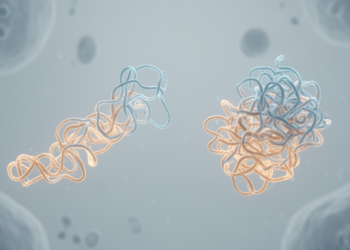
Subtle Shape Shifts, Not Misfolding: How FUS Mutations Drive ALS
A computational study shows that ALS-linked FUS mutations cause disease through subtle, site-specific changes in protein flexibility and molecular recognition ...
A computational study shows that ALS-linked FUS mutations cause disease through subtle, site-specific changes in protein flexibility and molecular recognition ...

A researcher at IIIT Allahabad has developed IDP-T5CKNN, a lightweight protein language model method that outperforms more than 20 existing ...
A co-led Buck Institute and Georgetown University team has won an ARPA-H award of up to $51.7 million to predict ...
A Stowers Institute scientist will help lead a $28.6 million ARPA-H effort to generate billions of protein aggregation measurements and ...
Genetic variants in the heat-resistant obscure chaperone protein Hero11, encoded by C19orf53, are associated with coronary artery disease risk and ...
A multi-species bioinformatics analysis of four tardigrade genomes reveals new Dsup diversity, conserved protein motifs, and statistical signatures of convergent ...
Researchers at UC Berkeley used active learning and a model called ADhunter to discover and characterize nearly 10,000 transcriptional activator ...
Researchers found that sublethal rifampicin exposure drives Lactobacillus delbrueckii subsp. bulgaricus into a reversible dormant state in which protein aggregates ...
Intrinsically disordered proteins (IDRs)—segments that do not adopt a single stable 3D structure—are common across life and perform crucial cellular ...
In the realm of protein science, a significant frontier has emerged, focusing on intrinsically disordered proteins (IDPs). Unlike their well-folded ...

Embark on a thrilling journey of discovery with Scienmag.com—your ultimate source for cutting-edge breakthroughs. Immerse yourself in a world where curiosity knows no limits and tomorrow’s possibilities become today’s reality!