

Thursday, July 16, 2026
Science
No Result
View All Result
  • Login
  • HOME
  • SCIENCE NEWS
  • CONTACT US
  • HOME
  • SCIENCE NEWS
  • CONTACT US
No Result
View All Result
Scienmag
No Result
View All Result
Home Science News Medicine

LIG1 Loss Reveals Targetable Weakness Against Chemotherapy-Resistant Triple-Negative Breast Cancer

July 16, 2026
in Medicine
Reading Time: 2 mins read
0
LIG1 Loss Reveals Targetable Weakness Against Chemotherapy-Resistant Triple-Negative Breast Cancer

LIG1 Loss Reveals Targetable Weakness Against Chemotherapy-Resistant Triple-Negative Breast Cancer

65
SHARES
587
VIEWS
Share on FacebookShare on Twitter
ADVERTISEMENT

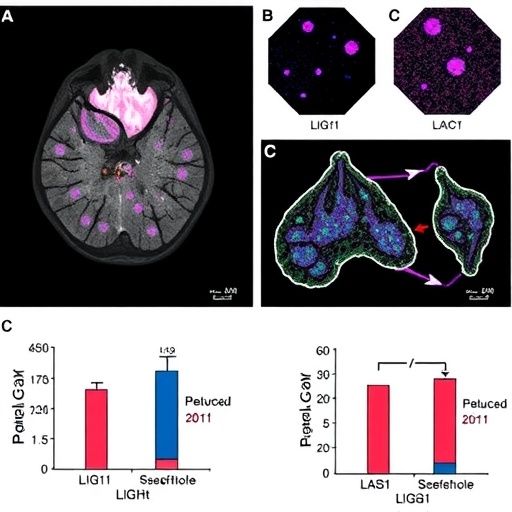
In triple-negative breast cancer (TNBC) that carries TP53 mutations, loss of one copy of the DNA ligase I gene (LIG1) is known to blunt chemotherapy responses. Now, researchers at Baylor College of Medicine and collaborators have turned that resistance into a therapeutic weakness, mapping how platinum drugs fail—and how to force cancer cells to buckle anyway.

Using deep proteogenomic profiling, the team previously found that LIG1 loss robustly correlates with resistance, particularly to platinum-based regimens. The new study digs into the DNA-repair circuitry behind that effect, focusing on how TP53-mutant cells reorganize damage responses when LIG1 is missing.

Early experiments tested whether PARP inhibition alone could reverse the phenotype. In LIG1-loss models, PARP inhibitors such as olaparib showed only modest anti-tumor activity, suggesting that blocking a single repair node is insufficient when repair pathways are rewired downstream of LIG1 deficiency.

The researchers then broadened the hunt by pairing PARP inhibitors with agents that interfere with other DNA damage response pathways. They collaborated with investigators at the Institute of Cancer Research in London to screen PARP inhibitors alongside a larger panel of 120 DNA damage response inhibitors, seeking a combination capable of overcoming the LIG1-loss rewiring.

The most striking result was the synergy between olaparib and ceralasertib, an ATR inhibitor. In TP53-mutant/LIG1-loss cell lines, the dual blockade outperformed either drug alone, and the advantage carried into animal models where tumor growth was reduced.

Mechanistically, the work points to ATR/PARP pathway dependence as a consequence of LIG1 loss under TP53-mutant stress. In other words, the same genetic event that enables chemotherapy resistance also creates a bottleneck in how cells tolerate replication stress and DNA lesions.

Beyond therapy, the study elevates LIG1 status as a practical patient stratification marker. If LIG1 levels are low in a tumor prior to treatment, patients may be more likely to benefit from PARP–ATR combination strategies—turning genomic profiling into a real-time decision tool.

“This Achilles’ heel” framing positions LIG1-loss TNBC as a precision oncology opportunity rather than an unmanageable subtype. With ongoing and future clinical trials, validating LIG1 as a predictive biomarker could refine who gets these therapies and why, accelerating progress for a group with limited options.

Subject of Research: Animals; experimental study
Article Title: LIG1 Loss in TP53-mutant Triple Negative Breast Cancer Rewires DNA Repair and Confers Sensitivity to PARP-ATR Inhibitor Combinations
News Publication Date: 15-Jul-2026
Web References: https://aacrjournals.org/mct/article/doi/10.1158/1535-7163.MCT-26-0182/786886/LIG1-Loss-in-TP53-mutant-Triple-Negative-Breast
References: 10.1158/1535-7163.MCT-26-0182
Image Credits:

Keywords: LIG1 loss, TP53 mutations, triple-negative breast cancer, chemotherapy resistance, platinum resistance, DNA repair, PARP inhibition, ATR inhibition, olaparib, ceralasertib, biomarkers, precision oncology

Tags: chemotherapy resistancecombination therapyDNA damage responseDNA repair pathwaysLIG1 lossPARP inhibitorsplatinum drug resistanceproteogenomic profilingsynthetic lethalitytargeted cancer therapyTP53 mutationstriple-negative breast cancer
Share26Tweet16
Previous Post

NYU Tandon Study Shows Disaster Evacuees Flee to Familiar-Looking Places

Next Post

Forest Rivers Remove Nitrogen as Natural Processes Shift Throughout Seasons

Related Posts

Perioperative D-dimer to albumin ratio predicts serious complications, mortality after hip fracture
Medicine

Perioperative D-dimer to albumin ratio predicts serious complications, mortality after hip fracture

July 16, 2026
Immune Cell Interaction Breakdown Drives Aging, New Study Finds
Medicine

Immune Cell Interaction Breakdown Drives Aging, New Study Finds

July 16, 2026
Crown Bioscience Joins C-Path Coalition for New Approach Methodologies
Medicine

Crown Bioscience Joins C-Path Coalition for New Approach Methodologies

July 16, 2026
Fractional High-Chern Insulator Realized in Twisted Rhombohedral Graphene
Medicine

Fractional High-Chern Insulator Realized in Twisted Rhombohedral Graphene

July 16, 2026
Plasma Ceramide Ratios Link Metabolic and Inflammation Markers to Parkinson’s Cognitive Decline
Medicine

Plasma Ceramide Ratios Link Metabolic and Inflammation Markers to Parkinson’s Cognitive Decline

July 16, 2026
AI Disagreements Could Undermine Patient Trust in Doctors
Medicine

AI Disagreements Could Undermine Patient Trust in Doctors

July 16, 2026
Next Post
Forest Rivers Remove Nitrogen as Natural Processes Shift Throughout Seasons

Forest Rivers Remove Nitrogen as Natural Processes Shift Throughout Seasons

  • Mothers who receive childcare support from maternal grandparents show more

    Mothers who receive childcare support from maternal grandparents show more parental warmth, finds NTU Singapore study

    27656 shares
    Share 11059 Tweet 6912
  • University of Seville Breaks 120-Year-Old Mystery, Revises a Key Einstein Concept

    1061 shares
    Share 424 Tweet 265
  • Bee body mass, pathogens and local climate influence heat tolerance

    682 shares
    Share 273 Tweet 171
  • Researchers record first-ever images and data of a shark experiencing a boat strike

    546 shares
    Share 218 Tweet 137
  • Groundbreaking Clinical Trial Reveals Lubiprostone Enhances Kidney Function

    531 shares
    Share 212 Tweet 133
Science

Embark on a thrilling journey of discovery with Scienmag.com—your ultimate source for cutting-edge breakthroughs. Immerse yourself in a world where curiosity knows no limits and tomorrow’s possibilities become today’s reality!

RECENT NEWS

  • Gender Pay Gap Persists Despite Ongoing Battle of the Sexes
  • NIH Grants $10.7 Million to Advance Sensory Biology at OU Medicine
  • Orienting Selective Attention Within Long-Term Contextual Memories
  • Permafrost Carbon Release Grows Linearly With Overshoot Warming via AMOC Tipping

Categories

  • Agriculture
  • Anthropology
  • Archaeology
  • Athmospheric
  • Biology
  • Biotechnology
  • Blog
  • Bussines
  • Cancer
  • Chemistry
  • Climate
  • Earth Science
  • Editorial Policy
  • Marine
  • Mathematics
  • Medicine
  • Pediatry
  • Policy
  • Psychology & Psychiatry
  • Science Education
  • Social Science
  • Space
  • Technology and Engineering

Subscribe to Blog via Email

Enter your email address to subscribe to this blog and receive notifications of new posts by email.

Join 5,146 other subscribers

© 2025 Scienmag - Science Magazine

Welcome Back!

Login to your account below

Forgotten Password?

Retrieve your password

Please enter your username or email address to reset your password.

Log In
No Result
View All Result
  • HOME
  • SCIENCE NEWS
  • CONTACT US

© 2025 Scienmag - Science Magazine

Discover more from Science

Subscribe now to keep reading and get access to the full archive.

Continue reading
