


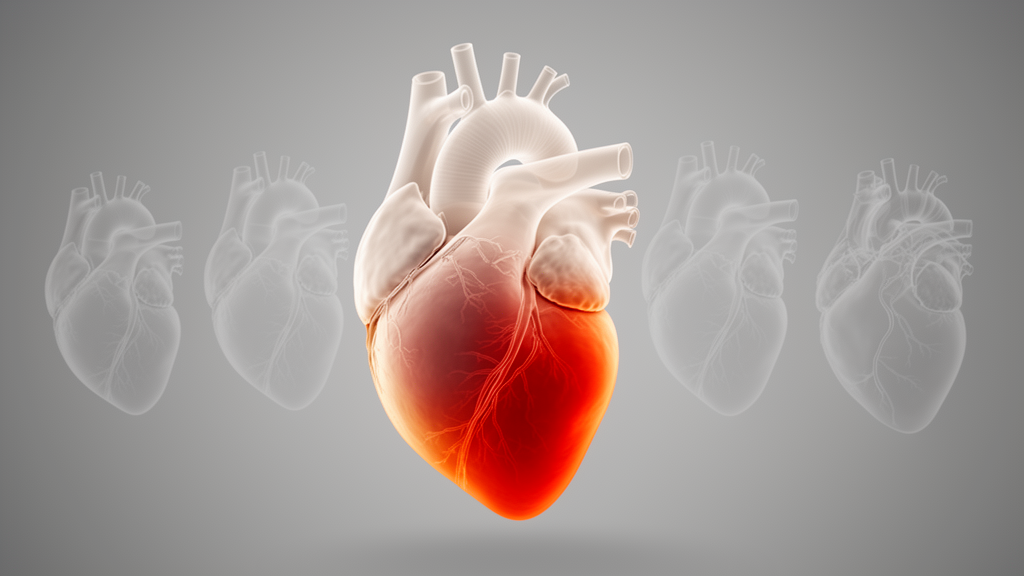
The right ventricle has long been the neglected chamber of cardiology. While decades of research and an arsenal of approved therapies have transformed the treatment of left-sided heart failure, the right ventricle has remained largely a mystery, and when it fails, patients die. Now a team led by researchers at the University of Pennsylvania and the Children’s Hospital of Philadelphia has produced the most detailed molecular map of the human right ventricle ever assembled, and their findings rewrite the story of how this chamber breaks down under pressure.
The study, published in Nature Cardiovascular Research, integrated three complementary genomic technologies on matched human heart tissue: bulk RNA sequencing of 142 individuals, single-nucleus RNA sequencing of 11 hearts yielding more than 61,000 nuclei, and Xenium spatial transcriptomics profiling over 625,000 cells across nine tissue sections. The team added mitochondrial respirometry, flow cytometry and histology, then placed the human data in context using a mouse model of pressure overload and a pediatric cohort of single-ventricle hearts. The result is an atlas resolving 34 cell subtypes across 12 major lineages, charted along the full trajectory from healthy tissue to outright failure.
The central discovery is that right ventricular failure unfolds in two sharply distinct phases. In the first phase, which occurs while the ventricle is still pumping normally despite elevated pressure, the tissue undergoes a sweeping, multi-lineage erosion of its protective machinery. This phase accounts for the overwhelming majority of detectable transcriptional change: roughly 95 percent of the differentially expressed genes resolved across platforms appear before functional decompensation ever sets in. The second phase, the actual transition to failure, produces surprisingly little change in bulk gene expression but is revealed by spatial transcriptomics as a set of focal, cell-type-specific programs.
What exactly is lost in that first phase? Nearly everything the tissue uses to defend itself. Resident macrophages, the heart’s home-grown immune sentinels, shed their scavenger identity markers CD163 and VSIG4. Fibroblasts activate, switching on myofibroblast markers such as THBS4 and ACTA2 while simultaneously losing the TGF-beta co-receptor TGFBR3 and the antioxidant enzyme GPX3. Endothelial cells shed vasoprotective genes including the IL-33 receptor, the matrix-protective inhibitors TIMP3 and TIMP4, and ACE2. Perhaps most strikingly, across 11 of 24 non-cardiomyocyte subtypes the team documented coordinated loss of glucocorticoid receptor transactivation targets, including the co-chaperone FKBP5, suggesting a tissue-wide rewiring of stress-hormone signaling that has never before been observed in the right heart.
Cardiomyocytes tell their own metabolic tragedy. The muscle cells coordinately downregulate nuclear-encoded mitochondrial genes spanning fatty acid oxidation, the TCA cycle, oxidative phosphorylation and the mitoribosome, driven by suppression of the master biogenesis regulators PGC-1alpha and ERRalpha. Crucially, this transcriptional decline has a functional counterpart: high-resolution respirometry on isolated mitochondria showed that maximal respiratory capacity fell by roughly 40 percent in both pressure-loaded and failing ventricles compared with healthy donors. The largest functional deficit occurs at the first phase transition, mirroring the dominant transcriptional changes and implying that the metabolic die is cast long before the chamber visibly fails.
The second phase is quieter but sinister. Spatial transcriptomics, with its ability to see where signals arise within intact tissue, caught programs invisible to bulk sequencing: cardiomyocytes upregulate a BMP/TGF-beta signaling axis, endothelial cells launch an angiogenic destabilization program involving ANGPT2 and ADAMTS1, and fibroblast subsets commit to a matrix-producing matrifibrocyte state. Cell-cell communication analysis revealed that failing tissue gains extracellular matrix signaling through collagen, laminin and thrombospondin pathways layered over a stable baseline of contact-mediated adhesion. Histology confirmed progressive fibrosis accumulating at each disease stage.
The immune findings carry particular weight. The team identified an inflammatory macrophage population marked by immediate-early genes that retained resident macrophage markers, a hybrid state not seen in left ventricular atlases. Because such gene signatures can be artifacts of tissue dissociation, the researchers took care to validate it: the program was defined in single-nucleus sequencing, which skips the dissociation step entirely, and independently recovered by spatial transcriptomics on fixed tissue, where it showed reproducible localization at sites of monocyte accrual. Meanwhile, the myeloid compartment showed a focused suppression of glucocorticoid target genes and induction of antigen presentation machinery, without the inflammasome or interferon activation often assumed to drive cardiac inflammation.
The cross-species and cross-age comparisons delivered the study’s most unexpected twist. A mouse model of pulmonary artery banding reproduced the metabolic and structural hallmarks of human right ventricular failure, including mitochondrial gene suppression and reduced respiratory capacity, but diverged sharply on immunity: the antigen presentation program induced in human failing ventricles was actually suppressed in mice. Even more striking, pediatric hearts from patients with hypoplastic left heart syndrome resisted the mitochondrial collapse entirely. In these failing single-ventricle hearts, mitochondrial transcripts were essentially unchanged and respiratory capacity was fully preserved, suggesting the developing heart sustains energy production under loads that devastate the adult organ.
Placed against existing left ventricular atlases, the data show that failing right and left ventricles share a substantial core program: mitochondrial suppression, cytoskeletal remodeling and immune activation. Yet the right ventricle adds its own signature, including glucocorticoid axis loss and a distinctive macrophage biology. This shared core may explain why therapies proven for left-sided failure, such as neurohormonal blockade, have failed clinically in isolated right ventricular failure, pointing instead toward the non-cardiac targets, biomechanical context and hemodynamic triggers that differ between the chambers.
The translational implications are concrete. The authors nominate anti-fibrotic strategies centered on TGFBR3, immunomodulatory approaches and direct mitochondrial support as plausible right-ventricle-specific therapeutic avenues, and the fibrosis-related transcripts identified here may serve as biomarkers of remodeling. With the atlas, its analysis code and all raw data deposited in public repositories, the study transforms the failing right ventricle from a molecular black box into a mapped, phased and targetable disease process, and offers pediatric cardiologists a tantalizing clue about why young hearts hold the line where adult hearts surrender.
Subject of Research: Molecular progression from pressure-loaded to failing human right ventricle
Article Title: Human adult and pediatric multimodal transcriptomic atlas of progression from pressure-loaded to failing right ventricle
Article References: Kuznetsov, I. A., Li, K., Guedira, Y., Simonson, B., Chaffin, M., Aberra, Y. T., Bedi, K. C., Jr., Thome, T., Yang, Y., Branch, K., Zhao, W., Zhu, W., Zhou, W., Kadyrov, F. F., Amrute, J. M., Lai, L., Griffin, J., Li, L., Li, J., … Edwards, J. J. (2026). Human adult and pediatric multimodal transcriptomic atlas of progression from pressure-loaded to failing right ventricle. Nature Cardiovascular Research. https://doi.org/10.1038/s44161-026-00885-5
Image Credits: AI Generated
DOI: 10.1038/s44161-026-00885-5
Keywords: right ventricular failure, transcriptomics, single-nucleus RNA sequencing, spatial transcriptomics, mitochondrial dysfunction, fibrosis, macrophages, endothelial cells, cardiomyocytes, glucocorticoid signaling, pulmonary artery banding, hypoplastic left heart syndrome
Cite Scienmag News
Juliet Wilcox. (October 9, 2026). Landmark heart atlas reveals two-phase collapse of the failing right ventricle. Scienmag. https://scienmag.com/landmark-heart-atlas-reveals-two-phase-collapse-of-the-failing-right-ventricle/
Juliet Wilcox. "Landmark heart atlas reveals two-phase collapse of the failing right ventricle." Scienmag, 9 October 2026, https://scienmag.com/landmark-heart-atlas-reveals-two-phase-collapse-of-the-failing-right-ventricle/. Accessed 9 October 2026.
Juliet Wilcox. "Landmark heart atlas reveals two-phase collapse of the failing right ventricle." Scienmag. October 9, 2026. https://scienmag.com/landmark-heart-atlas-reveals-two-phase-collapse-of-the-failing-right-ventricle/


