


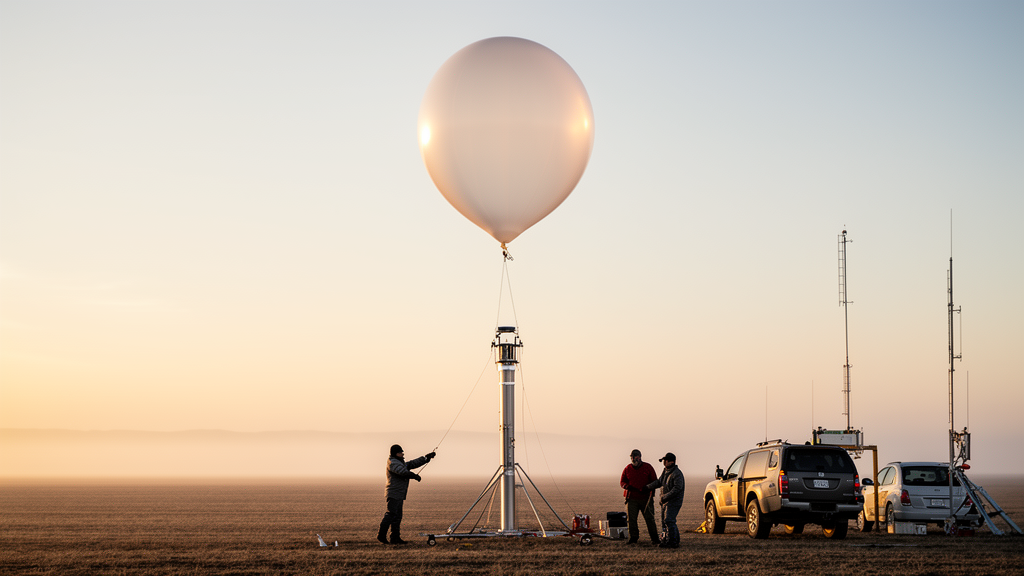
High above our heads, in the layered realm of the stratosphere, two climate-relevant gases are quietly being destroyed by sunlight and reactive chemistry. Carbonyl sulfide, the most abundant sulfur-bearing gas in the atmosphere, and methane, the second most important anthropogenic greenhouse gas after carbon dioxide, both rely on the stratosphere as a major sink. Yet precisely how fast these gases are removed there has remained stubbornly uncertain, because direct, high-resolution measurements of their vertical distributions in the lower stratosphere are remarkably sparse. A new study published in Atmospheric Chemistry and Physics by Alessandro Zanchetta of the University of Groningen and colleagues now delivers some of the tightest observational constraints to date, using a deceptively simple sampling technology that rides aloft on weather balloons.
The team deployed AirCore samplers during three Northern Hemisphere summer campaigns at sites spanning a wide latitudinal range: Trainou in France at roughly 48 degrees north, and the polar-latitude stations of Kiruna in Sweden and Sodankylä in Finland, both near 67 degrees north. An AirCore is essentially a long coil of stainless-steel tubing, internally coated with a passivating layer to prevent the tube from chemically altering the air it captures. Launched beneath a stratospheric balloon, the device fills passively during descent as the ambient pressure gradient pushes air through the tube. Because radiosondes record pressure and temperature throughout the flight, analysts can calculate exactly how many moles of air entered the tube during any interval, allowing each aliquot of gas to be mapped back to the altitude at which it was sampled. The result is a continuous vertical profile of atmospheric composition, offering far finer vertical resolution than satellite remote sensing can typically achieve.
Once recovered, the samples were analyzed immediately on a dual-laser Quantum Cascade Laser Spectrometer, a mid-infrared absorption instrument capable of measuring carbonyl sulfide, methane, nitrous oxide, carbon dioxide, carbon monoxide and ozone simultaneously from a single air sample. This combination proved crucial, because the entire lifetime analysis hinges on comparing the stratospheric behavior of carbonyl sulfide and methane against nitrous oxide, a long-lived tracer of tropospheric origin whose own stratospheric lifetime is comparatively well constrained at around 116 plus or minus 9 years. The researchers also drew on version 5.3 data from the Atmospheric Chemistry Experiment Fourier Transform Spectrometer, a satellite instrument that retrieves vertical profiles using solar occultation, selecting summer observations between 45 and 49 degrees north for comparison with Trainou and between 65 and 69 degrees north for the polar sites. Obtaining consistent answers from two such different observational methodologies, the authors argue, provides strong evidence for the reliability of both.
The analytical framework rests on tracer-tracer correlation theory first formalized by Plumb and Ko in 1992. In the lower stratosphere, long-lived gases destroyed by similar chemistry display tight, approximately linear relationships with one another when their mole fractions are plotted against each other. The slope of this relationship, combined with the ratio of the gases’ tropospheric burdens and the known lifetime of the reference gas, yields the stratospheric lifetime of the target species. The team applied this classic method alongside a more comprehensive refinement by Volk and colleagues from 1997, which accounts for non-diffusive mixing between the tropics and mid-latitudes by extrapolating the correlation slope to the extratropical tropopause and using globally integrated atmospheric burdens rather than simple tropospheric averages. For the burden estimates, the authors followed the approach of Andrews and colleagues, averaging twelve-month running means of surface observations from Mauna Loa and American Samoa, delayed by two months to reflect transport to the stratosphere.
Careful data curation proved essential. Just above the thermal tropopause, the correlations between carbonyl sulfide and nitrous oxide, and between methane and nitrous oxide, bent away from linearity, likely reflecting the mixing of seasonally varying tropospheric air into the lowermost stratosphere. Including this region would have biased the regressions, so the team restricted their analysis to nitrous oxide mole fractions below roughly 295 to 300 parts per billion, depending on the campaign year. Curvatures at higher altitudes, where different stratospheric chemistry alters the source-sink balance differently for each gas, further limited the usable range to altitudes up to about 20 to 22 kilometers. One flight, designated KRN-a, was flagged as an outlier for carbonyl sulfide after showing anomalously low mole fractions between 17 and 20 kilometers, possibly due to instrument instability or contamination, while another flight had to be excluded entirely because data selection left only a single usable point.
The headline results are strikingly consistent. Using the Plumb and Ko method, the stratospheric lifetime of carbonyl sulfide came out between 69 and 90 years, with an overall average of 76 plus or minus 6 years, corresponding to a stratospheric sink of roughly 37 plus or minus 3 gigagrams of sulfur per year. The Volk method produced an overlapping range of 71 to 83 years and a sink of 35 plus or minus 3 gigagrams of sulfur per year. For methane, the Plumb and Ko approach yielded lifetimes between 153 and 166 years, while the Volk method gave 149 to 162 years, translating into stratospheric sinks of approximately 24 to 27 teragrams of carbon per year. These figures sit comfortably within the ranges reported by earlier studies, which span 39 to 76 years for carbonyl sulfide and 152 to 160 years for methane, and they agree closely with independent estimates derived from ACE-FTS satellite observations, which suggested 75 to 76 years for carbonyl sulfide and 146 to 172 years for methane.
Perhaps the most consequential finding is what the data do not show: no significant long-term trend in the stratospheric removal of either gas, despite clear trends in their tropospheric abundances. Nitrous oxide and methane rose steadily across the sampling years, from 332.0 to 336.8 parts per billion and from 1844.6 to 1899.2 parts per billion respectively between 2019 and 2023, while carbonyl sulfide declined from 490 to 479 parts per billion between 2019 and 2021 before recovering to 487 parts per billion by 2023. This decline in the carbonyl sulfide burden, confirmed by other recent observational records between 2016 and 2020, contrasts with the continued growth of the other two gases and slightly reduces the estimated carbonyl sulfide sink relative to some earlier studies. The authors also note that lifetime estimates differed subtly with latitude, with carbonyl sulfide lifetimes running slightly longer at polar latitudes and methane lifetimes slightly shorter, though in neither case did the differences reach statistical significance.
The study also exposed genuine atmospheric variability that remains poorly understood. Tracer-tracer correlations varied from flight to flight, and even within the same campaign, pointing to day-to-day changes in the composition of the lower stratosphere. To investigate whether these differences reflected sampling location rather than measurement error, the team computed equivalent latitudes from ERA5 potential vorticity fields, a coordinate that captures the transport history of air parcels more faithfully than geographic latitude. The analysis revealed that most sampled air had mid-latitude origins, even over the polar sites, and that the balloon profiles captured localized, latitudinally dependent air masses that zonally averaged satellite data cannot fully resolve. This may partly explain why methane lifetime estimates from the Volk method diverged somewhat between the two observational platforms, though the discrepancies were not statistically significant.
Beyond the specific numbers, the work carries broader implications for how the atmospheric science community constrains trace-gas budgets. The authors found that when they recalculated the lifetimes reported by previous studies using standardized tropospheric burdens, the revised estimates shifted but never significantly departed from the original values, underscoring how sensitive these calculations are to methodological choices about burden definitions, regression altitude ranges and reference tracers. Earlier investigations used everything from cryogenic whole-air samplers to balloon-borne spectrometers and ground-based Fourier transform instruments, and some sampled only the lowest few kilometers of the stratosphere, where tropospheric mixing can corrupt the correlations. Given these inconsistencies, the team advocates for a more standardized methodology across the field. What is already clear, however, is that a modest coil of steel tubing dangling beneath a balloon, paired with laser spectroscopy on the ground, can now deliver stratospheric lifetime estimates rivaling those from orbiting satellites, offering an affordable and repeatable tool for monitoring how the upper atmosphere processes the gases that shape our climate.
Subject of Research: Observational estimates of stratospheric lifetimes and sinks of carbonyl sulfide and methane from balloon-borne AirCore vertical profiles
Article Title: Consistent estimates of carbonyl sulfide and methane stratospheric lifetimes retrieved from AirCore profiles at different latitudes
Article References: Zanchetta, A., van Heuven, S., Kivi, R., Ramonet, M., Engel, A., Krol, M., & Chen, H. (2026). Consistent estimates of carbonyl sulfide and methane stratospheric lifetimes retrieved from AirCore profiles at different latitudes. Atmospheric Chemistry and Physics, 26(19), 13909-13927. https://doi.org/10.5194/acp-26-13909-2026
Image Credits: AI Generated
DOI: 10.5194/acp-26-13909-2026
Keywords: carbonyl sulfide, methane, stratosphere, AirCore, atmospheric lifetime, nitrous oxide, tracer-tracer correlations, ACE-FTS, balloon sounding, greenhouse gases, stratospheric sink, atmospheric chemistry
Cite Scienmag News
Bethany Barker. (October 9, 2026). Balloon-Borne AirCore Soundings Pin Down Stratospheric Lifetimes of Carbonyl Sulfide and Methane. Scienmag. https://scienmag.com/balloon-borne-aircore-soundings-pin-down-stratospheric-lifetimes-of-carbonyl-sulfide-and-methane/
Bethany Barker. "Balloon-Borne AirCore Soundings Pin Down Stratospheric Lifetimes of Carbonyl Sulfide and Methane." Scienmag, 9 October 2026, https://scienmag.com/balloon-borne-aircore-soundings-pin-down-stratospheric-lifetimes-of-carbonyl-sulfide-and-methane/. Accessed 9 October 2026.
Bethany Barker. "Balloon-Borne AirCore Soundings Pin Down Stratospheric Lifetimes of Carbonyl Sulfide and Methane." Scienmag. October 9, 2026. https://scienmag.com/balloon-borne-aircore-soundings-pin-down-stratospheric-lifetimes-of-carbonyl-sulfide-and-methane/


