


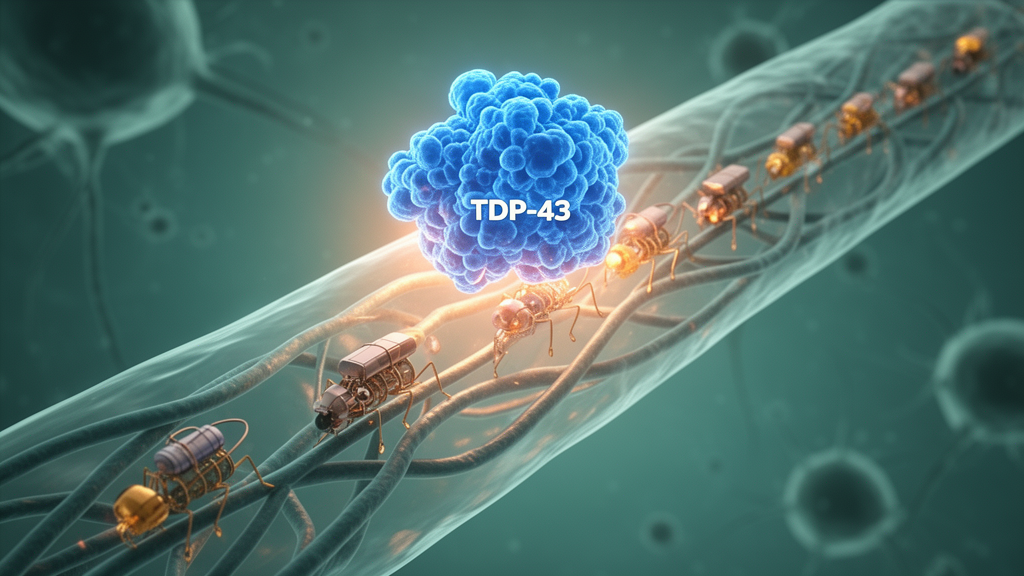
In nearly every case of amyotrophic lateral sclerosis, or ALS, a single protein goes catastrophically wrong. TAR DNA-binding protein 43, better known as TDP-43, vanishes from the nucleus where it normally orchestrates RNA processing and piles up instead in the cytoplasm as clumps that poison neurons. Now a team working with human neurons has mapped, in unprecedented molecular detail, how the healthy version of this protein travels down the long, slender axons that die first in the disease, and the answer is more complicated, and more elegant, than anyone expected. Rather than relying on one delivery vehicle, TDP-43 appears to commandeer an entire fleet of molecular motors, a redundancy that may explain how neurons keep their distant synapses supplied with the genetic instructions they need to survive.
The study, led by Monica Feole and Gorazd B. Stokin and published in Acta Neuropathologica, used human neurons derived from the H9 embryonic stem cell line, cultured for forty days until they developed mature axons. The researchers tagged TDP-43 with green fluorescent protein and filmed it under a high-resolution confocal microscope at four frames per second, capturing sixty-second movies of the protein’s movements inside living axons. To interpret what they saw, they compared TDP-43 against three well-characterized axonal cargoes with known transport behaviors: Rab5, an endosomal protein that mostly travels backward toward the cell body; synaptophysin, a synaptic vesicle protein that races forward to nerve terminals; and amyloid precursor protein, or APP, which moves in both directions with a slight forward bias.
The first surprise came from the directionality data. Using semi-automated particle tracking software, the team found that TDP-43 exhibited balanced bidirectional transport, with roughly equal proportions of particles heading toward the synaptic terminal and back toward the soma. This contrasts sharply with the reference cargoes, which showed their canonical patterns: Rab5 was predominantly retrograde, consistent with its role in endosomal recycling, while synaptophysin displayed a strong anterograde bias reflecting its kinesin-driven delivery to synapses. The balanced profile of TDP-43 suggests that its granules deliver messenger RNA to multiple axonal regions rather than a single destination, consistent with the protein’s role in maintaining RNA homeostasis throughout the neuron’s longest compartment.
Direction alone, however, tells only part of the story. The researchers employed a segmental analysis approach that divides each trajectory into vectorial segments, allowing frame-by-frame examination of velocity, pausing behavior, and directional reversals. This revealed that TDP-43 is a fast cargo. It spent significantly more time in anterograde motion than Rab5, paused less often, and reversed direction more frequently, all characteristics that align it with the fast-moving vesicular proteins synaptophysin and APP rather than the slower, pause-prone Rab5. Its total track lengths were comparable to synaptophysin and Rab5 but shorter than APP, which traveled the widest range of distances, hinting that TDP-43 granules may be heterogeneous in composition or in the motors they recruit.
Velocity distributions provided an even sharper clue about the underlying machinery. When the team plotted the speeds of anterograde segments, TDP-43’s velocities almost completely overlapped with those of APP, suggesting that both cargoes may share kinesin-dependent, plus-end-directed transport mechanisms. In the retrograde direction, by contrast, TDP-43’s velocities differed significantly from all three reference cargoes, implying that although the dynein-dynactin complex broadly mediates backward transport, its processivity is tuned in a cargo-specific manner, perhaps through unique adaptor proteins or post-translational modifications on membraneless ribonucleoprotein granules. Correlation analysis further showed that for TDP-43, longer runs correlated with higher speeds in both directions, a hallmark of processive motor engagement, with no significant difference in coupling strength between anterograde and retrograde movement.
To identify the actual molecular motors, the team turned to biochemistry. Co-immunoprecipitation experiments in the mature human neurons revealed that TDP-43 physically associates with kinesin light chain 1, or KLC1, the adaptor that links cargoes to the kinesin-1 family of anterograde motors, and with dynactin 1, a core component of the retrograde dynein complex. Notably, TDP-43’s binding to KLC1 was more robust than its binding to dynactin 1, a preference consistent with the strong anterograde characteristics observed in the live imaging. Reciprocal pulldowns confirmed the interactions: pulling down KLC1 brought along TDP-43 and the expected kinesin-5B partner, while pulling down dynactin 1 co-purified TDP-43 together with dynein intermediate chain 1.
The most striking result came from proximity ligation assays, a technique that detects proteins lying within forty nanometers of each other in their native environment. When the researchers knocked down KLC1 using short hairpin RNA delivered by lentiviral vectors, the TDP-43–KLC1 proximity signal in axons dropped dramatically, validating the specificity of the interaction. Then, using isoform-specific antibodies, they discovered that TDP-43 associates with all three mammalian kinesin-1 heavy chain isoforms: KIF5A, KIF5B, and KIF5C. This is significant because KIF5B is ubiquitously expressed while KIF5A and KIF5C are neuron-specific, and KIF5A is a recognized genetic cause of ALS. The engagement with all three isoforms suggests a flexible, redundant transport system in which distinct motor combinations could deliver different mRNA payloads to different axonal subdomains.
There was one more motor in the fleet. Because TDP-43’s anterograde dynamics resembled those of synaptophysin, which is transported by the kinesin-3 family member KIF1A, the team tested whether TDP-43 also engages this rapid synaptic vesicle motor. Co-immunoprecipitation in both directions confirmed the interaction, and proximity ligation assays placed TDP-43 and KIF1A within nanometers of each other along neuronal projections. The picture that emerges is of a multi-motor system: KIF1A may shuttle selected TDP-43 granules rapidly over long distances to distal synaptic terminals, while the kinesin-1 isoforms support more regulated delivery to intermediate axonal regions. Alternatively, distinct populations of TDP-43 granules, defined by their mRNA cargo or phase-separation properties, may preferentially recruit different motors.
Why does this matter for disease? In ALS, where TDP-43 accumulates abnormally in the cytoplasm, this flexible transport system may become compromised in multiple ways simultaneously. Pathological aggregates could sequester motor proteins or adaptor molecules, disrupting the delivery of mRNAs needed for local translation at synapses, including transcripts for cytoskeletal proteins, synaptic components, and nuclear-encoded mitochondrial proteins. Mutations in TARDBP and C9orf72 repeat expansions have already been linked to impaired mRNA trafficking, and mutations affecting the dynein-dynactin complex are associated with motor neuron disorders. The multi-motor redundancy documented in this study might normally provide resilience, allowing partial compensation when one pathway fails, but combined insults to cytoskeletal integrity, mitochondrial function, and RNA granule homeostasis could eventually overwhelm the system, driving the distal axonal degeneration that characterizes the dying-back model of ALS.
The findings also raise fundamental questions about how transport works without membranes. Classical models of axonal transport were built largely from studies of membrane-bound vesicles, where transmembrane proteins serve as docking sites for motor-adaptor complexes. TDP-43 travels in membraneless organelles, condensates of RNA and protein with no lipid bilayer, yet it clearly engages the same motor machinery. How motors recognize and bind these condensates, whether specific RNA sequences or RNA-binding protein motifs serve as adaptor recruitment sites, and whether the biophysical state of the condensates regulates motor engagement are all open questions. Previous work showed that some RNA granules hitchhike on lysosomes or mitochondria; this study demonstrates that TDP-43 can also associate directly with motors, suggesting both mechanisms may operate in parallel. By establishing a physiological baseline in human neurons, the work provides the framework against which ALS-linked mutations and patient-derived models can now be measured, and it points to axonal TDP-43 transport pathways as promising therapeutic targets for a disease that urgently needs them.
Subject of Research: Axonal transport mechanisms of the RNA-binding protein TDP-43 in human neurons and their relevance to ALS
Article Title: Multiple motor proteins regulate TDP-43 anterograde axonal transport
Article References: Feole, M., Devoto, V. M. P., Dragišić, N., Čarna, M., Klosterman, K., Limbaek-Stokin, C., Forte, G., Moya, K. L., Smith, R. A., Svendsen, C. N., & Stokin, G. B. (2026). Multiple motor proteins regulate TDP-43 anterograde axonal transport. Acta Neuropathologica, 152(1), Article 47. https://doi.org/10.1007/s00401-026-03071-w
Image Credits: AI Generated
DOI: 10.1007/s00401-026-03071-w
Keywords: TDP-43, axonal transport, amyotrophic lateral sclerosis, kinesin, KIF5A, KIF1A, KLC1, dynein, RNA-binding proteins, motor proteins, human neurons, neurodegeneration
Cite Scienmag News
Diana Fleming. (October 9, 2026). TDP-43 Rides Multiple Molecular Motors Along Human Axons, Study Reveals. Scienmag. https://scienmag.com/tdp-43-rides-multiple-molecular-motors-along-human-axons-study-reveals/
Diana Fleming. "TDP-43 Rides Multiple Molecular Motors Along Human Axons, Study Reveals." Scienmag, 9 October 2026, https://scienmag.com/tdp-43-rides-multiple-molecular-motors-along-human-axons-study-reveals/. Accessed 9 October 2026.
Diana Fleming. "TDP-43 Rides Multiple Molecular Motors Along Human Axons, Study Reveals." Scienmag. October 9, 2026. https://scienmag.com/tdp-43-rides-multiple-molecular-motors-along-human-axons-study-reveals/


