


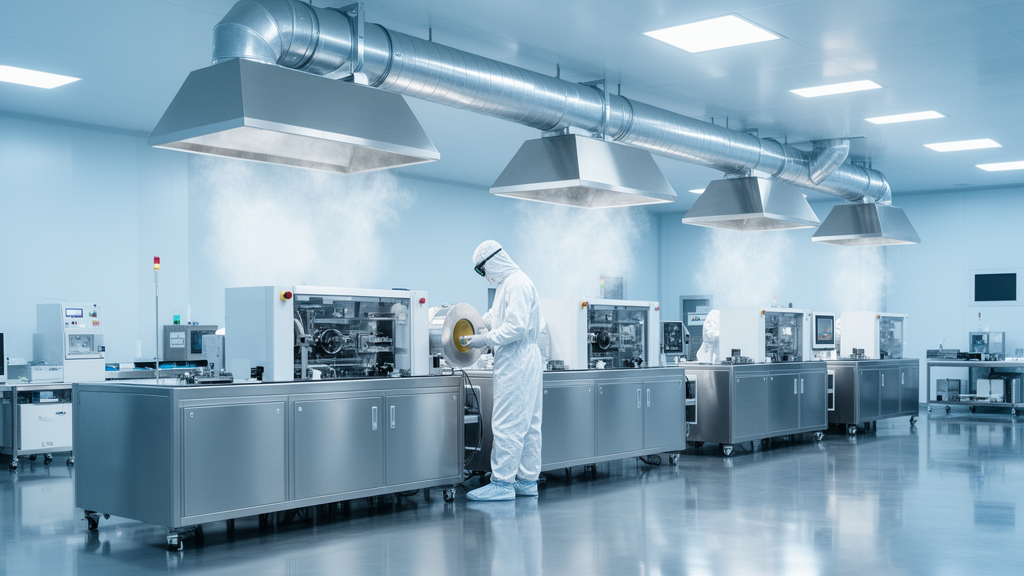
Deep inside the failure-analysis laboratories where engineers dissect defective silicon wafers, a quiet but persistent health question has been growing. Every time a technician manually cuts a wafer to isolate a faulty circuit, the process releases fine particulate matter and volatile organic compounds into the surrounding air. A new study published in Air Quality, Atmosphere & Health by Yongsoon Park and colleagues from Hankyong National University and SK hynix offers one of the most detailed looks yet at what workers in these labs actually breathe, and how a redesigned workbench can change the airflow physics that determine whether contaminants drift toward their faces or get swept away.
Failure analysis is an essential step in semiconductor manufacturing. When a chip fails quality control, engineers must physically section the wafer to locate the defect, often using manual cutting tools at a workbench. Unlike the highly automated cleanrooms that dominate public perceptions of chip fabrication, these analysis stations involve close human contact with the workpiece. The cutting action abrades silicon, resins, and patterned layers, generating airborne dust, while any organic materials in the wafer stack can release volatile compounds. Because operators lean over the bench for extended periods, their breathing zone sits directly above the emission source, making the geometry of airflow around the bench a matter of occupational health.
The research team combined direct field measurements with computational fluid dynamics, or CFD, to characterize exposure conditions during real wafer-cutting operations. They measured total volatile organic compound concentrations during both bare-wafer and patterned-wafer cutting. The results revealed a striking difference: cutting patterned wafers, which carry processed circuit layers, produced TVOC concentrations of 0.12 to 0.15 milligrams per cubic meter, roughly five times higher than the 0.02 to 0.03 milligrams per cubic meter observed when cutting bare silicon. The patterned layers, which include organic resins and dielectric materials, clearly contribute additional chemical emissions that bare wafers do not.
Particulate matter measurements completed the exposure picture, capturing the dust generated as cutting tools grind through the wafer structure. But the researchers recognized that concentration numbers alone tell only half the story. What ultimately determines inhalation exposure is not just how much contaminant is released, but where the air carries it. A plume of dust that rises from the cutting point and drifts toward the operator’s face poses a far greater risk than the same plume drawn immediately into an exhaust duct. That insight drove the team to examine the airflow field itself, using both experimental velocity measurements and steady-state CFD simulations to map how air moved across the workbench.
The centerpiece of the study was the evaluation of a hybrid containment workbench, or HCW, a modified local exhaust ventilation system designed to redirect contaminant-laden air away from the worker. The CFD simulations predicted air velocities that matched experimentally measured values with relative errors ranging from 5.3 to 18.2 percent, a level of agreement that gives the modeling approach real credibility for engineering design work. In industrial ventilation, where small changes in flow direction can determine whether a contaminant reaches the breathing zone, validating simulations against physical measurements is essential, and this study did so systematically.
The airflow analysis showed that the HCW produced a flow directed toward the rear exhaust system, and that recirculation near the worker’s breathing zone was reduced compared with the original configuration. Recirculation zones are the hidden villains of ventilation design: they trap contaminants in slow-moving eddies that can linger near the operator, allowing dust and vapors to accumulate in exactly the region where the worker inhales. By suppressing these recirculating patterns and establishing a coherent sweep toward the exhaust, the redesigned bench created airflow conditions that the authors describe as potentially reducing contaminant movement toward the operator.
To confirm that the simulations reflected physical reality, the team performed qualitative smoke visualization experiments at the workbench. Tracer smoke released at the cutting area followed the same trajectories predicted by the CFD model, streaming toward the rear exhaust rather than pooling around the operator. This convergence of quantitative simulation, measured air velocities, and visual flow tracing provides a three-way verification that is often missing from ventilation assessments, which frequently rely on a single method. It also demonstrates a practical workflow that other semiconductor facilities could adopt: model the airflow, validate with anemometer measurements, and confirm with smoke tests before committing to hardware changes.
The human element of the study came from anonymous worker questionnaires administered before and after the HCW installation. Before the new workbench, 84.2 percent of the surveyed workers, sixteen out of nineteen, reported perceiving process odors during wafer cutting. After the HCW was implemented, worker-rated odor and dust control scores improved, indicating that the operators themselves noticed the difference in their working environment. While subjective perceptions are not a substitute for concentration measurements, they capture the lived experience of exposure, including irritation and discomfort that instruments may miss, and the near-universal odor reporting before the intervention underscores how noticeable the emissions were to the people closest to the work.
Perhaps the most important message of the study is methodological. The authors argue that local airflow should be evaluated together with contaminant concentrations when assessing worker exposure and local exhaust ventilation in semiconductor failure-analysis laboratories. A bench can achieve acceptable average concentration readings while still allowing intermittent contaminant excursions into the breathing zone, particularly during the dynamic, short-duration emissions that manual cutting produces. Time-weighted averages can smooth away these fluctuations, which is why understanding the instantaneous flow field, where eddies form, and which paths contaminants take, adds a layer of protection that concentration monitoring alone cannot provide. The combination of CFD, field measurement, and worker feedback offers a template for a more complete exposure assessment.
The findings arrive at a moment when the semiconductor industry is expanding rapidly and scrutiny of occupational health in high-tech manufacturing is intensifying. Failure-analysis labs are smaller and less automated than fabrication cleanrooms, and their ventilation challenges have received comparatively little attention. This study shows that relatively contained engineering interventions, a redesigned workbench with properly directed exhaust, can meaningfully alter the airflow landscape that governs what workers breathe. For an industry built on controlling contamination at the nanometer scale to protect its products, the study is a reminder that the same precision, applied to protecting the people who dissect failed chips, is both achievable and measurable, one airflow streamline at a time.
Subject of Research: Occupational exposure to particulate matter and volatile organic compounds during semiconductor wafer cutting and the evaluation of local exhaust ventilation using field measurements and computational fluid dynamics
Article Title: Worker exposure to particulate matter and volatile organic compounds during semiconductor failure analysis: assessment of local exhaust ventilation using field measurements and computational fluid dynamics
Article References: Park, Y., Choung, M.-H., Oh, J.-S., Roh, H.-S., & Kang, C. (2026). Worker exposure to particulate matter and volatile organic compounds during semiconductor failure analysis: assessment of local exhaust ventilation using field measurements and computational fluid dynamics. Air Quality, Atmosphere & Health, 19(10), Article 229. https://doi.org/10.1007/s11869-026-02123-0
Image Credits: AI Generated
DOI: 10.1007/s11869-026-02123-0
Keywords: semiconductor failure analysis, worker exposure, particulate matter, volatile organic compounds, local exhaust ventilation, computational fluid dynamics, wafer cutting, hybrid containment workbench, occupational health, airflow simulation, smoke visualization, indoor air quality
Cite Scienmag News
Audrey Campbell. (October 9, 2026). Inside the Chip Labs: New Ventilation Design Cuts Worker Exposure to Cutting Dust and Fumes. Scienmag. https://scienmag.com/inside-the-chip-labs-new-ventilation-design-cuts-worker-exposure-to-cutting-dust-and-fumes/
Audrey Campbell. "Inside the Chip Labs: New Ventilation Design Cuts Worker Exposure to Cutting Dust and Fumes." Scienmag, 9 October 2026, https://scienmag.com/inside-the-chip-labs-new-ventilation-design-cuts-worker-exposure-to-cutting-dust-and-fumes/. Accessed 9 October 2026.
Audrey Campbell. "Inside the Chip Labs: New Ventilation Design Cuts Worker Exposure to Cutting Dust and Fumes." Scienmag. October 9, 2026. https://scienmag.com/inside-the-chip-labs-new-ventilation-design-cuts-worker-exposure-to-cutting-dust-and-fumes/


