


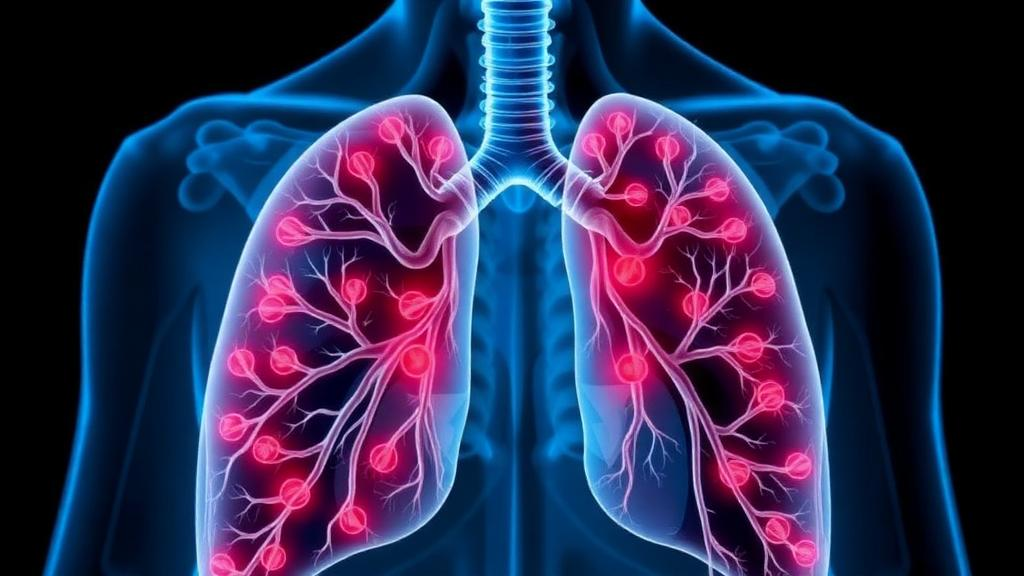
People living with HIV face a higher risk of many cancers that are not classically classified as AIDS-defining, and non-small cell lung cancer (NSCLC) sits prominently among them. For decades, the leading explanations centered on higher smoking prevalence, chronic inflammation, and co-infection with oncogenic viruses. A recent study by Abbar and colleagues, highlighted in a letter to the editor published in the Journal of Translational Medicine by Yang and colleagues at the Affiliated Traditional Chinese Medicine Hospital of Southwest Medical University, now points to a far more specific and unsettling mechanism: HIV appears to strip the immune system of its ability to recognize tumor neoepitopes, the mutant protein fragments that normally mark cancer cells for destruction, without altering the tumor’s mutational profile at all.
The technical core of the original study rests on a multi-omics comparison of tumors from people living with HIV and comparable tumors from HIV-negative patients. The researchers integrated whole-exome sequencing, which catalogs the full repertoire of coding mutations in a tumor, with RNA sequencing, which reveals which of those mutated genes are actually transcribed, and paired both with detailed immune profiling of the tumor microenvironment. If HIV had acted as a viral hypermutator, driving oncogenesis by flooding the genome with mutations, the tumors from people living with HIV should have shown elevated tumor mutational burden and a distorted antigenic landscape. They did not. Mutational burden and antigen presentation machinery appeared broadly intact, yet the immune response to those antigens was profoundly blunted.
This dissociation is what makes the finding paradigm-shifting, as Yang and colleagues emphasize in their letter. Historically, excess cancer risk in people living with HIV has been attributed to generalized immunosuppression or to co-infections with viruses such as human papillomavirus or Epstein-Barr virus. The new data pivot the explanatory model toward a HIV-mediated bystander effect on antitumor immunity: the virus does not create the cancer’s mutations, but it disables the surveillance system that would otherwise detect and eliminate cells bearing them. In immunological terms, the target list remains written, but the readers assigned to act on it have been depleted, exhausted, or functionally silenced.
The immune profiling in the study described a recognizable signature of chronic dysfunction. T cells from patients carried elevated levels of the inhibitory receptors PD-1 and TIM-3, hallmarks of the exhausted state that develops when lymphocytes are chronically stimulated and progressively lose effector function. Alongside this T-cell exhaustion, the natural killer cell repertoire appeared depleted, weakening the innate arm of antitumor surveillance that normally complements cytotoxic T lymphocytes. Together, these defects mean that even when a tumor presents perfectly recognizable neoantigens on its surface, the cellular machinery required to mount a response against them is compromised at multiple levels.
The clinical implications are immediate and consequential for the roughly 38 million people living with HIV worldwide. Immune checkpoint inhibitors, the antibodies that block PD-1, PD-L1, or CTLA-4, have transformed outcomes in NSCLC for the general population, and the exhaustion phenotype documented in this study provides a strong rationale for using them in people living with HIV, particularly as next-generation agents targeting TIM-3 and LAG-3 advance through clinical development. Blocking inhibitory pathways is precisely the intervention that an exhausted T-cell state would seem to call for, and early clinical experience with checkpoint inhibitors in people living with HIV has generally shown acceptable safety.
Yet the letter’s authors argue that checkpoint blockade alone may not be enough. If the fundamental defect lies in the initial recognition and priming of neoantigen-specific responses, then releasing the brakes on T cells that were never adequately activated in the first place may produce only partial reinvigoration. This could explain the heterogeneous clinical responses to checkpoint inhibitors observed among people living with HIV who develop cancer, a variability that likely stems from deeper HIV-related immune dysfunction than the exhaustion markers alone suggest. In a significant subset of patients, the problem may not be an overactive brake but a missing engine.
That reasoning pushes the therapeutic conversation toward combination strategies that actively induce de novo immune responses rather than merely removing suppression. Personalized cancer vaccines built from validated neoepitopes identified by tumor sequencing could supply the priming signal that the endogenous immune system failed to generate, presenting mutant peptides in an immunogenic format that bypasses the defective antigen-presentation step. Adoptive cell therapies, in which T cells are engineered ex vivo to recognize specific tumor antigens and expanded to large numbers before infusion, offer a parallel route around the recognition deficit, effectively outsourcing the surveillance function that HIV has compromised. Both approaches are already advancing in solid tumors more broadly, and the new findings give them a specific rationale in this population.
The letter also frames a set of pressing open questions that will shape the next phase of research. The first concerns mechanism: is the failure of neoepitope recognition due to the physical loss of specific T-cell clones from the repertoire, a generalized defect in antigen presentation potentially mediated by HIV-associated dysfunction of dendritic cells, or some combination of the two? The authors propose that single-cell T-cell receptor sequencing coupled with epitope mapping, performed on both blood and tumor tissue, could resolve the clonal architecture and specificity of whatever residual response remains, distinguishing a hole in the repertoire from a failure of activation.
A second question concerns the reversibility of the defect under long-term suppressive antiretroviral therapy. Modern antiretroviral regimens can drive viral loads to undetectable levels and allow substantial CD4 T-cell recovery, yet it remains unknown whether antitumor immune surveillance is restored in parallel or whether the neoantigen-recognition deficit persists as a scar of chronic infection. Longitudinal studies that track neoantigen-specific immune responses in patients on antiretroviral therapy, ideally before and after a cancer diagnosis and informed by emerging immune monitoring guidelines for this population, would directly address whether the damage is reversible and at what stage intervention is most effective.
Finally, the generalizability of the mechanism extends well beyond lung cancer. If HIV impairs immunosurveillance of tumor neoepitopes as a general principle, then other solid malignancies that are disproportionately prevalent among people living with HIV, such as anal and cervical carcinomas, may be shaped by the same deficit. Confirming or refuting that broader pattern will determine whether the therapeutic recalibration proposed in the letter represents a niche adjustment for NSCLC or a foundational shift in how cancer immunotherapy is designed for the entire population of people living with HIV. Either way, the work of Abbar and colleagues, as distilled by Yang and colleagues, delineates a novel and specific immune deficit that transcends any single tumor type, and it issues a clear imperative: next-generation immunotherapies for this population must rebuild immune recognition, not merely unleash it.
Subject of Research: HIV-induced impairment of neoantigen immune recognition in non-small cell lung cancer and its implications for immunotherapy
Article Title: HIV-induced neoantigen immunodeficiency: a novel mechanism of immune evasion in non-small cell lung cancer and implications for next-generation immunotherapies
Article References: Yang, D., Yang, L., Yang, J., & Wang, G. (2026). HIV-induced neoantigen immunodeficiency: a novel mechanism of immune evasion in non-small cell lung cancer and implications for next-generation immunotherapies. Journal of Translational Medicine, 24(1), Article 1162. https://doi.org/10.1186/s12967-026-08578-0
Image Credits: AI Generated
DOI: 10.1186/s12967-026-08578-0
Keywords: HIV, non-small cell lung cancer, neoantigens, immune evasion, immune checkpoint inhibitors, T-cell exhaustion, cancer immunotherapy, tumor mutational burden, antiretroviral therapy, personalized cancer vaccines, adoptive cell therapy, people living with HIV
Cite Scienmag News
Nathaniel Bowman. (October 5, 2026). HIV Blinds the Immune System to Lung Cancer Mutations, Study Suggests. Scienmag. https://scienmag.com/hiv-blinds-the-immune-system-to-lung-cancer-mutations-study-suggests/
Nathaniel Bowman. "HIV Blinds the Immune System to Lung Cancer Mutations, Study Suggests." Scienmag, 5 October 2026, https://scienmag.com/hiv-blinds-the-immune-system-to-lung-cancer-mutations-study-suggests/. Accessed 5 October 2026.
Nathaniel Bowman. "HIV Blinds the Immune System to Lung Cancer Mutations, Study Suggests." Scienmag. October 5, 2026. https://scienmag.com/hiv-blinds-the-immune-system-to-lung-cancer-mutations-study-suggests/


