


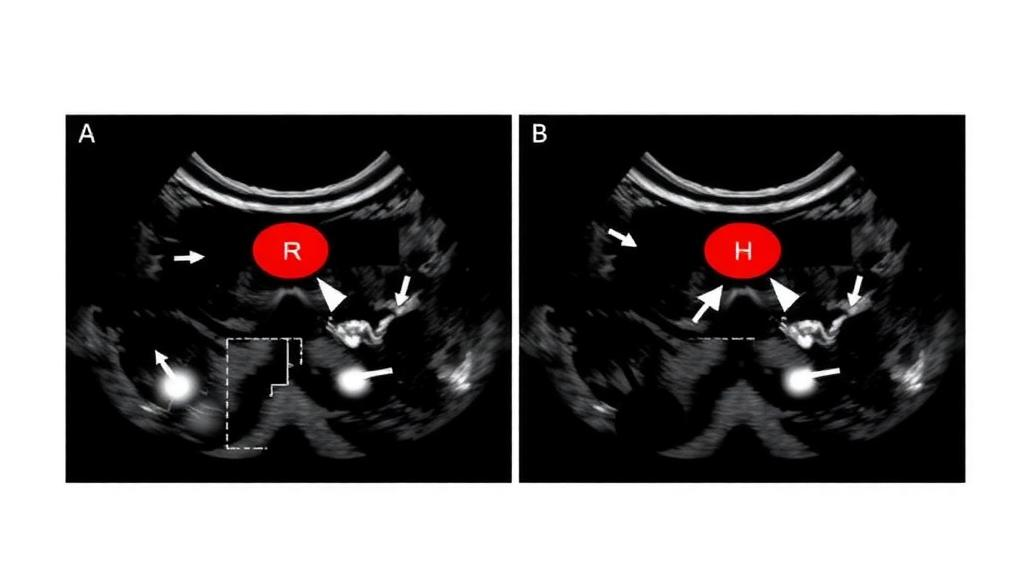
Papillary thyroid carcinoma has become one of the most commonly diagnosed cancers in the world, and a striking share of those diagnoses involve tumors so small that many guidelines now consider them safe to leave untreated. The strategy, known as active surveillance, asks patients to forgo immediate surgery in favor of regular ultrasound monitoring. The approach spares thousands of people the lifelong consequences of thyroid removal, from daily hormone replacement to the small but real risks of nerve injury and parathyroid damage. Yet the strategy carries an uncomfortable blind spot: surgeons and endocrinologists cannot directly see whether cancer cells have already slipped into the lymph nodes of the central neck, the most common first destination of thyroid cancer spread. A new study published in BMC Cancer reports that a deep learning system can make that invisible risk visible, reading routine ultrasound images to predict which surveillance-eligible patients harbor occult central lymph node metastasis.
The research, led by Yingying Li and Yukun Luo of the Department of Ultrasound at Chinese PLA General Hospital in Beijing, together with collaborators at the School of Artificial Intelligence at Beijing University of Posts and Telecommunications, describes a two-stage, two-path deep learning network the authors call TTN. The team assembled ultrasound data from 1,016 patients with papillary thyroid carcinomas who met established criteria for active surveillance, yielding 2,032 images from their own institution. Crucially, they also secured an independent external test set of 200 images from 100 patients at a second hospital, a step that matters enormously in machine learning research because models that merely memorize the quirks of one scanner or one hospital’s imaging protocols can look brilliant internally and fail catastrophically elsewhere. Whether a patient actually had central cervical lymph node metastasis was confirmed by pathological examination, giving the algorithm a ground truth that no imaging-based label could provide.
The architecture of TTN reflects a deliberate answer to two distinct technical problems. The first stage is built on U²-Net, a nested encoder-decoder network originally designed for salient object detection, which performs automated segmentation of the thyroid nodule. Segmentation is the unglamorous but essential first step in any image-based diagnostic pipeline: the network must draw a precise boundary around the region of interest, the suspicious nodule itself, so that the downstream classifier examines the right tissue rather than background parenchyma or artifacts. Automated segmentation also removes a major source of variability in clinical practice, since manually drawn regions of interest differ from one sonographer to the next and can bias a model toward features that have nothing to do with biology.
The second stage is where the prediction happens. TTN runs parallel ResNet pathways, one processing the transverse ultrasound view and the other the longitudinal view, and then fuses those image-derived features with clinical and ultrasonographic variables. This two-path design acknowledges a basic fact of thyroid imaging: a nodule looks different along different planes, and information that is ambiguous in one view may be decisive in the other. Residual networks, with their skip connections that allow gradients to flow through very deep stacks of layers, are well suited to extracting the subtle texture and echogenicity patterns that distinguish aggressive from indolent tumors, patterns that even experienced radiologists may register only as an ill-defined sense that a nodule looks worrisome. The authors also constructed two multi-task learning networks for comparison, architectures that attempt segmentation and classification simultaneously within a single shared network, to test whether their staged design offered a genuine advantage.
The answer, by the standard metrics of diagnostic machine learning, was yes. Trained on 90 percent of the internal dataset and tested on the remaining 10 percent, TTN achieved an area under the curve of 0.849, with a 95 percent confidence interval of 0.833 to 0.864. Its sensitivity reached 90.0 percent, meaning it correctly flagged nine out of ten patients whose pathology later confirmed lymph node spread, while specificity stood at 65 percent. The positive predictive value was 81 percent and the negative predictive value 77 percent, with an F1 score of 0.86. On the external validation cohort from the second hospital, performance dipped only modestly: an AUC of 0.823, the same 90.0 percent sensitivity, specificity of 54 percent, and an F1 score of 0.83. The model significantly outperformed both multi-task comparison networks across all evaluated metrics, with p values below 0.05.
Those numbers deserve careful reading, because they reveal both the promise and the honest limitations of the approach. The near-identical sensitivity across internal and external cohorts, 90 percent in both, is the headline finding. It suggests the network learned features of metastatic risk that generalize beyond the hospital where it was trained, which is precisely the property that separates clinically useful algorithms from statistical curiosities. The drop in specificity, from 65 percent internally to 54 percent externally, is more sobering. In practical terms, the model errs on the side of caution, and at the external site nearly half of the patients it flagged as high-risk would turn out not to have nodal spread. For a tool intended to guide decisions about surgery, that trade-off is arguably the right one: a false alarm leads to an operation that surveillance would have recommended anyway if the nodule progressed, whereas a missed metastasis could allow disease to advance silently.
The clinical stakes of that trade-off are substantial. Central neck lymph node metastasis in papillary thyroid carcinoma is common even in small tumors, and its presence changes management. Patients with confirmed or highly suspected nodal disease are generally advised to undergo surgery, including lymph node dissection, while those without may remain under surveillance for years. Today, the assessment of occult nodal involvement relies on the subjective interpretation of ultrasound features and, ultimately, on pathology after the fact. A non-invasive, automated risk estimate computed from the same ultrasound images already acquired during surveillance visits could shift the decision from a population-level rule to a personalized one, reserving surgery for patients whose imaging signature indicates hidden spread and sparing the rest the operating room.
The study also illustrates a broader trend in medical artificial intelligence: the move away from monolithic end-to-end models toward architectures that mirror clinical reasoning. By separating the task of finding the lesion from the task of judging its aggressiveness, and by explicitly incorporating both imaging planes and structured clinical features, TTN encodes a rough approximation of how a multidisciplinary team works. The comparison with multi-task networks is more than an engineering footnote. If shared representations had sufficed, the simpler architecture would have won on efficiency. The fact that the staged design prevailed suggests that segmentation quality feeds directly into prediction quality, and that forcing one network to do both jobs dilutes both.
Caveats remain, as they do for any retrospective study. The model was trained and tested on patients already deemed eligible for active surveillance at two Chinese centers, and its performance in other populations, with different ultrasound equipment, different prevalence of nodal metastasis, and different criteria for surveillance candidacy, will require further prospective validation. The authors note that the published version is an early-release article subject to final edits, and the work was supported by the National Natural Science Foundation of China. Ethical approval was obtained from the Institutional Ethics Committee of Chinese PLA General Hospital, and written informed consent was collected from all patients before surgery.
Even with those qualifications, the trajectory is clear. Ultrasound is cheap, ubiquitous, and radiation-free, which makes it the ideal substrate for AI-assisted risk stratification in thyroid disease. If tools like TTN can be validated prospectively and integrated into surveillance protocols, the decision facing a patient with a small papillary thyroid carcinoma could move from a statistical gamble to an individualized estimate, backed by a network that has learned, from thousands of images, what hidden spread looks like before anyone can see it. For the growing population of patients weighing surveillance against surgery, that kind of evidence could redefine what watchful waiting really means.
Subject of Research: Deep learning prediction of central lymph node metastasis in active surveillance-eligible papillary thyroid carcinoma using ultrasound
Article Title: Deep learning for predicting central cervical lymph node metastasis of papillary thyroid carcinomas deemed appropriate for active surveillance: a dual-center retrospective study
Article References: Li, Y., Zhang, H., Chen, D., Liu, Z., Yan, L., Li, X., Xiao, J., Yang, Z., Jing, H., Sun, B., Xie, F., Zhang, M., & Luo, Y. (2026). Deep learning for predicting central cervical lymph node metastasis of papillary thyroid carcinomas deemed appropriate for active surveillance: a dual-center retrospective study. BMC Cancer. https://doi.org/10.1186/s12885-026-17032-9
Image Credits: AI Generated
DOI: 10.1186/s12885-026-17032-9
Keywords: deep learning, papillary thyroid carcinoma, active surveillance, lymph node metastasis, ultrasound, U²-Net, ResNet, medical AI, nodule segmentation, BMC Cancer, predictive medicine, thyroid cancer
Cite Scienmag News
Nathaniel Bowman. (October 5, 2026). AI Spots Hidden Thyroid Cancer Spread From Ultrasound Scans, Dual-Center Study Shows. Scienmag. https://scienmag.com/ai-spots-hidden-thyroid-cancer-spread-from-ultrasound-scans-dual-center-study-shows/
Nathaniel Bowman. "AI Spots Hidden Thyroid Cancer Spread From Ultrasound Scans, Dual-Center Study Shows." Scienmag, 5 October 2026, https://scienmag.com/ai-spots-hidden-thyroid-cancer-spread-from-ultrasound-scans-dual-center-study-shows/. Accessed 5 October 2026.
Nathaniel Bowman. "AI Spots Hidden Thyroid Cancer Spread From Ultrasound Scans, Dual-Center Study Shows." Scienmag. October 5, 2026. https://scienmag.com/ai-spots-hidden-thyroid-cancer-spread-from-ultrasound-scans-dual-center-study-shows/


