


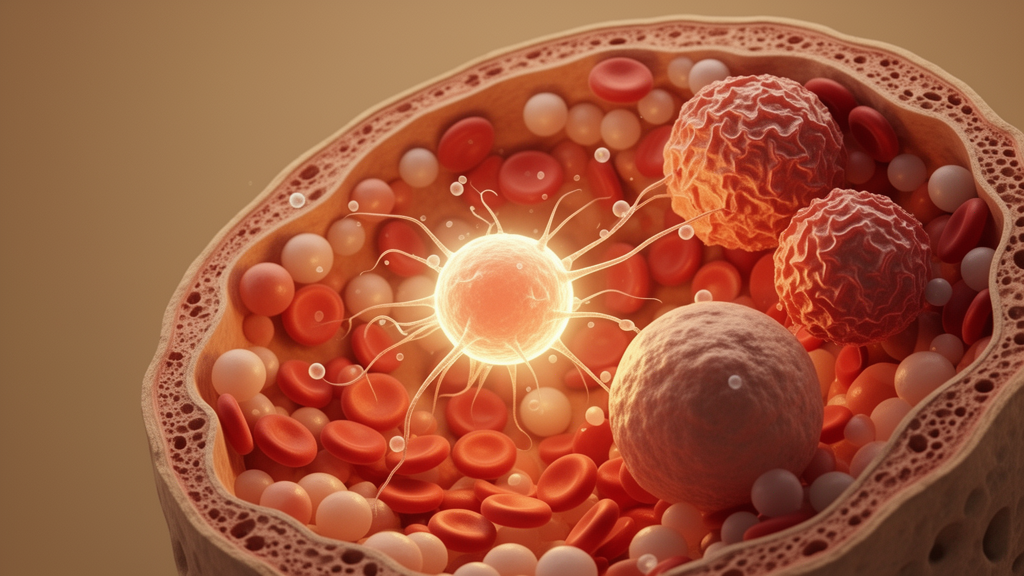
Scientists have identified a previously unrecognized progenitor cell in adult bone marrow that can generate macrophages without going through the monocyte stage long considered the sole source of these immune cells in adulthood. The cell, named EMPROR for erythro–myeloid progenitor, was tracked using a fluorescent reporter strain and shown to possess an unusual combination of traits: it carries markers of the CD4 lineage, lacks the receptors that define conventional monocyte precursors, and can give rise to macrophages, neutrophils, megakaryocytes and erythroid cells. The findings, published in Nature Immunology, suggest that adult myelopoiesis is more diverse than the classical textbook pathway and that an embryonic-like program persists in the adult bone marrow.
The discovery emerged from studies of perivascular macrophages, or PVMs, a specialized population of tissue-resident macrophages that wraps around postcapillary venules in the skin and other organs. In mice carrying a reporter in which regulatory elements of the CD4 locus drive green fluorescent protein expression, PVMs but not interstitial macrophages fluoresce, making them easy to visualize. The researchers confirmed that these cells line blood vessels in the mammary fat pad, meninges and superficial cortex, and intravital microscopy showed them sitting sessile with dendrites probing their surroundings. In breast tumors implanted into reporter mice, fluorescent PVMs accumulated around newly formed tumor vasculature, particularly at the tumor periphery.
To trace the origin of these cells, the team created bone marrow chimeras in which irradiated recipient mice received reporter marrow mixed with a small amount of wild-type marrow to restore the adaptive immune system. Seven to eight months after reconstitution, very few fluorescent cells appeared in skin, circulation, spleen or mammary fat pads, consistent with PVMs being long-lived or self-renewing. By fifteen months, however, roughly five percent of skin PVMs were reporter-positive, indicating slow replenishment from the marrow. When breast cancer cells were implanted into chimeras reconstituted for only six to eight weeks, fluorescent macrophages developed within the tumors but not in other organs, demonstrating that one or more PVM precursors reside in the adult bone marrow.
A depletion experiment strengthened this conclusion. Injecting mannosylated clodronate liposomes into the meningeal space eliminated resident meningeal macrophages and created a vacant niche. Four weeks later, intravital microscopy revealed fluorescent PVMs lining postcapillary venules in the meninges of chimeric mice, and direct transfer of bulk bone marrow from reporter mice into depleted recipients produced the same result. The obvious candidate precursor, the circulating Ly6C-high monocyte, seemed unlikely, because fluorescent monocytes were never observed in the chimeras, and the classical monocyte and monocyte precursor populations, which express the CSF1R and CCR2 receptors, did not carry the fluorescent marker.
Instead, flow cytometric analysis of the lineage-negative fraction of bone marrow revealed a small, distinct population of fluorescent cells that lacked CSF1R and CCR2 but expressed the stem cell factor receptor Kit. These cells, designated EMPROR cells, also lacked Sca-1 and CD150, distinguishing them from hematopoietic stem cells, and did not match common myeloid progenitors, which showed no reporter expression. A fraction of EMPROR cells was positive for CD4, CD11b and Ly6C, displayed low to intermediate CX3CR1, low CD34, and no CCR2, and they lacked mature macrophage markers such as F4/80, CD64, CD206 and CD209b. Numerically, EMPROR cells were rare compared with monocyte precursors and monocytes.
Single-cell RNA sequencing placed EMPROR cells in their own cluster, separate from B cell, T cell and plasmacytoid dendritic cell populations. They expressed transcripts for PU.1, CD34 and Kit but lacked Sca-1, Flt3 and CD45 transcripts, and notably lacked Cx3cr1, Csf1r, Ccr2, Klf4 and Irf5, marking them as distinct from the conventional monocyte, macrophage and dendritic cell lineages. Within the cluster, a small fraction of cells expressed erythroid genes such as Gata1, Klf1 and Car1 and megakaryocytic genes including Itga2b, Mpl and Pf4, while other cells carried neutrophil precursor genes such as Cebpe and Pglyrp1 without mature neutrophil markers like Ly6g or Lyz2. RNA velocity analysis predicted trajectories from EMPROR cells toward erythroid, neutrophil and monocyte, macrophage and dendritic cell clusters, and bulk transcriptomic comparisons confirmed their distinct profile relative to monocyte precursors, monocytes and plasmacytoid dendritic cells.
Functional assays then tested what these cells can actually do. In culture with macrophage colony-stimulating factor, sorted EMPROR cells expanded robustly into macrophages, as did monocyte precursors. In the meningeal depletion model, however, only EMPROR cells, and neither monocyte precursors nor monocytes, generated fluorescent PVMs in the brain after adoptive transfer, demonstrating a unique capacity to give rise to this specialized macrophage subset under the tested conditions. EMPROR cells failed to generate T cells or B cells in OP9 coculture systems and did not produce dendritic cell-like populations in GM-CSF culture, unlike monocyte precursors. In semisolid methylcellulose medium containing a cocktail of cytokines, EMPROR cells formed colonies containing macrophage, neutrophil, megakaryocytic and erythroid lineages, an erythro–myeloid potential resembling that described for embryonic erythro–myeloid progenitors, whereas monocyte precursor colonies were restricted to the monocyte–macrophage lineage. Notably, when macrophage colony-stimulating factor and GM-CSF were removed from the culture, monocyte precursors and monocytes failed to survive, but EMPROR cells retained their erythro–myeloid potential at a reduced level, a property associated with embryonic progenitors.
In vivo tests used a dual-reporter strategy in which all cells carry a membrane-bound tomato fluorescent protein while CD4-lineage cells additionally express green fluorescent protein. Sorted EMPROR cells, monocyte precursors or monocytes were transferred into irradiated recipients, and breast tumors were established one day later. Monocyte precursors and monocytes produced scarce tumor-associated macrophages, whereas EMPROR cells gave rise to a robust population of tumor-associated macrophages and a smaller green fluorescent population, along with neutrophils within tumors. Further analysis showed EMPROR-derived neutrophils and macrophages in liver and lung, including tomato-positive CD169-positive Kupffer cells, and EMPROR-derived macrophages, neutrophils and CD71-positive erythroblasts in bone marrow. Analysis of non-hemolyzed marrow and blood revealed circulating reporter-positive erythrocytes derived from EMPROR cells, confirming erythroid potential in vivo. In an additional experiment, breast tumors implanted into reporter mice lacking CCR2 still showed robust infiltration of CD4-lineage perivascular macrophages, indicating that this macrophage lineage can develop within tumors independently of CCR2-mediated monocyte recruitment.
Transcriptomic comparisons placed EMPROR cells closest to embryonic erythro–myeloid progenitors. When bulk RNA sequencing data from adult EMPROR cells were compared with embryonic EMPROR cells isolated from fetal liver at embryonic day 14.5 and with published datasets of hematopoietic stem cells and progenitors, the adult and embryonic EMPROR cells clustered together on their own branch, separate from hematopoietic stem cells, multipotent progenitors, monocyte precursors, monocytes, common myeloid progenitors and granulocyte–monocyte progenitors. In an integrated analysis with published embryonic datasets, adult and embryonic EMPROR cells clustered adjacent to classical embryonic erythro–myeloid progenitors and pre-macrophages, while monocyte precursors clustered with tissue macrophages. The authors emphasize that they use the term EMP-like to denote similarity in transcriptional state and lineage potential, without implying direct developmental continuity.
The researchers are careful about what remains unresolved. Whether adult EMPROR cells represent long-lived descendants of embryonic progenitors or arise from hematopoietic stem cell-derived populations that adopt an embryonic-like erythro–myeloid program after birth cannot be determined from the current data, and definitive answers would require genetic fate-mapping approaches that are currently limited by the scarcity of the embryonic cells and the lack of methods for labeling precursors without compromising embryo viability. The experiments were performed in mice, and the authors note that analogous progenitor populations may exist in humans but have not yet been defined. They also caution that the work was not randomized and that data collection was not blinded. Within those limits, the study establishes that the adult bone marrow harbors a progenitor population that transcriptionally and functionally mirrors embryonic erythro–myeloid progenitors and provides an alternative, monocyte-independent route to macrophage generation, raising the possibility that macrophage replacement in inflamed or tumor-bearing tissues may sometimes be driven by precursors with an embryonic-like program rather than solely by monocyte recruitment.
Subject of Research: A CD4-lineage erythro–myeloid progenitor in adult bone marrow that generates macrophages independently of monocytes
Article Title: A CD4-lineage erythro–myeloid progenitor within the adult bone marrow defines an alternative pathway for macrophage generation
Article References: Tikoo, S., Jain, R., Martinez, B., Song, R., Wielscher, M., Márquez-Burgoa, C., Hladik, A., Rizzetto, S., Shaw, L. E., Ghannadan, M., Gerhofer, S. A., Mitchell, A. J., Torres-Pacheco, M. E., Luciani, F., Farlik, M., Wong, J. J. L., Knapp, S., Starkl, P., Fraser, S. T., … Weninger, W. (2026). A CD4-lineage erythro–myeloid progenitor within the adult bone marrow defines an alternative pathway for macrophage generation. Nature Immunology. https://doi.org/10.1038/s41590-026-02686-1
Image Credits: AI Generated
DOI: 10.1038/s41590-026-02686-1
Keywords: macrophages, bone marrow, progenitor cells, myelopoiesis, perivascular macrophages, single-cell RNA sequencing, embryonic erythro–myeloid progenitors, tumor-associated macrophages, CCR2, hematopoiesis, CD4 lineage, immune cell development
Cite Scienmag News
Drew Townsend. (October 26, 2026). Hidden bone marrow progenitor offers alternative route to macrophage production. Scienmag. https://scienmag.com/hidden-bone-marrow-progenitor-offers-alternative-route-to-macrophage-production/
Drew Townsend. "Hidden bone marrow progenitor offers alternative route to macrophage production." Scienmag, 26 October 2026, https://scienmag.com/hidden-bone-marrow-progenitor-offers-alternative-route-to-macrophage-production/. Accessed 26 October 2026.
Drew Townsend. "Hidden bone marrow progenitor offers alternative route to macrophage production." Scienmag. October 26, 2026. https://scienmag.com/hidden-bone-marrow-progenitor-offers-alternative-route-to-macrophage-production/


