


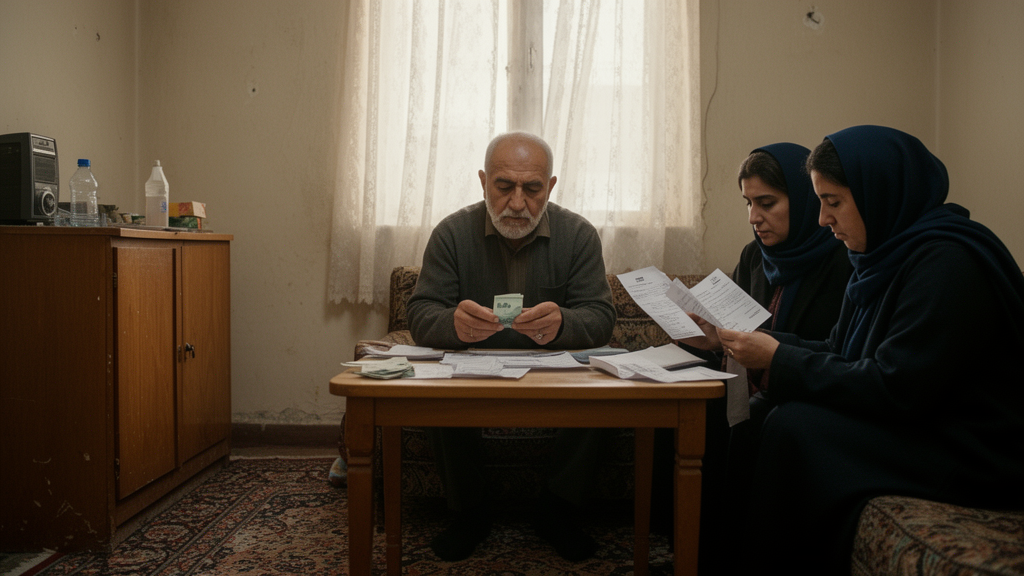
Financial hardship from health care in Iran has declined over the past decade, but the burden continues to fall hardest on the country’s poorest and rural households, according to an inequality analysis published in the International Journal for Equity in Health. Drawing on nine consecutive waves of the Iranian Household Income and Expenditure Survey from 2016 to 2024, covering roughly 37,000 to 38,000 households each year, the researchers tracked the share of the population experiencing catastrophic health spending as defined by the revised Sustainable Development Goal indicator 3.8.2. Under this measure, a household counts as facing financial hardship when out-of-pocket health payments exceed 40 percent of its discretionary budget, the income left over after covering basic necessities such as food, housing and utilities.
The headline numbers show a gradual improvement. Overall financial hardship affected 17.57 percent of the population in 2016 and fell to 14.53 percent by 2024, although the trajectory was not smooth and the authors note substantial year-to-year variation. The composition of that hardship is telling: impoverishing out-of-pocket expenditure, meaning spending that pushes households below the poverty line, accounted for the majority of the burden in both years, at 11.19 percent in 2016 and 9.60 percent in 2024. Large out-of-pocket payments that are catastrophic but not impoverishing declined from 6.38 percent to 4.92 percent over the same period. In other words, the dominant form of financial damage in Iranian health care is not merely very large bills, but bills large enough to tip families into poverty.
To quantify how this burden is distributed across society, the team used the Erreygers-corrected concentration index, a standard tool for measuring socioeconomic inequality in health financing indicators. The index was negative throughout the study period, confirming that financial hardship is concentrated among poorer households, a pattern described as pro-poor inequality. The index stood at minus 0.330 in 2016 and moved to minus 0.290 in 2024, a shift toward zero that indicates a narrowing of absolute inequality over the nine years. That narrowing, however, occurred against a backdrop in which the poor remained consistently more exposed than the rich, and the aggregate national improvement masked this persistent stratification.
Decomposition analysis, using the Wagstaff method, identified which household and demographic characteristics drove the observed inequality. Economic quintiles, taken together, dominated the picture, contributing 61.2 percent of the inequality in 2016 and 66.5 percent in 2024. All other household and demographic characteristics made substantially smaller contributions. The rising share attributable to economic status suggests that household wealth became an even stronger predictor of who bears catastrophic health costs as the period progressed, even as the overall level of hardship declined.
The study’s disaggregation into two components carries practical weight for policy design. Because impoverishing expenditure, rather than merely large expenditure, makes up most of the financial hardship in Iran, the authors argue that meaningful financial protection will likely require financing reforms that go beyond aggregate coverage expansion. They point instead toward pro-poor, redistributive benefit design, with priority given to reducing impoverishing out-of-pocket spending among lower socioeconomic groups. An expansion of insurance coverage that raises headline coverage rates without shielding poor households from poverty-inducing payments would leave the core problem largely intact.
Several caveats frame the findings. The analysis relies on household expenditure survey data, which capture reported out-of-pocket spending and household consumption but cannot identify the specific channels, such as particular services, medicines or provider types, through which households incur damaging payments. The revised SDG 3.8.2 definition, based on the discretionary budget rather than total consumption, is deliberately stricter about what counts as disposable income, which shapes the measured prevalence. The concentration index captures relative socioeconomic patterning, and the observed movement toward zero reflects a narrowing of absolute inequality rather than an elimination of the gap between rich and poor.
Iran’s experience over this period offers a quantitative case study for health systems globally that monitor financial risk protection through SDG indicator 3.8.2. The Iranian data show that national averages can improve steadily while the distribution of harm remains anchored to household economic status, and that the most damaging component of catastrophic spending is the kind that creates new poverty rather than simply large bills. For a health system seeking universal health coverage, the study’s decomposition results suggest that the levers with the greatest potential lie in how benefits are targeted and financed across income groups, not merely in how many people hold coverage on paper.
The authors conclude that despite the decline in financial hardship between 2016 and 2024, the burden remained concentrated among poorer and rural households and was driven predominantly by impoverishing out-of-pocket spending. Their assessment is that closing the remaining gap will depend on redistributive financing reforms aimed squarely at the lower socioeconomic groups where impoverishing payments cluster, a conclusion grounded in the decomposition evidence rather than in aggregate trend lines alone.
Subject of Research: Socioeconomic inequality in financial hardship from out-of-pocket health spending in Iran, 2016 to 2024
Article Title: Financial hardship in health in Iran during 2016 to 2024: an inequality analysis
Article References: Mousavi, A., Fazaeli, A. A., Akbari Sari, A., Farrokhian, P., Manavi, S., & Daroudi, R. (2026). Financial hardship in health in Iran during 2016 to 2024: an inequality analysis. International Journal for Equity in Health. https://doi.org/10.1186/s12939-026-03091-8
Image Credits: AI Generated
DOI: 10.1186/s12939-026-03091-8
Keywords: financial hardship in health, out-of-pocket expenditure, catastrophic health spending, impoverishing health expenditure, SDG indicator 3.8.2, universal health coverage, socioeconomic inequality, concentration index, Iran, household survey, health financing, financial risk protection
Cite Scienmag News
Courtney Benton. (October 26, 2026). Health Costs Still Push Poor Iranian Households Deeper Into Poverty. Scienmag. https://scienmag.com/health-costs-still-push-poor-iranian-households-deeper-into-poverty/
Courtney Benton. "Health Costs Still Push Poor Iranian Households Deeper Into Poverty." Scienmag, 26 October 2026, https://scienmag.com/health-costs-still-push-poor-iranian-households-deeper-into-poverty/. Accessed 26 October 2026.
Courtney Benton. "Health Costs Still Push Poor Iranian Households Deeper Into Poverty." Scienmag. October 26, 2026. https://scienmag.com/health-costs-still-push-poor-iranian-households-deeper-into-poverty/


