


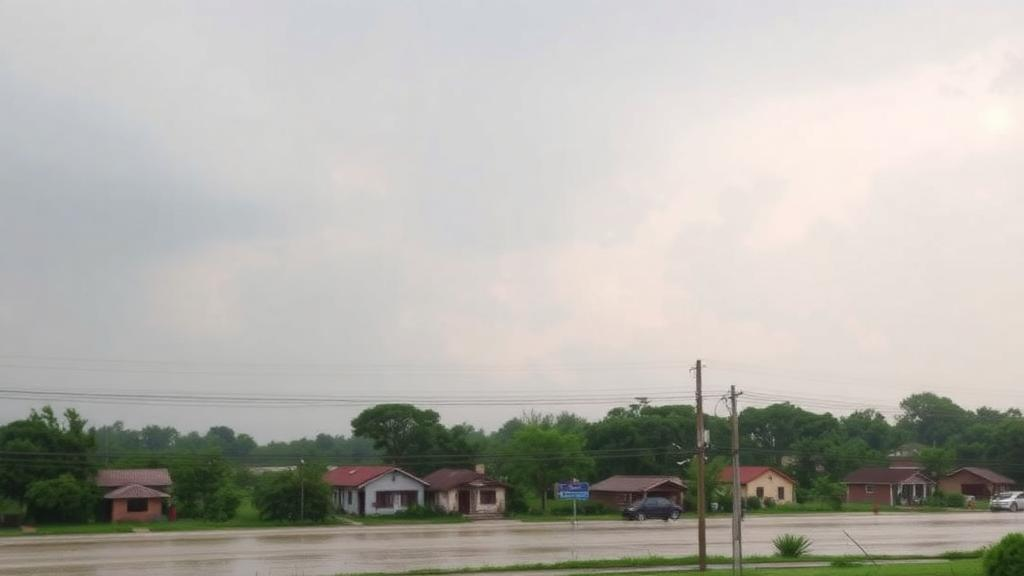
In the flood-prone imagination of South Asia, Bangladesh’s disasters have long been dominated by monsoon waters and tropical cyclones. A new study published in Theoretical and Applied Climatology challenges that hierarchy. Researchers from the University of Dhaka and the Bangladesh Meteorological Department report that in the northeastern district of Sylhet, residents now rank hailstorms as the most significant natural hazard threatening their homes and livelihoods, ahead of both floods and cyclones. The finding emerges from a detailed community-based risk assessment conducted across five Union Parishads of Golapganj Upazila, an area where shifting climate patterns have visibly altered the frequency and intensity of local hazards in recent years.
The research team, led by Shah Usama Hasan and Md. Shahoriar Sarker of the Department of Disaster Science and Climate Resilience, together with Shah Md Shajib Hossain of the Bangladesh Meteorological Department in Sylhet, combined three complementary lines of evidence. They analyzed climatological records, administered structured household questionnaires, and organized Focus Group Discussions to capture how local people identify hazards, perceive seasonal variability, and prioritize evolving risks. The survey covered 200 household representatives across the study unions, with men making up 77 percent of respondents and women 23 percent, reflecting the gender composition of those available and willing to participate in household-level interviews.
To move beyond perception alone, the researchers applied two established hazard-evaluation frameworks. The first was the Federal Emergency Management Agency, or FEMA, framework, which assesses hazards according to criteria such as probability, impact, and the spatial extent of potential damage. The second was the SMUG model, which scores each hazard on four dimensions: Seriousness, Manageability, Urgency, and Growth. Both models are widely used in disaster risk reduction practice because they convert qualitative judgments into comparable quantitative rankings, allowing planners to allocate limited resources to the threats that matter most. Notably, the results derived from the FEMA and SMUG assessments showed strong consistency with the community’s own perceptions, a convergence that strengthens confidence in the hailstorm finding.
The technical core of the study examined cloud formation patterns and hailstorm frequency across the Sylhet region to characterize the physical basis of the risk. Hailstorms develop in severe convective storms where strong updrafts repeatedly lift supercooled water droplets above the freezing level, allowing ice layers to accumulate until the hailstone’s weight overcomes the updraft. The pre-monsoon months in northeastern Bangladesh provide favorable conditions for this process: intense surface heating, abundant moisture from the nearby wetlands and the Surma River basin, and orographic influences from the neighboring Meghalaya plateau that can enhance atmospheric instability. The authors analyzed these cloud formation patterns alongside historical hailstorm occurrence to assess how the regional risk is evolving.
The consequences on the ground have been severe. News reports cited in the study document hailstorms hammering Sylhet and Golapganj in early April 2024, with storms damaging roughly 1,000 houses in Golapganj alone. For a rural economy built on agriculture, the timing and intensity of hail events matter enormously. Hail can shred rice paddies, destroy vegetable crops, and damage fragile roofing structures within minutes, and the losses ripple through household incomes and food security. Previous research from northern Bangladesh has documented how rapidly emerging hailstorms pose a potential threat to sustainable agriculture among smallholder farmers, and the new study suggests the northeastern region is following a similar trajectory.
What makes the study distinctive is its integration of institutional assessment with lived experience. The researchers found that community members were not simply reacting to the most recent disaster; their hazard prioritization reflected a genuine shift in the local risk landscape. Hailstorms, once considered a secondary concern compared with the region’s chronic flood exposure, have become the hazard residents fear most for settlement safety and agricultural sustainability. This reordering of priorities carries practical implications, because disaster management strategies in Bangladesh have historically been organized around flood and cyclone preparedness, with early warning systems, shelters, and relief mechanisms tailored to slow-onset and forecastable events rather than sudden convective storms.
The study identifies institutional response gaps as a key part of the problem. Hailstorms strike with little warning, typically lasting minutes, which makes evacuation and protective action difficult even when forecasts are available. Unlike riverine floods, which unfold over days and allow staged responses, hail events demand rapid, localized mitigation such as hail nets for high-value crops, reinforced roofing, and community-level warning dissemination through mobile networks. The authors argue that these sector-specific vulnerabilities, combined with climatological trends and the documented gaps in institutional response, justify recognizing hailstorms as a priority hazard in northeastern Bangladesh rather than an occasional footnote in national disaster planning.
The broader context reinforces the urgency. Bangladesh is consistently ranked among the most disaster-prone countries in the world, and climate change is expected to intensify extreme convective weather across South Asia. Regional studies of cloud characteristics during the Indian summer monsoon, along with climatological analyses of hail in other parts of Asia, indicate that understanding the behavior of deep convective systems is essential for anticipating future hail risk. In Bangladesh specifically, researchers have begun mapping housing vulnerability to hailstorms as a decision-support tool for disaster risk reduction, signaling a growing recognition that the built environment must be adapted to a hazard that national frameworks have largely overlooked.
The methodological approach of the new study offers a template for other hazard-exposed regions. By triangulating household surveys, focus group discussions, and formal risk-scoring models, the researchers demonstrated that community perception and quantitative assessment can reinforce rather than contradict each other. This alignment matters because risk communication is most effective when official warnings match what residents already experience. Where communities perceive a hazard that institutions ignore, preparedness suffers; where institutions prioritize hazards that communities discount, resources are wasted. The Golapganj case shows both frameworks converging on the same conclusion, giving planners an unusually clear mandate.
The authors conclude that integrating hailstorm risk mitigation into regional planning and disaster management strategies is now essential to enhance community resilience and protect agricultural sustainability in northeastern Bangladesh. That integration, they suggest, should span improved climatological monitoring of convective storm development, targeted structural measures for housing and crops, and disaster management protocols that treat hailstorms with the same seriousness long reserved for floods and cyclones. As climate patterns continue to shift, the study stands as a reminder that hazard landscapes are not static: the disaster that defines a region’s future may not be the one that defined its past, and listening to the people who live with that risk is the first step toward managing it.
Subject of Research: Community risk perception and hazard prioritization of emerging hailstorm hazards in northeastern Bangladesh
Article Title: Emerging hailstorm hazards in Northeastern Bangladesh: integrating recent impacts and community perception
Article References: Hasan, S. U., Sarker, M. S., & Hossain, S. M. S. (2026). Emerging hailstorm hazards in Northeastern Bangladesh: integrating recent impacts and community perception. Theoretical and Applied Climatology, 157(10), Article 612. https://doi.org/10.1007/s00704-026-06556-6
Image Credits: AI Generated
DOI: 10.1007/s00704-026-06556-6
Keywords: hailstorms, Bangladesh, Sylhet, risk perception, hazard prioritization, FEMA framework, SMUG model, climate change, agriculture, disaster risk reduction, community-based assessment, convective storms
Cite Scienmag News
Violet Maxwell. (October 8, 2026). Hailstorms Now Outrank Floods as the Top Hazard in Northeastern Bangladesh. Scienmag. https://scienmag.com/hailstorms-now-outrank-floods-as-the-top-hazard-in-northeastern-bangladesh/
Violet Maxwell. "Hailstorms Now Outrank Floods as the Top Hazard in Northeastern Bangladesh." Scienmag, 8 October 2026, https://scienmag.com/hailstorms-now-outrank-floods-as-the-top-hazard-in-northeastern-bangladesh/. Accessed 8 October 2026.
Violet Maxwell. "Hailstorms Now Outrank Floods as the Top Hazard in Northeastern Bangladesh." Scienmag. October 8, 2026. https://scienmag.com/hailstorms-now-outrank-floods-as-the-top-hazard-in-northeastern-bangladesh/


