


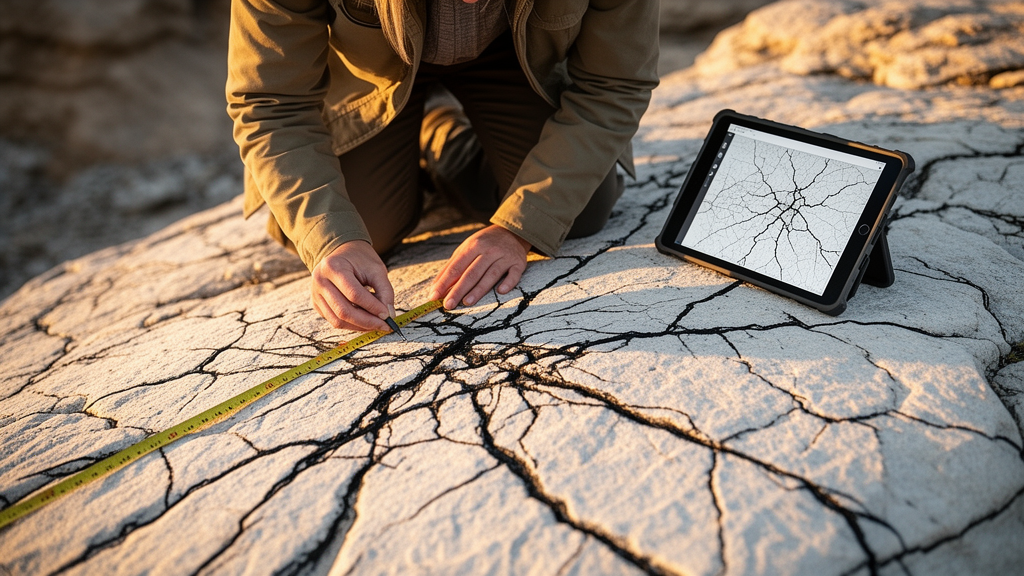
Fractures are the hidden plumbing of the Earth’s crust. They control how water, oil, geothermal heat, and even carbon dioxide move through rock masses, and they determine whether a slope will hold or collapse. Yet mapping them has remained a stubbornly manual, slow, and inconsistent craft. Now a team of geoscientists and machine-learning researchers led by Ayoub Fatihi of the University of Lausanne has delivered the most rigorous head-to-head test yet of automated fracture mapping, and the verdict is clear: deep learning leaves decades-old image filters far behind. The study, published in the journal Solid Earth, introduces FraXet, a harmonised benchmark dataset of 8,953 image patches drawn from high-resolution drone surveys of real rock outcrops, and uses it to evaluate everything from classic edge detectors to modern neural networks.
The problem the researchers set out to solve is deceptively simple to state but hard to crack. Drone photogrammetry has revolutionised field geology by producing orthophotographs of rock faces at millimetre to centimetre resolution, capturing outcrops too dangerous or inaccessible to climb. But turning those images into fracture maps still depends on a human tracing lines on a screen. At a resolution of one centimetre per pixel, mapping a modest 10 by 10 metre patch of rock takes more than half an hour even with semi-automated tools. Scaling that up, a single 200 by 50 metre outcrop demands roughly 55 hours of dedicated interpreter time. For regional studies involving dozens of outcrops, the bottleneck becomes prohibitive.
Worse, the manual process is unreliable in ways that ripple through downstream science. Different interpreters, or even the same interpreter on different days, produce fracture maps that disagree on which fractures exist, where they begin and end, and how they connect into networks. These inconsistencies propagate into calculations of fracture orientation, length, spacing, and connectivity, the very quantities used to assess groundwater flow, reservoir quality, and rock stability. The new study argues that reproducibility, not just speed, is the real prize that automation offers structural geology.
FraXet was built from three publicly available annotated datasets spanning strikingly different geology. Ovaskainen22 captures fracture networks in the coarse-grained rapakivi granites of southeastern Finland, where K-feldspar megacrystals up to ten centimetres long texture the rock surface. Matteo21 documents the Granite Dells of Arizona, a granitic terrain of similar age but finer, more equigranular grain. Samsu19, by contrast, maps fractures in layered mudstones and sandstones of the Lower Cretaceous Strzelecki Group in southeastern Australia, a sedimentary setting where bedding and weathering complicate the visual signal. Each patch in the benchmark pairs a red-green-blue orthophotograph tile with a digital elevation model tile and a one-pixel-wide fracture label, with ground sampling distances ranging from roughly half a millimetre to 32 millimetres per pixel.
Against this benchmark the team pitted two families of methods. The first comprised five classical image-processing filters: Canny and Sobel edge detectors, Gabor and Sato ridge detectors, and phase congruency, a Fourier-based technique prized for its robustness to changing illumination. Because these filters depend on user-chosen parameters, the researchers ran a systematic grid search with cross-validation to give each filter its best possible shot, rather than dismissing them with careless settings. The second family consisted of two deep learning models: U-Net, a convolutional encoder-decoder architecture with skip connections that has become the workhorse of medical and geoscientific image segmentation, and SegFormer, a transformer-based model that uses self-attention to capture long-range spatial context.
The results were decisive. On held-out test data, the deep models achieved F1 scores of roughly 0.3 to 0.5, while the best classical filters topped out near 0.29, with most clustering far lower and achieving zero structural similarity to the ground truth. Just as striking was the character of the outputs: the neural networks produced smoother, more continuous fracture traces, often reconnecting segments that the filters left fragmented. The Gabor filter illustrated the failure mode of classical approaches in extreme form, achieving perfect recall only by labelling nearly every pixel as fracture, collapsing every other metric in the process. Fixed rules and hand-tuned parameters, the study concludes, simply lack the flexibility to cope with the lighting, weathering, vegetation, and textural variability of real outcrops.
One of the study’s most consequential findings concerns generalisation. A single model trained on all three datasets combined consistently outperformed models trained on individual sites, particularly on the harder sedimentary and Arizona granite data, where site-specific models scored F1 values as low as 0.06 to 0.24. The combined model more than doubled overlap metrics on those challenging sites, suggesting that exposure to varied lithologies, scales, and illumination teaches networks transferable features rather than site-specific shortcuts. For a field where labelled data are scarce and expensive, the message that diversity in training data buys robustness is a practical roadmap for future model development.
The researchers were candid about the limits of their results. Even the best model, U-Net, reached a mean F1 of only 0.48, well below the scores above 0.8 typical of segmentation benchmarks in other domains. Part of the gap reflects the unusual nature of the target: fractures are thin, high-aspect-ratio lines in images where background pixels can exceed 99 percent, an extreme class imbalance that punishes conventional metrics. Part reflects the labels themselves. The team found that manually drawn ground-truth traces often deviate from the actual pixel-level fracture geometry, and in several error cases the neural network was arguably more accurate than the annotations it was judged against. Probability maps, which assign each pixel a confidence value between zero and one, proved essential for distinguishing these high-confidence disagreements from genuine model uncertainty.
The speed gains are transformative in their own right. Where manual mapping of a 10 by 10 metre area took 54 to 57 minutes, and semi-automatic assisted tracing 35 to 37 minutes, the trained U-Net generated a fracture probability map for the same area in six seconds on a modest free-tier cloud instance. Post-processing to convert probability maps into vectorised, topologically consistent fracture networks remains a bottleneck the study does not fully solve, and the authors stress that semantic segmentation alone does not yet preserve network connectivity. But by collapsing the upstream time cost from hours to seconds, the workflow makes it feasible to sample fracture networks across whole regions, or repeatedly through time before and after rockfalls or excavations, producing datasets large enough for statistically robust analysis.
To lower the barrier to adoption, the team has released everything openly: the FraXet dataset on Zenodo, the full source code on GitLab, trained model weights on Hugging Face, a browser-based application that accepts paired RGB images and elevation models without any machine-learning expertise, and a QGIS plugin that runs inference directly inside a widely used geographic information system. FraXet is designed as a living benchmark, to be expanded with carbonate, metamorphic, and volcanic lithologies as annotated public data become available. For a discipline whose quantitative foundations have long rested on the patience and consistency of individual human tracers, the arrival of a standardised, reproducible, and openly accessible testing ground marks a genuine turning point in how the fractured fabric of the Earth’s surface gets mapped.
Subject of Research: Benchmarking automated fracture mapping from 2D outcrop imagery using classical image filters and deep learning models
Article Title: Towards robust fracture mapping: benchmarking automatic fracture mapping in 2D outcrop imagery
Article References: Fatihi, A., Caldeira, J., Beucler, T., Thiele, S. T., & Samsu, A. (2026). Towards robust fracture mapping: benchmarking automatic fracture mapping in 2D outcrop imagery. Solid Earth, 17(9), 1087-1115. https://doi.org/10.5194/se-17-1087-2026
Image Credits: AI Generated
Keywords: fracture mapping, deep learning, U-Net, SegFormer, FraXet dataset, drone photogrammetry, orthophotographs, digital elevation models, image segmentation, structural geology, benchmarking, rock fractures
Cite Scienmag News
Violet Maxwell. (October 8, 2026). AI Outperforms Classic Filters in Landmark Benchmark for Mapping Rock Fractures. Scienmag. https://scienmag.com/ai-outperforms-classic-filters-in-landmark-benchmark-for-mapping-rock-fractures/
Violet Maxwell. "AI Outperforms Classic Filters in Landmark Benchmark for Mapping Rock Fractures." Scienmag, 8 October 2026, https://scienmag.com/ai-outperforms-classic-filters-in-landmark-benchmark-for-mapping-rock-fractures/. Accessed 8 October 2026.
Violet Maxwell. "AI Outperforms Classic Filters in Landmark Benchmark for Mapping Rock Fractures." Scienmag. October 8, 2026. https://scienmag.com/ai-outperforms-classic-filters-in-landmark-benchmark-for-mapping-rock-fractures/


