


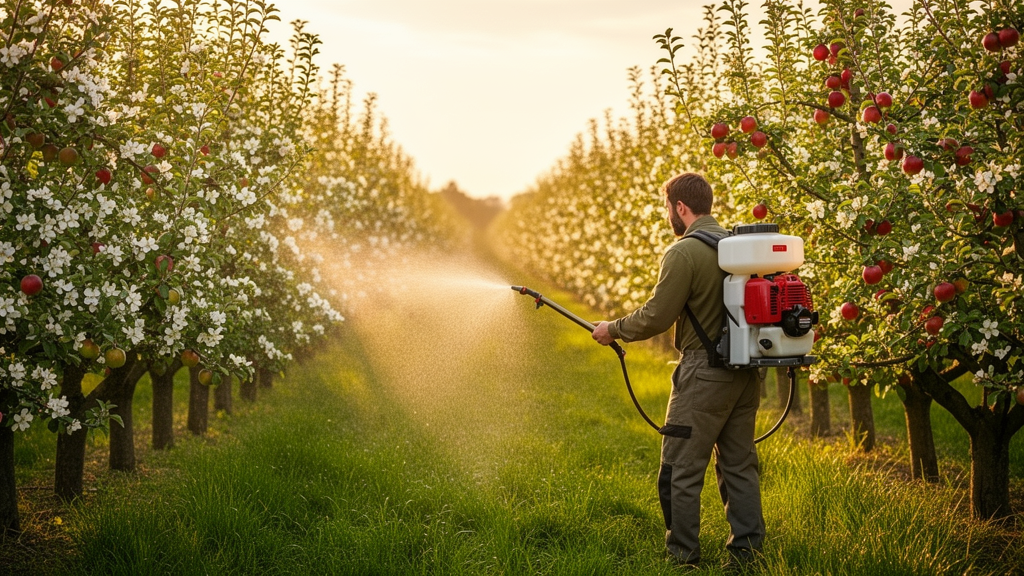
Apple growers racing to meet rising demand for sustainable fruit production may soon have an unlikely ally growing in their own field margins: weeds. A new field study published in BMC Plant Biology reports that foliar sprays made from weed-derived bio-formulations, applied at precisely timed stages of the apple tree’s annual growth cycle, significantly increased fruit set, yield, fruit quality and leaf nutrient concentrations in the commercial cultivar ‘Gala Schniga Schnico’. The findings, from a research team led by Pramod Kumar and Tanzin Ladon at Dr YS Parmar University of Horticulture and Forestry in Solan, India, suggest that plants usually dismissed as orchard pests can be converted into a low-cost biostimulant resource for high-density apple production systems.
The research addresses a pressing challenge in modern horticulture. High-density orchards, which pack dwarfing rootstocks and slender trees into tight rows to maximize early returns, demand intensive inputs of fertilizers and agrochemicals. Input costs have been climbing steadily, while environmental scrutiny of conventional chemical programs has intensified. Growers and scientists alike have been searching for eco-friendly alternatives that can sustain productivity without compromising fruit quality or soil health. Plant biostimulants, substances that modulate plant growth and stress responses rather than simply feeding crops, have emerged as one of the most promising candidates, and weed-derived formulations are an especially attractive class because their raw material is abundant, cheap and otherwise destined for disposal.
What makes weeds chemically interesting, the authors note, is their diverse arsenal of bioactive secondary metabolites. Plants that thrive in harsh, competitive environments often accumulate phenolics, alkaloids, terpenoids and other compounds that, when extracted and applied to crops, can influence hormone signaling, nutrient uptake and stress tolerance. Rather than treating these formulations as a generic tonic, the Indian team hypothesized that timing matters enormously. A tree’s needs shift dramatically across its phenological calendar, from budbreak and flowering through fruit set, cell expansion and ripening, so a spray that helps at one stage may be irrelevant or wasteful at another. Their experiment was designed to test whether matching applications to nine distinct phenological stages would unlock the full potential of the bio-formulations.
The field trials were conducted during 2024 and 2025 at two contrasting orchard sites in the apple-growing hills of Himachal Pradesh. One site, at Nauni, used trees on the dwarfing EMLA9 rootstock, while the other, at Kandaghat, used trees on the more vigorous MM111 rootstock. Both orchards were managed under high-density systems, the very conditions where input costs and tree stress tend to be most acute. The researchers employed a split-plot design with four replications, a statistically robust layout that allowed them to separate treatment effects from site and block variation. Five treatments were compared, each consisting of a different combination of stage-specific bio-formulation applications, alongside a control that received only water sprays.
The standout treatment, designated T1, involved sequential applications of the bio-formulations across all nine phenological stages, effectively accompanying the tree through its entire productive cycle. The results were striking. Fruit set rose from 38.56 percent in the control trees to 44.67 percent in the T1 trees, a meaningful gain in a crop where every percentage point of set translates directly into marketable fruit. More dramatically, yield per tree climbed from 2.81 kilograms to 4.83 kilograms, an increase of roughly 72 percent. For high-density growers calculating returns per hectare, a jump of that magnitude, achieved without synthetic agrochemical inputs, represents a potentially transformative economics shift.
Fruit quality, the attribute that ultimately determines price and consumer acceptance, improved alongside quantity. Apples from treated trees were measurably firmer, registering 7.67 kilograms per square centimeter of flesh resistance compared with 6.58 in controls, a difference that matters for shelf life, transport tolerance and the crisp bite that ‘Gala’ consumers expect. Total soluble solids, the standard proxy for sweetness measured in degrees Brix, rose from 10.83 to 12.44, while total sugar content increased from 9.91 percent to 11.19 percent. Taken together, these figures describe fruit that is not only more abundant but also sweeter, firmer and better suited to the demands of long-distance supply chains.
Beneath the visible improvements in the fruit, the leaf analysis revealed a physiological mechanism at work. Concentrations of the three primary macronutrients in the foliage all rose significantly relative to the control: nitrogen increased by 29.2 percent, phosphorus by 50.0 percent and potassium by 18.6 percent. Phosphorus, often the most limiting nutrient in hill soils, plays central roles in energy transfer and flowering, while potassium governs fruit size, sugar accumulation and firmness. The pattern of nutrient enhancement aligns neatly with the observed gains in fruit set, sweetness and texture, suggesting that the bio-formulations improved the trees’ ability to acquire and mobilize nutrients rather than merely stimulating growth at the expense of quality.
To test whether these improvements were statistically coherent rather than a collection of coincidental effects, the team applied two complementary analytical tools. Pearson’s correlation analysis revealed significant positive associations among vegetative growth, nutrient status, yield and fruit quality traits, indicating that the treatments lifted the entire performance profile of the trees in concert. Principal component analysis then condensed the many measured variables into a few underlying dimensions, and the results were unusually clean: the first two components together explained 97.57 percent of the total variation, with the first component alone accounting for 68.96 percent. When a small number of components capture nearly all the variation in an experiment, it signals that the treatments produced a strong, systematic biological response rather than scattered, noise-driven differences.
The implications extend well beyond one cultivar and one growing season. Because the formulations are derived from weeds, they offer a circular-economy twist: plants that compete with crops for water and nutrients can be harvested, processed and returned to the orchard as a growth-enhancing spray. That could reduce both the labor of weed management and the expenditure on synthetic inputs, a double saving for smallholder growers in the Himalayan apple belt who face some of the steepest production costs in the industry. The phenology-based protocol also gives growers a practical scheduling framework, since the nine application stages correspond to observable milestones such as budbreak, bloom and fruit development that are already part of standard orchard record-keeping.
Cautions remain before the practice can be widely recommended. The study covered two seasons at two sites on a single cultivar, and the published version is an early-release, peer-reviewed accepted manuscript that will be replaced by a final Version of Record. Follow-up work will need to establish how the formulations perform across different rootstocks, climates and cultivars, and to characterize the active compounds responsible for the effects. Nevertheless, the core result stands on firm statistical ground: timed applications of weed-derived bio-formulations increased fruit set, boosted yield by more than 70 percent, improved firmness and sweetness, and elevated leaf nitrogen, phosphorus and potassium in high-density ‘Gala Schniga Schnico’ apple orchards. If those gains hold at scale, the humble weeds at the edge of the orchard may become one of its most valuable assets.
Subject of Research: Phenology-based application of weed-derived plant biostimulants in high-density apple orchards
Article Title: Phenology-based application of weed-derived bio-formulations enhances growth, yield, fruit quality and leaf nutrient status of ‘Gala Schniga Schnico’ apple under high-density orchard systems
Article References: Kumar, P., Ladon, T., Sharma, A., Devi, M., Vikram, A. K., Chauhan, J. K., & Rana, R. K. (2026). Phenology-based application of weed-derived bio-formulations enhances growth, yield, fruit quality and leaf nutrient status of ‘Gala Schniga Schnico’ apple under high-density orchard systems. BMC Plant Biology. https://doi.org/10.1186/s12870-026-09504-8
Image Credits: AI Generated
DOI: 10.1186/s12870-026-09504-8
Keywords: weed-derived bio-formulations, plant biostimulants, phenology, apple production, high-density orchards, fruit quality, fruit set, leaf nutrient status, sustainable horticulture, Gala apple, foliar application, BMC Plant Biology
Cite Scienmag News
Alan Morgan. (October 8, 2026). Weed-Based Sprays Boost Apple Yield and Quality When Timed to Tree Growth Stages. Scienmag. https://scienmag.com/weed-based-sprays-boost-apple-yield-and-quality-when-timed-to-tree-growth-stages/
Alan Morgan. "Weed-Based Sprays Boost Apple Yield and Quality When Timed to Tree Growth Stages." Scienmag, 8 October 2026, https://scienmag.com/weed-based-sprays-boost-apple-yield-and-quality-when-timed-to-tree-growth-stages/. Accessed 8 October 2026.
Alan Morgan. "Weed-Based Sprays Boost Apple Yield and Quality When Timed to Tree Growth Stages." Scienmag. October 8, 2026. https://scienmag.com/weed-based-sprays-boost-apple-yield-and-quality-when-timed-to-tree-growth-stages/


