

Wednesday, July 29, 2026
Science
No Result
View All Result
  • Login
  • HOME
  • SCIENCE NEWS
  • CONTACT US
  • HOME
  • SCIENCE NEWS
  • CONTACT US
No Result
View All Result
Scienmag
No Result
View All Result
Home Science News Earth Science

Flash Droughts Worsen Maize Yield Losses by Intensifying Atmospheric Dryness

July 29, 2026
in Earth Science
Reading Time: 2 mins read
0
Flash Droughts Worsen Maize Yield Losses by Intensifying Atmospheric Dryness

Flash Droughts Worsen Maize Yield Losses by Intensifying Atmospheric Dryness

65
SHARES
587
VIEWS
Share on FacebookShare on Twitter
ADVERTISEMENT

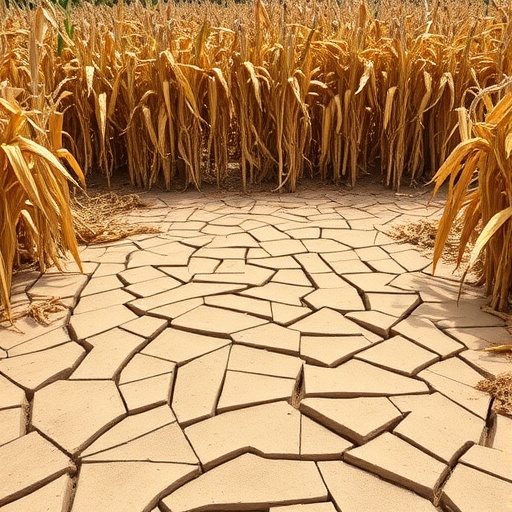
A new study in Communications Earth & Environment warns that “flash droughts” are now poised to worsen crop losses by pushing the atmosphere itself into deeper dryness—right at the moments maize is most vulnerable. The research, published in 2026, links these abrupt drought events to intensified atmospheric aridity rather than relying solely on how little rain reaches the ground.

Flash droughts differ from conventional droughts because they develop quickly. Instead of seasonal drying, soil moisture and plant access to water can collapse over days to weeks. The team found that this rapid decline triggers chain reactions in the lower atmosphere, amplifying conditions that make water extraction from the soil increasingly difficult.

Using observational datasets and model-based analyses, the authors track how maize yield responds when the air becomes unusually dry while heat and atmospheric demand rise. Their results indicate that aridity is not a passive background factor; it actively drives additional stress by increasing evapotranspiration demand and deepening the vapor-pressure deficit experienced by crops.

The mechanism is both direct and indirect. As the atmosphere dries, plants lose water faster through stomata—often before they can fully adjust their growth or root water uptake. At the same time, rapid soil drying reduces the water reservoir available to replenish leaf water, creating a feedback loop that accelerates stress.

In the model experiments, intensified atmospheric aridity magnified yield declines during flash drought periods. Even when rainfall deficits were not identical, the same crop responded more strongly when the atmosphere increased its drying power, suggesting that “how dry the air gets” may be as important as “how little it rains.”

The findings also imply that risk forecasts based only on precipitation may underestimate actual agricultural damage. Flash drought damage could intensify under climate-change scenarios that raise atmospheric vapor demand, making early warning systems that include atmospheric humidity and aridity metrics more effective.

For maize-dependent regions, the study points to a potentially urgent adaptation challenge: managing crops when both soil and air rapidly turn against them. Strategies may need to focus on buffering atmospheric stress, not just conserving soil water.

Overall, the work reframes flash droughts as events that couple fast hydrologic collapse with rapid atmospheric drying. As such, agricultural vulnerability may depend on the speed of these combined changes, and not simply on drought duration alone.

Subject of Research: Maize yield loss during flash droughts
Article Title: Flash droughts amplify maize yield losses through intensified atmospheric aridity.
Article References: Qiao, C., Wang, S., Zhu, P. et al. Flash droughts amplify maize yield losses through intensified atmospheric aridity. Commun Earth Environ (2026). https://doi.org/10.1038/s43247-026-03834-z
Image Credits: AI Generated

Tags: atmospheric aridityatmospheric demand for waterchain reactions in lower atmosphereclimate change impacts on agriculturecrop water stressdrought intensification mechanismsevapotranspiration increaseFlash droughtsmaize yield lossrapid drought developmentsoil moisture collapseVapor Pressure Deficit
Share26Tweet16
Previous Post

Single-Cell Profiling of NK/T-Cell Lymphoma Uncovers Stratified Immune States

Next Post

UK oncology drug development analyzed over 25 years, with 2026 trial reboot

Related Posts

Shrub-driven vertical coupling shaped Holocene ecosystem variability and transitions
Earth Science

Shrub-driven vertical coupling shaped Holocene ecosystem variability and transitions

July 29, 2026
Subtropical Gyre Expansion Drives Southern Ocean Salinity Up, Defying Predictions
Earth Science

Subtropical Gyre Expansion Drives Southern Ocean Salinity Up, Defying Predictions

July 29, 2026
Continental Inorganic Halogens Shape Global Air Quality Evolution
Earth Science

Continental Inorganic Halogens Shape Global Air Quality Evolution

July 29, 2026
Aerobic Methanotrophs Enrichments Accelerate Methane Consumption in Hydrothermal Deep Waters
Earth Science

Aerobic Methanotrophs Enrichments Accelerate Methane Consumption in Hydrothermal Deep Waters

July 29, 2026
Mid-Holocene Thar Desert hydroclimate patterns reveal seasonal shifts in India
Earth Science

Mid-Holocene Thar Desert hydroclimate patterns reveal seasonal shifts in India

July 28, 2026
Mafic and Ultramafic Rocks Could Supply Reactive Phosphorus for Life Origins
Earth Science

Mafic and Ultramafic Rocks Could Supply Reactive Phosphorus for Life Origins

July 28, 2026
Next Post
UK oncology drug development analyzed over 25 years, with 2026 trial reboot

UK oncology drug development analyzed over 25 years, with 2026 trial reboot

  • Mothers who receive childcare support from maternal grandparents show more

    Mothers who receive childcare support from maternal grandparents show more parental warmth, finds NTU Singapore study

    27656 shares
    Share 11059 Tweet 6912
  • University of Seville Breaks 120-Year-Old Mystery, Revises a Key Einstein Concept

    1061 shares
    Share 424 Tweet 265
  • Bee body mass, pathogens and local climate influence heat tolerance

    682 shares
    Share 273 Tweet 171
  • Researchers record first-ever images and data of a shark experiencing a boat strike

    546 shares
    Share 218 Tweet 137
  • Groundbreaking Clinical Trial Reveals Lubiprostone Enhances Kidney Function

    531 shares
    Share 212 Tweet 133
Science

Embark on a thrilling journey of discovery with Scienmag.com—your ultimate source for cutting-edge breakthroughs. Immerse yourself in a world where curiosity knows no limits and tomorrow’s possibilities become today’s reality!

RECENT NEWS

  • UK oncology drug development analyzed over 25 years, with 2026 trial reboot
  • Flash Droughts Worsen Maize Yield Losses by Intensifying Atmospheric Dryness
  • Single-Cell Profiling of NK/T-Cell Lymphoma Uncovers Stratified Immune States
  • EEG Modeling Predicts Conversion and Reveals Diverse Outcomes in Isolated REM Sleep Disorder

Categories

  • Agriculture
  • Anthropology
  • Archaeology
  • Athmospheric
  • Biology
  • Biotechnology
  • Blog
  • Bussines
  • Cancer
  • Chemistry
  • Climate
  • Earth Science
  • Editorial Policy
  • Marine
  • Mathematics
  • Medicine
  • Pediatry
  • Policy
  • Psychology & Psychiatry
  • Science Education
  • Social Science
  • Space
  • Technology and Engineering

Subscribe to Blog via Email

Enter your email address to subscribe to this blog and receive notifications of new posts by email.

Join 5,147 other subscribers

© 2025 Scienmag - Science Magazine

Welcome Back!

Login to your account below

Forgotten Password?

Retrieve your password

Please enter your username or email address to reset your password.

Log In
No Result
View All Result
  • HOME
  • SCIENCE NEWS
  • CONTACT US

© 2025 Scienmag - Science Magazine

Discover more from Science

Subscribe now to keep reading and get access to the full archive.

Continue reading
