

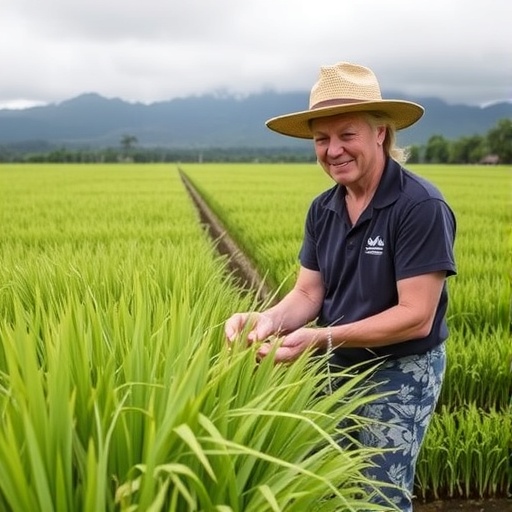
For decades, the idea of reviving rice farming across the Hawaiian Islands—where the crop was once a thriving staple before vanishing in the 1960s—has seemed like an agricultural fantasy. Now, an international team of researchers has not only brought premium Japanese rice varieties back to Hawaiian soil but has done so using a water-saving technique that produced grains larger, more translucent, and of higher quality than those grown in Japan, all while maturing a full month faster than usual. The unexpected success, published in Frontiers in Agronomy, offers a blueprint for island nations and water-scarce regions worldwide to reclaim local food production in an era of climate instability.
Hawai‘i today is a stark example of food dependency: nearly every grain of rice consumed across the archipelago is imported, leaving the state vulnerable to shipping disruptions, global price spikes, and extreme weather events. Rice was historically grown in flooded paddies across the islands by Asian immigrant communities, but competition for water, rising labor costs, and the dominance of sugarcane and pineapple plantations pushed the crop into extinction by the mid-twentieth century. Thousands of hectares of former plantation land have since lain fallow, while the state’s rice self-sufficiency remains at essentially zero percent. The challenge of re-establishing rice in Hawai‘i has always been water—the traditional paddy method demands enormous volumes, a resource not easily spared on isolated volcanic islands.
The research team from Tokyo University of Agriculture and Technology and the University of Hawai‘i at Mānoa took a radical departure from the conventional paddies by employing upland cultivation, a method where rice is grown directly in well-drained soil, much like wheat or corn, and irrigated only sparingly. This approach slashes water use, lowers the cost of land preparation, and adapts perfectly to the gently sloping, unused plantation terrains of Kaua‘i. In March 2025, they planted two iconic Japanese short-grain cultivars, Koshihikari and Hitomebore, on a farm in Kapa‘a, Kaua‘i, while running identical trials at their experimental fields in Tokyo for side-by-side comparison. The Hawai‘i plots received only rainfall and occasional supplemental watering, never the continuous flooding that defines typical rice production.
The results upended expectations. The Hawai‘i-grown rice reached harvest about four weeks earlier than the same varieties in Tokyo, a dramatic shortening of the growth cycle driven by Hawai‘i’s lower latitude and shorter day lengths. Despite the compressed timeline, yields held steady at approximately four metric tons per hectare—matching standard upland yields in Japan and confirming that the early maturity did not come at the cost of productivity. The real surprise, however, came when the researchers assessed grain quality. The brown rice kernels harvested in Hawai‘i were significantly larger and notably more translucent, with a markedly lower proportion of chalky, opaque grains. Chalkiness is a common defect in rice exposed to high temperatures during the grain-filling stage, causing the starchy interior to scatter light poorly and reducing both culinary and market value.
To understand why Hawaiian conditions produced such superior grains, the team delved into the environmental and physiological drivers. The tropical photoperiod triggered earlier flowering, naturally restricting the number of grains that each panicle set. This built-in, climate-induced limitation turned out to be a blessing: with fewer grains competing for the plant’s photosynthetic resources, the sugars and starches produced during the post-flowering period could be channeled intensively into each individual kernel. Compounding the effect, the critical grain-filling phase in Hawai‘i unfolded under day after day of intense, uninterrupted solar radiation and moderately warm temperatures—conditions that maximized photosynthesis without pushing the plants into heat stress. Professor Shunsuke Adachi, who led the study, explained that this source-sink balance is precisely what breeders strive for, yet here it emerged naturally from the environment.
Public tastings held on the University of Hawai‘i campus drew enthusiastic crowds and gave the project a palpable sense of momentum. The locally grown Koshihikari and Hitomebore—varieties revered in Japan for their sticky texture and mild sweetness—retained their celebrated culinary properties while carrying an added narrative of island resilience. The researchers now envision a pathway from experimental plots to school cafeterias, with the rice eventually branded as a premium Hawaiian product that supports food education and reduces dependence on imports. The initiative, supported by Japan’s Peak Research Universities program, is already mapping out low-cost, scalable production models that local farmers can adopt without the prohibitive infrastructure of flooded paddies.
Beyond the shores of Hawai‘i, the findings resonate with regions from the Caribbean to the Pacific Islands to sub-Saharan Africa, where water scarcity and high food import bills collide. Upland rice, once considered a lower-yielding compromise, emerges here as a technique that can deliver both calorie security and exceptional quality when paired with the right genetics and environmental insight. The Hawaiian experiment demonstrates that by working with a location’s natural photoperiod and solar intensity, rather than fighting them, agriculture can turn perceived climatic disadvantages into product-defining advantages. As climate change redraws the maps of where and how crops can grow, such adaptive strategies will be essential.
The work carries historical echoes, too. Reviving rice on Kaua‘i reconnects the islands with a crop that once stitched together the cultural fabric of plantation communities. Today’s revival, however, is rooted in cutting-edge agronomy rather than nostalgia. The field sensors tracking solar radiation, the physiological models explaining grain translucency, and the genetic potential of Japanese cultivars all converge to make this a thoroughly modern agricultural feat. If the project scales as intended, Hawai‘i-grown rice could transform from an impossibility into a sought-after staple that tells a story of science, sustainability, and self-reliance.
Subject of Research: Yield formation and grain quality of Japanese rice cultivars under upland conditions in Hawai‘i and Japan
Article Title: Comparative analysis of yield formation and grain quality of Japanese rice cultivars under upland cultivations in Hawai‘i and Japan
News Publication Date: 4 May 2026
Web References: 10.3389/fagro.2026.1826804
References: Frontiers in Agronomy, DOI: 10.3389/fagro.2026.1826804
Image Credits: Professor Shunsuke Adachi, Tokyo University of Agriculture and Technology, Japan
Keywords: Upland rice, food security, Hawai‘i, grain quality, Koshihikari, Hitomebore, water-saving agriculture, photoperiod sensitivity, grain filling, climate adaptation


