


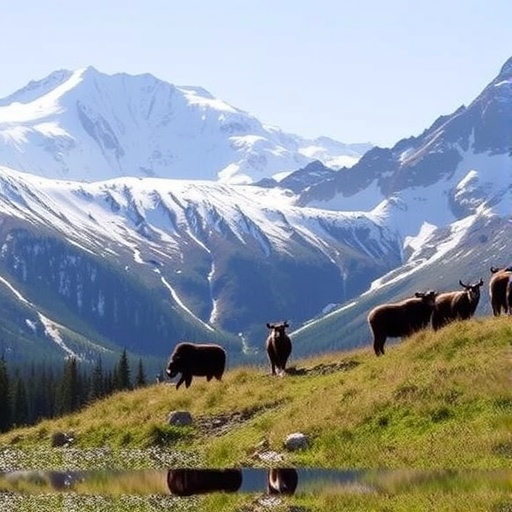
In the expansive alpine meadows of the Qingzang Plateau, a land shaped by the relentless presence of yaks and their intricate relationship with the fragile ecosystem, scientists have unveiled surprising new insights into greenhouse gas emissions linked to livestock excreta. Nitrous oxide (N₂O), a potent greenhouse gas with substantial warming potential and an ability to deplete stratospheric ozone, has long been known to emanate from nitrogen-rich patches created by grazing animals’ urine and dung. Yet, until recently, the interactions between these combined excretions and their effect on soil microbial processes remained poorly understood.
A groundbreaking field study has now challenged assumptions about how urine and dung influence soil N₂O emissions in these unique high-altitude grasslands. Contrary to the intuitive expectation that overlapping urine and dung patches would compound their individual emissions—simply summing to a larger total—the data reveals an antagonistic interaction. Rather than additive or synergistic, the emissions from combined urine and dung deposition were notably lower than the theoretical sum derived from observing urine-only and dung-only contributions.
This phenomenon offers critical nuance to the understanding of nitrogen cycling within alpine meadows, where millions of yaks graze and maintain the ecosystem balance. Researchers meticulously set up an in-situ experiment on the Qingzang Plateau to juxtapose four different treatments: plots without any excreta inputs, those receiving only yak urine, others with only yak dung, and finally plots with co-application of both urine and dung. The quantification of N₂O fluxes from these treatment zones allowed for detailed evaluation of how nitrogen inputs and soil biochemical activity translate into greenhouse gas emissions.
The findings were unequivocal in showing that urine deposition substantially outweighs dung in driving soil N₂O emissions. Measurements indicated that urine-treated plots emitted cumulative N₂O amounts of approximately 295.82 grams of nitrogen per hectare over the experimental period—more than fourfold higher than the 72.29 grams per hectare observed from dung-only plots. This stark contrast was attributed to the bioavailability of nitrogen in urine, its immediate impact on elevating soil pH levels, and intensified nitrification processes, which accelerate the transformation of nitrogen compounds producing N₂O as a byproduct.
Despite this dominance of urine emissions, the combined urine-plus-dung treatment did not further amplify N₂O outputs as hypothesized based on additive models. Instead, emissions plateaued at roughly 296.45 grams per hectare—a figure nearly indistinguishable from the urine-only scenario and well below the sum predicted by adding dung and urine effects separately. The researchers quantified this with a proportional change value under one (0.84), signaling an antagonistic relationship wherein the presence of dung somehow moderated or mitigated net N₂O emissions in the presence of urine.
Delving deeper into causal mechanisms, the study suggested that two concurrent yet countervailing microbial processes could explain these observations. On one side, the combined nitrogen and carbon sources from the overlapping excreta likely promoted N₂O-generating pathways such as nitrification and denitrification. Conversely, components inherent in dung may enhance the soil’s potential to reduce N₂O further to innocuous nitrogen gas (N₂), effectively serving as a biological sink. This dualism, under the dry environmental conditions prevailing during the experiment, seemingly maintained a flux equilibrium preventing the proportional rise in emissions that additive logic would expect.
The implications of this research reverberate across ecological modeling and greenhouse gas accounting in grazing systems worldwide. If current emission inventories and predictive frameworks fail to incorporate such antagonistic interactions between co-applied excreta types, they risk overestimating the greenhouse gas footprint of yak grazing, particularly within alpine meadows. Yanjiang Cai, the study’s corresponding author, emphasized that these nuanced microbial interactions and their dependence on environmental variables necessitate more refined modeling inputs tailored to region-specific dynamics.
Moreover, the researchers highlighted the critical role of soil moisture status as a modulating factor in dictating emission outcomes. Comparative analysis with studies from more humid contexts revealed that wetter conditions often foster synergistic effects wherein urine and dung together elevate N₂O emissions above additive forecasts. In contrast, drier alpine soils, akin to the Qingzang Plateau experiment, exhibit the antagonistic patterns observed here. This moist-dry gradient underscores the complexity of biogeochemical feedbacks that govern nitrogen transformations and their trace gas emissions.
Beyond emissions accounting, the findings furnish fresh perspectives on yak grazing’s ecological influences in these vulnerable highland ecosystems. Understanding how nutrient inputs interact within soil microbial networks helps unravel how grazing patterns affect nitrogen cycling strength, soil health, and ecosystem resilience. This knowledge may ultimately inform sustainable pasture management strategies that balance livestock productivity with minimizing environmental harm.
The study’s experimental design, integrating precise measurement of gas fluxes with soil chemical and microbiological analyses, embodies the kind of field-based empirical research essential for advancing nitrogen cycling science. The findings beckon further investigations into how animal behavior patterns—such as congregation at watering spots—shape excreta spatial distribution and consequent greenhouse gas impacts. Likewise, deepening insight into microbially mediated nitrogen pathways under varying climatic and soil moisture regimes promises to refine global biogeochemical models.
As climate change poses growing threats to alpine and pastoral ecosystems, dissecting the fine-scale mechanisms controlling trace gas emissions in grazing contexts becomes ever more urgent. This research provides an invaluable piece of that puzzle, revealing that the interactions between urine and dung deposition are not straightforward, but instead mediated by intricate microbial feedbacks susceptible to environmental constraints. Harnessing this understanding can help navigate more accurate greenhouse gas inventories and potentially uncover mitigation avenues embedded within ecosystem processes.
While urine has taken center stage in explaining nitrous oxide emissions, recognizing the mitigating role of dung underscores the need for a holistic view of excreta effects. The antagonistic effects observed call for caution against oversimplified assumptions in emissions modeling that treat urine and dung as additive contributors. The alpine meadow ecosystem on the Qingzang Plateau thus exemplifies a natural laboratory where ecology, microbiology, and climate science intersect.
In conclusion, this study marks a significant advancement in comprehending nitrogen-based greenhouse gas emissions within yak-grazed alpine meadows. Its demonstration of antagonistic interactions between urine and dung excreta deposition disrupts prevailing paradigms and opens new avenues for research aimed at aligning livestock management with environmental stewardship. Continued pursuit of such integrative field studies promises to enrich our understanding of nitrogen cycling’s complexity in some of the planet’s most sensitive and impactful ecosystems.
News Publication Date: 13-Apr-2026
Web References: https://doi.org/10.48130/nc-0026-0005
References: Fan B, Jiang W, Wang Y, Liang H, Chen H, et al. 2026. Co-application of yak urine and dung deposition antagonistically affected soil nitrous oxide emissions in an alpine meadow. Nitrogen Cycling 2: e018.
Cite Scienmag News
Russell Cooper. (July 4, 2026). Unexpected Greenhouse Gas Fluctuations Uncovered in Alpine Meadows by New Yak Waste Study. Scienmag. https://scienmag.com/unexpected-greenhouse-gas-fluctuations-uncovered-in-alpine-meadows-by-new-yak-waste-study/
Russell Cooper. "Unexpected Greenhouse Gas Fluctuations Uncovered in Alpine Meadows by New Yak Waste Study." Scienmag, 4 July 2026, https://scienmag.com/unexpected-greenhouse-gas-fluctuations-uncovered-in-alpine-meadows-by-new-yak-waste-study/. Accessed 4 September 2026.
Russell Cooper. "Unexpected Greenhouse Gas Fluctuations Uncovered in Alpine Meadows by New Yak Waste Study." Scienmag. July 4, 2026. https://scienmag.com/unexpected-greenhouse-gas-fluctuations-uncovered-in-alpine-meadows-by-new-yak-waste-study/


