


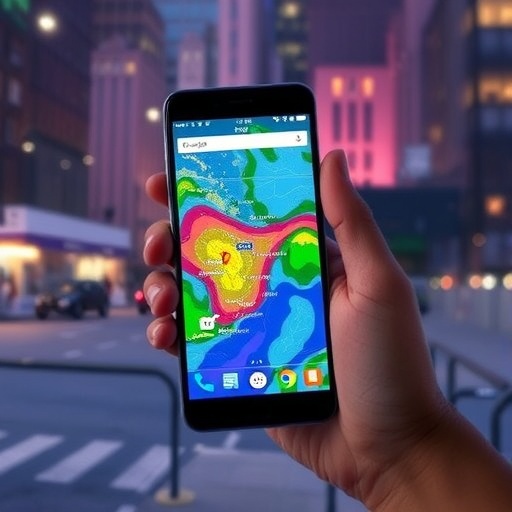
Smartphones could soon become more than pocket-sized weather assistants. According to a new study from researchers at Peking University, the barometric pressure sensors already built into millions of mobile phones may help meteorologists improve forecasts of dangerous storms, including hailstorms that can intensify and shift within minutes. When pressure observations gathered from smartphones were incorporated into a high-resolution weather model, the system produced a substantially more accurate simulation of a damaging hailstorm over Beijing. The result points toward a possible new generation of weather observation networks—one assembled not from thousands of specialized stations, but from the phones people already carry every day.
The research, published in Advances in Atmospheric Sciences, focuses on a fundamental challenge in severe-weather prediction. Thunderstorms are driven by atmospheric processes that can change rapidly across very short distances. Warm, moist air may surge into one neighborhood while cooler, denser air spreads across another. Pressure can fall or rise as storm-scale circulations develop, but conventional weather stations are often separated by many kilometers. That spacing may be sufficient for monitoring broad weather patterns, yet it can miss the localized signals that determine where a storm strengthens, produces hail, or unleashes intense rainfall. A dense network of low-cost observations could provide weather models with a much more detailed picture of the atmosphere near the ground.
Many smartphones contain microelectromechanical-system barometers designed primarily to support functions such as altitude estimation, indoor navigation, and location services. These sensors measure atmospheric pressure electronically, generally detecting tiny changes through the movement of a microscopic mechanical component. Although an individual phone’s readings can be affected by temperature, device design, indoor conditions, or elevation, large numbers of measurements may reveal meaningful patterns when the data are carefully calibrated. The researchers explored whether these imperfect but abundant observations could be transformed into useful information for numerical weather prediction.
For their test, the team examined a severe hailstorm that struck Beijing on June 30, 2021. The researchers used anonymized pressure measurements collected, with users’ consent, through the Moji Weather mobile application. Before the observations could be used, the raw readings had to be corrected for errors and inconsistencies. The team applied machine-learning methods to process the measurements, accounting for differences among devices and attempting to distinguish genuine atmospheric signals from noise caused by buildings, sensor behavior, and other local effects. The cleaned observations were then assimilated into a high-resolution numerical weather model, allowing the model to update its description of the atmosphere as the storm evolved.
Data assimilation is a central technique in modern forecasting. Weather models calculate how temperature, pressure, moisture, wind, and other variables change according to physical equations. However, even the most advanced model begins with an imperfect representation of the real atmosphere. Data assimilation combines the model’s previous forecast with observations, weighting each according to its estimated reliability. In this study, smartphone pressure readings supplied additional information about the near-surface pressure field. That information helped the model adjust the storm’s structure and evolution, producing a more realistic simulation of the event.
The improvement was significant. Assimilating the smartphone observations increased hail forecast skill by approximately 14 to 17 percent and generated a better representation of where hail occurred and how the storm developed. In the Beijing case, the smartphone-derived measurements performed better overall than observations from traditional weather stations. Their advantage did not come from greater precision at any single location. Instead, it came from density: smartphones were distributed throughout populated areas, creating a finely spaced network capable of capturing pressure gradients and local changes that a sparse station network might overlook. In rapidly developing convection, such small-scale information can influence forecasts of storm intensity and location.
“Surface pressure contains useful information about the development and movement of convective storms, but traditional station networks cannot always observe these features in sufficient detail,” said Rumeng Li, the study’s corresponding author. The value of smartphones, Li explained, lies in their existing presence across cities. Establishing new meteorological stations requires land, equipment, maintenance, communications infrastructure, and long-term funding. By contrast, a smartphone-based observing system could potentially expand as more people use participating applications. If the data are collected responsibly and processed with rigorous quality control, the same devices that receive weather alerts could also help generate the observations behind them.
The approach nevertheless has important limitations. Smartphone measurements are not distributed evenly across the landscape. They are concentrated in places where people live, work, and travel, while forests, mountains, farmland, and sparsely populated areas may have few contributing devices. That imbalance was especially important in the Beijing storm because the system began developing over mountainous terrain, where smartphone observations were relatively scarce. The data improved the forecast after the storm moved into the city, but they could not fully correct errors in the earlier stages of storm formation. Smartphone observations also require careful handling of privacy, consent, location uncertainty, sensor calibration, and quality control before they can support operational warnings.
The researchers describe the Beijing analysis as an initial demonstration rather than proof that smartphones can replace conventional weather infrastructure. Future studies will need to test the method across many storms, climates, cities, and population distributions. Researchers will also need to determine how pressure data can be combined with radar, satellites, lightning networks, weather stations, and other sources of information. Even with those challenges, the concept offers an unusual route toward more localized forecasting. A phone network could provide high-frequency observations in places where conventional instruments are too expensive or too widely spaced, while also delivering warnings directly to the people most at risk. “Smartphones could help fill part of that gap by contributing pressure observations to forecast models,” said Qinghong Zhang, the project leader. The long-term vision is a cooperative system in which personal devices, meteorological stations, and radar work together to improve short-term predictions of hail, damaging winds, torrential rain, and other rapidly developing hazards.
News Publication Date: 25-Jul-2026
Web References: https://doi.org/10.1007/s00376-026-5647-y
References: Advances in Atmospheric Sciences, DOI: 10.1007/s00376-026-5647-y
Cite Scienmag News
Russell Cooper. (August 13, 2026). Could smartphone data help forecast the next storm? Scienmag. https://scienmag.com/could-smartphone-data-help-forecast-the-next-storm/
Russell Cooper. "Could smartphone data help forecast the next storm?" Scienmag, 13 August 2026, https://scienmag.com/could-smartphone-data-help-forecast-the-next-storm/. Accessed 4 September 2026.
Russell Cooper. "Could smartphone data help forecast the next storm?" Scienmag. August 13, 2026. https://scienmag.com/could-smartphone-data-help-forecast-the-next-storm/


