


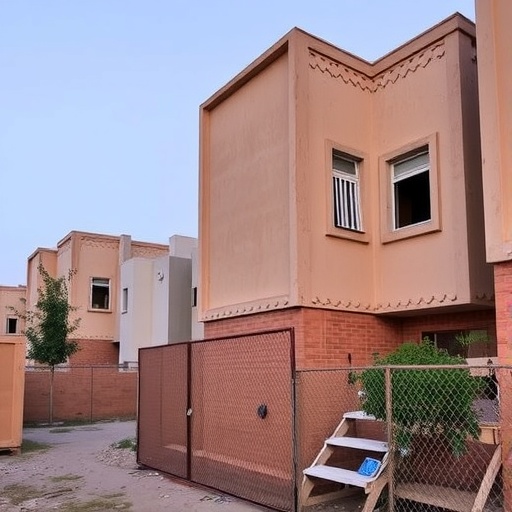
North Sinai’s social-housing blocks could become significantly more comfortable—and potentially less dependent on energy-intensive cooling—by turning local waste into building materials, according to a new study published in Scientific Reports. The research by Y. Eid examines whether discarded materials can be repurposed as thermal retrofit components for existing homes, addressing two urgent problems at once: the harsh heat experienced by residents and the growing environmental burden of construction and household waste. Rather than treating waste only as a disposal challenge, the study frames it as a potential resource for upgrading buildings that were not designed to perform well in the region’s demanding climate.
North Sinai presents a particularly difficult test for housing design. The region experiences intense solar radiation, high summer temperatures and substantial differences between daytime and nighttime conditions. In buildings with poorly insulated walls and roofs, outdoor heat can pass through the envelope and raise indoor temperatures long after the sun has set. Residents may respond by using fans or air-conditioning, but cooling equipment increases electricity demand and can be unaffordable for low-income households. In social housing, where residents often have limited control over the building’s original construction, retrofit measures must be inexpensive, practical and capable of being installed without major disruption.
The study focuses on the building envelope—the walls, roofs, windows and other surfaces separating indoor spaces from the outdoor environment. This envelope controls the rate at which heat enters or escapes a building. A key technical measure is thermal transmittance, commonly expressed as the U-value. A lower U-value means that a wall or roof allows less heat to pass through it under a given temperature difference. Materials with low thermal conductivity can reduce heat flow, while thick, dense materials can delay the movement of heat through a wall. That delay, known as thermal lag, is especially important in hot climates because it can shift peak heat entering a room from the hottest part of the afternoon to a cooler evening period.
Waste-derived materials may support both forms of thermal protection. Some agricultural and industrial residues contain porous structures that trap air, and trapped air is a poor conductor of heat. When processed into insulation, panels, blocks or composite layers, these materials can reduce conductive heat transfer through walls and roofs. Other waste-based products may add thermal mass, allowing a building component to absorb and store heat before releasing it later. The performance of any proposed material, however, depends on more than its origin. Density, moisture content, particle size, compaction, bonding agents and installation thickness all influence thermal conductivity and long-term behavior.
Eid’s analysis is significant because it considers retrofit strategies in the context of existing North Sinai housing rather than focusing exclusively on new construction. Retrofitting is technically more complicated than designing a building from the beginning. The structure must accommodate additional layers, existing walls may have uneven surfaces, and interventions must avoid blocking ventilation, damaging finishes or creating moisture problems. A measure that performs well in a laboratory may be impractical if it requires specialized equipment or expensive transportation. By assessing waste-based options for real social-housing conditions, the research addresses the gap between promising material science and solutions that residents can actually use.
The thermal effect of a retrofit is also shaped by the entire building system. Improving a roof may deliver major benefits because roofs receive direct solar exposure and can become powerful sources of indoor heat gain. Wall insulation can be particularly valuable where buildings are exposed to prolonged sunlight or where construction consists of thin masonry with limited thermal resistance. Windows and ventilation openings introduce another challenge: even a well-insulated wall can be undermined by unshaded glazing, air leakage or poorly controlled ventilation. Effective strategies therefore need to consider conduction through solid materials, solar radiation through openings and the movement of warm air through gaps.
The environmental case for using waste is broader than energy savings during a building’s operation. Conventional insulation and construction products can require significant quantities of raw materials and industrial energy, while discarded materials may create landfill pressure, pollution or uncontrolled burning. Reusing waste in retrofit components could reduce the demand for virgin resources and lower the amount of material sent to disposal. Yet the environmental advantage is not automatic. Processing, transporting, drying and binding waste can consume energy, and some products may contain additives that complicate recycling at the end of their service life. A complete evaluation must therefore consider both operational performance and the material’s life cycle.
For residents, the most immediate question is whether a retrofit changes the experience of living through a North Sinai summer. Thermal performance is commonly assessed through indoor air temperature, surface temperature, heat flux and cooling-load calculations. When the building envelope resists heat transfer more effectively, indoor temperatures can remain closer to the comfort range for longer periods, potentially reducing the time that mechanical cooling is required. Lower cooling demand can reduce household electricity costs and ease pressure on local energy infrastructure. The health implications may also be important, because prolonged exposure to excessive indoor heat can increase risks for older adults, children and people with cardiovascular or respiratory conditions.
The study also highlights the importance of durability and safety. Organic waste materials can be vulnerable to moisture, biological deterioration or fire if they are not properly treated and protected. A retrofit layer must remain stable under repeated heating and cooling cycles, resist water intrusion and maintain its insulating properties over time. Fire resistance is particularly important in multi-unit housing, where a failure in one dwelling can affect neighboring residents. These concerns do not eliminate the potential of waste-based materials, but they show why successful implementation requires testing, standards and careful detailing rather than simply placing untreated waste inside a wall.
The broader message from North Sinai is that climate adaptation and waste reduction do not have to be separate policy goals. In regions where housing is exposed to extreme heat and construction budgets are limited, locally available waste could become part of a new generation of low-cost retrofit solutions. The approach could be adapted to other hot, rapidly developing areas, provided that materials are matched to local climate conditions and validated for structural, thermal, moisture and fire performance. Eid’s research places social housing at the center of that discussion, suggesting that the most valuable innovation may not be a futuristic building system, but a practical way to upgrade existing homes while transforming discarded resources into protection from a warming climate.
Cite Scienmag News
Violet Maxwell. (August 16, 2026). Waste-Based Retrofits Improve Thermal Performance in North Sinai Social Housing. Scienmag. https://scienmag.com/waste-based-retrofits-improve-thermal-performance-in-north-sinai-social-housing/
Violet Maxwell. "Waste-Based Retrofits Improve Thermal Performance in North Sinai Social Housing." Scienmag, 16 August 2026, https://scienmag.com/waste-based-retrofits-improve-thermal-performance-in-north-sinai-social-housing/. Accessed 3 September 2026.
Violet Maxwell. "Waste-Based Retrofits Improve Thermal Performance in North Sinai Social Housing." Scienmag. August 16, 2026. https://scienmag.com/waste-based-retrofits-improve-thermal-performance-in-north-sinai-social-housing/


