


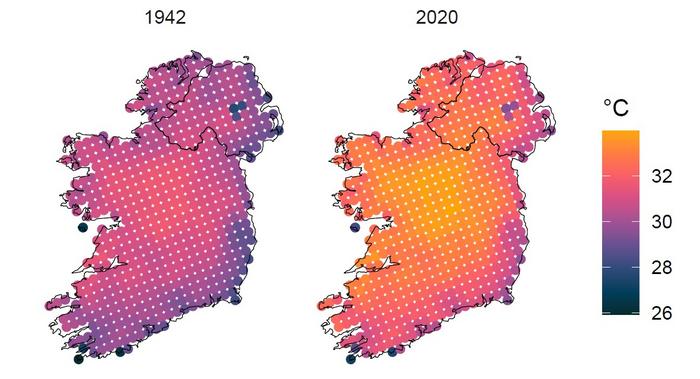
A temperature event of 33 degrees Celsius in Dublin’s Phoenix Park has gone from being a 1 in 180-year event in 1942 to a 1 in 9-year event in 2020, according to a new study led by Ireland’s Maynooth University.

Credit: Prof Andrew Parnell and Dr Daire Healy of the Hamilton Institute at Maynooth University
A temperature event of 33 degrees Celsius in Dublin’s Phoenix Park has gone from being a 1 in 180-year event in 1942 to a 1 in 9-year event in 2020, according to a new study led by Ireland’s Maynooth University.
The study, which developed a new model to predict the frequency, magnitude and spatial extent of extreme summer temperature events in Ireland, also estimates that a temperature of more than 34 degrees Celsius — a value not yet recorded in Ireland – changed from a 1 in 1,600-year event to a 1 in 28-year event between 1942 and 2020.
The study was carried out by a team of researchers led by Prof Andrew Parnell and Dr Dáire Healy of the Hamilton Institute at Maynooth University, in collaboration with Prof Peter Thorne of Maynooth University’s ICARUS Climate Research Centre and Prof Jonathan Tawn of Lancaster University in the UK.
“We found that spatial heatwave events over thresholds that are critical for society have become much larger, having at least doubled in extent for 28 degree Celsius, with this change increasing at more extreme temperatures,” Dr Healy said.
The findings were detailed in a recent paper “Inference for Extreme Spatial Temperature Events in a Changing Climate with Application to Ireland” and were read to The Royal Statistical Society at a meeting on ‘Statistical Aspects of Climate Change’ held online on June 3, 2024.
According to Prof Parnell: “We are often focussed on average changes, and particularly focus on the Paris Climate Agreement of 1.5 degrees Celsius. What we have shown here is that the changes in extremes are much larger than the changes in the average, and are something we should be seriously concerned about.”
He said the findings underscored the urgency for societal adaptation to increasing extreme temperature events, which have profound implications for public health, agriculture, economic stability, and infrastructure resilience. The research team believe that the model’s ability to predict spatial patterns of extreme events offers a powerful tool for policymakers and stakeholders to mitigate risks and plan for future climate scenarios.
The model captures both location and temporal variations in extreme daily maximum temperatures using new mathematical techniques. Analysis by the research team identifies a significant change in the behaviour of extreme temperature events over time, which exceeds the observed changes in mean temperature levels over the same period.
The full study can be found here.
Journal
Journal Of The Royal Statistical Society
Method of Research
Observational study
Subject of Research
Not applicable
Article Title
Inference for Extreme Spatial Temperature Events in a Changing Climate with Application to Ireland
Cite Scienmag News
Violet Maxwell. (July 2, 2024). Extreme temperatures becoming more common in Ireland, Maynooth University study finds. Scienmag. https://scienmag.com/extreme-temperatures-becoming-more-common-in-ireland-maynooth-university-study-finds/
Violet Maxwell. "Extreme temperatures becoming more common in Ireland, Maynooth University study finds." Scienmag, 2 July 2024, https://scienmag.com/extreme-temperatures-becoming-more-common-in-ireland-maynooth-university-study-finds/. Accessed 3 September 2026.
Violet Maxwell. "Extreme temperatures becoming more common in Ireland, Maynooth University study finds." Scienmag. July 2, 2024. https://scienmag.com/extreme-temperatures-becoming-more-common-in-ireland-maynooth-university-study-finds/

