


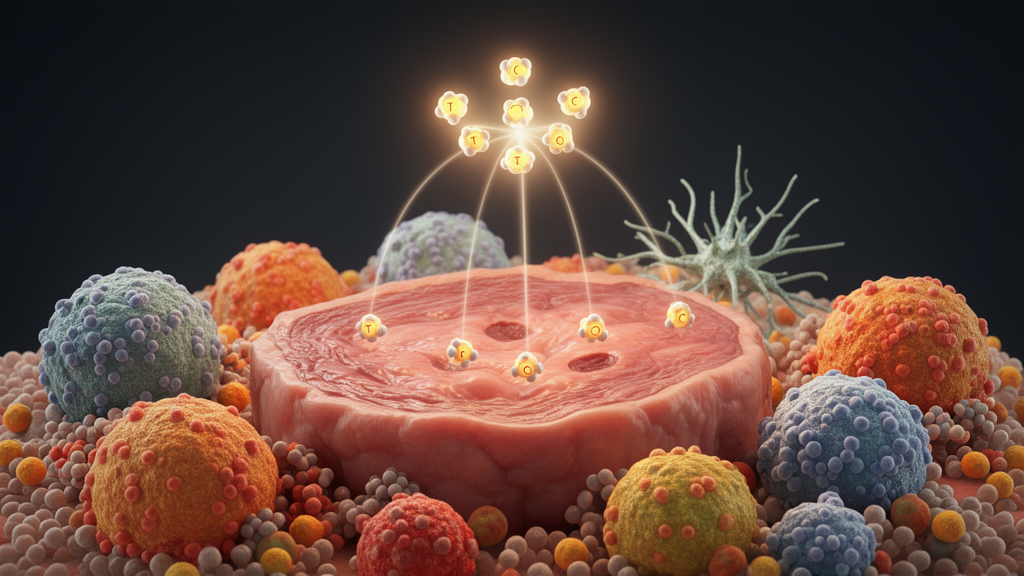
Gastric cancer remains one of the world’s most lethal malignancies, accounting for roughly 4.9 percent of all cancer diagnoses and 6.8 percent of cancer deaths globally, and ranking third in cancer mortality in China. Even as first-line immunotherapy regimens tested in trials such as CheckMate-649, ORIENT-16, and KEYNOTE-811 have delivered meaningful survival gains for selected patients with advanced disease, primary and acquired resistance remain common. A new study published in Frontiers in Oncology now offers an integrated look at how molecular signatures and immune features intertwine in this disease, developing an eight-gene prognostic score and tracing one of its components, RGS1, all the way from single-cell transcriptomics to stained tissue sections from more than one hundred patients.
The research team, led by investigators at the Fourth Hospital of Hebei Medical University and Baoding No. 1 Central Hospital in Hebei, China, began with an exploratory question rooted in etiology: Helicobacter pylori, the bacterium responsible for an estimated ninety percent of non-cardia gastric cancers worldwide, is known to reshape the tumor immune microenvironment. Yet whether H. pylori-associated transcriptional features persist and matter after malignant transformation has remained poorly characterized. The global prevalence of H. pylori infection has declined but still exceeds forty percent, with a pooled estimate of approximately 42.8 percent in China between 2014 and 2023, and only one to three percent of infected individuals ever develop gastric cancer, making the infection’s downstream immunological footprint a genuinely open question.
To probe that question, the researchers analyzed a single-cell RNA-sequencing dataset, GSE234129, comprising three H. pylori-positive and three H. pylori-negative gastric cancer patients. After stringent quality control yielded 5,109 high-quality cells, clustering annotated eight major cell types, including T cells, B cells, monocytes, fibroblasts, endothelial cells, NK cells, plasma cells, and mast cells. Descriptive comparisons suggested that H. pylori-positive samples contained relatively higher proportions of T cells, including CD8-positive exhausted T cells and regulatory T cells, along with lower proportions of monocytes, mast cells, and fibroblasts. Cell-level differential expression identified 163 candidate genes distributed mainly in T cells, monocytes, and B cells, with enrichment of antigen processing and presentation pathways and MHC-related functions.
The authors were careful to flag the fragility of these single-cell findings. Because only six patients were included, they performed a patient-level pseudobulk sensitivity analysis on T cells to guard against cellular pseudoreplication, aggregating raw counts from patients with at least twenty T cells and applying edgeR with TMM normalization. Among 9,046 tested genes, none met the strict thresholds of a log2 fold change of at least one and a false discovery rate below 0.05, although 78 genes met nominal exploratory criteria. The team therefore framed the H. pylori-related compositional and transcriptional patterns as hypothesis-generating context rather than definitive differences, a caution that runs throughout the paper.
From the 163 candidate genes, the researchers built their prognostic model in the TCGA-STAD cohort of 383 gastric cancer patients. Univariable Cox regression retained 38 genes with p below 0.20, LASSO Cox regression with ten-fold cross-validation trimmed the list to 14, and multivariable Cox modelling with bidirectional AIC-based stepwise selection settled on a final eight-gene signature: RGS1, CXCR4, CXCR6, TMSB4X, APOD, RPS4X, RPS5, and RPS18. Patients stratified by the median risk score showed markedly poorer overall survival in the high-risk group, with p below 0.0001, and apparent time-dependent AUCs of 0.72, 0.69, and 0.77 at one, three, and five years. The signature also stratified survival in two independent external cohorts, GSE26899 and GSE15459, though discrimination varied between datasets.
Crucially, the team did not stop at apparent performance. They repeated the entire modelling pipeline, from univariable screening through LASSO and stepwise selection, in 1,000 bootstrap resamples to quantify optimism. The corrected C-index came out at a modest 0.575, with corrected one-, three-, and five-year AUCs of 0.612, 0.558, and 0.636, indicating limited discrimination once model-development optimism was accounted for. Comparative analyses showed the eight-gene score outperformed a previously published 32-gene gastric cancer signature in matched TCGA-STAD patients and added incremental value to a clinicopathological model based on age, sex, and pathological stage. The full signature also beat RGS1 alone, with a C-index of 0.673 versus 0.574, and a nested likelihood-ratio test confirmed improved fit when the remaining seven genes were included.
Because three of the eight genes, RPS4X, RPS5, and RPS18, encode ribosomal proteins that might reflect general transcriptional or cellular-composition effects rather than disease-specific biology, the researchers ran sensitivity analyses. When all ribosomal genes were excluded from the candidate pool and the pipeline repeated, all five non-ribosomal components were independently reselected, and removing the ribosomal contributions with fixed coefficients produced only modest drops in apparent discrimination. In the H. pylori-annotated GSE62254 cohort, the five non-ribosomal genes showed directionally higher expression in H. pylori-positive tumors with nominal gene-set-level enrichment by CAMERA at P equal to 0.044, though the composite eight-gene risk score itself did not differ significantly by H. pylori status. The authors concluded that the model was not entirely dependent on ribosomal signals but that H. pylori specificity was not established.
The high- and low-risk groups also diverged genomically and immunologically. Low-risk tumors showed significantly higher tumor mutational burden and were more often associated with microsatellite instability, while risk scores were higher in microsatellite-stable tumors. Pathway analyses linked high risk scores to epithelial-mesenchymal transition, angiogenesis, Hedgehog signaling, and coagulation, whereas low-risk tumors showed greater activity of cell-cycle, MYC, and DNA repair programs. CIBERSORT and ESTIMATE analyses associated low-risk tumors with more plasma cells, CD8-positive T cells, and follicular helper T cells, and the risk score correlated positively with the stromal score. TIDE and immunophenoscore analyses suggested differences in computationally inferred immune-response features, but when the team examined observed anti-PD-1 response in the disease-matched PRJEB25780 cohort, the risk score did not differ between responders and non-responders, and the authors explicitly cautioned against interpreting the computational features as evidence of differential immunotherapy benefit.
The strongest tissue-level signal came from RGS1, a regulator of chemokine receptor signaling predominantly expressed in T cells in the single-cell data, where CellChat-based inference suggested interactions including MIF binding to the CD74-CXCR4 complex. In an immunohistochemical cohort of 128 surgically resected gastric cancer patients with documented H. pylori status, RGS1 protein was higher in tumors than in adjacent normal mucosa and higher in H. pylori-positive tumors. High RGS1 expression was independently associated with poorer overall survival after multivariable adjustment, with a hazard ratio of 2.36 and a 95 percent confidence interval of 1.36 to 4.10, and H. pylori positivity itself carried a hazard ratio of 2.28 in the complete-case analysis, a finding that remained significant after excluding patients assessed by serology alone. RGS1-high tumors showed lower CD8-positive T-cell density alongside higher CD163-positive macrophage and FOXP3-positive regulatory T-cell staining, and the combined H. pylori-positive, RGS1-high group showed the least favorable survival pattern.
The study’s limitations are as prominent as its findings. The prognostic model was derived from retrospective datasets with limited optimism-corrected discrimination, the single-cell dataset comprised only six patients, the immunohistochemical cohort came from a single center with heterogeneous H. pylori diagnostic methods, and EBV status and PD-L1 combined positive scores were unavailable for direct comparison. The authors position the eight-gene score as an exploratory, survival-associated molecular measure rather than a clinically validated tool, and they frame RGS1 as an association requiring functional work on T-cell migration and ligand-receptor signaling before any mechanistic claims. Intriguingly, RGS1 expression was higher in anti-PD-1 responders despite its adverse prognostic association, a reminder that prognostic and treatment-response biomarkers need not coincide. Prospective multicenter validation, the team concludes, is the necessary next step before any of these signals reach the clinic.
Subject of Research: An eight-gene prognostic signature and its immune associations in gastric cancer
Article Title: An eight-gene prognostic signature and its immune associations in gastric cancer: integrated transcriptomic and clinical analyses
Article References: Wen, D., Mi, L., Zhang, Y., Ji, Y., Yang, B., & Yin, F. (2026). An eight-gene prognostic signature and its immune associations in gastric cancer: integrated transcriptomic and clinical analyses. Frontiers in Oncology, 16, Article 1930319. https://doi.org/10.3389/fonc.2026.1930319
Image Credits: AI Generated
DOI: 10.3389/fonc.2026.1930319
Keywords: gastric cancer, Helicobacter pylori, prognostic signature, RGS1, tumor immune microenvironment, immunotherapy, TCGA, single-cell RNA sequencing, biomarker, survival analysis, eight-gene, prognostic
Cite Scienmag News
Nathaniel Bowman. (October 26, 2026). Eight-Gene Signature Ties Immune Landscape to Gastric Cancer Survival. Scienmag. https://scienmag.com/eight-gene-signature-ties-immune-landscape-to-gastric-cancer-survival/
Nathaniel Bowman. "Eight-Gene Signature Ties Immune Landscape to Gastric Cancer Survival." Scienmag, 26 October 2026, https://scienmag.com/eight-gene-signature-ties-immune-landscape-to-gastric-cancer-survival/. Accessed 26 October 2026.
Nathaniel Bowman. "Eight-Gene Signature Ties Immune Landscape to Gastric Cancer Survival." Scienmag. October 26, 2026. https://scienmag.com/eight-gene-signature-ties-immune-landscape-to-gastric-cancer-survival/


