


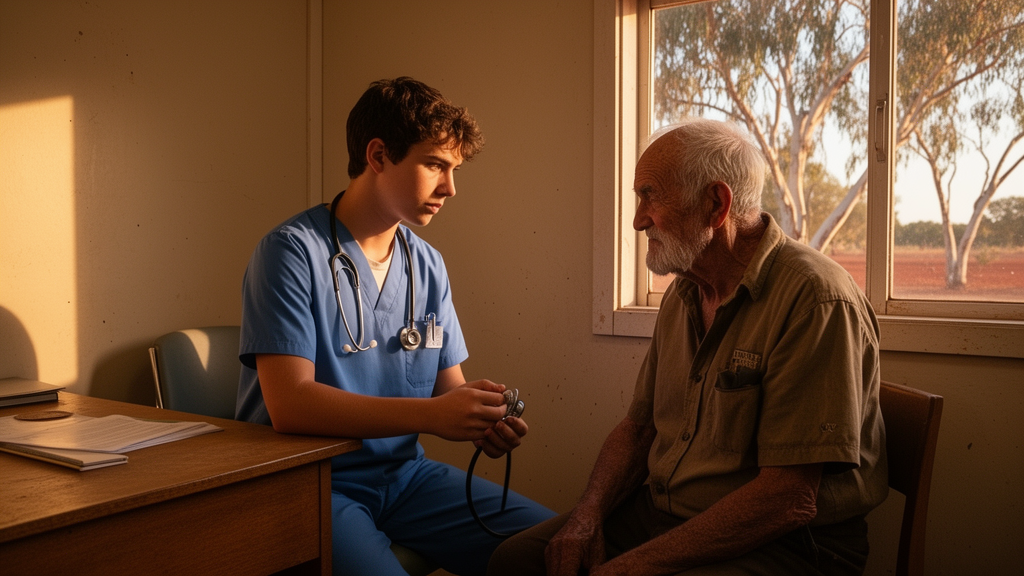
A medical workforce crisis continues to grip rural Australia, and while strategies to steer graduates into country practice have worked for larger rural towns and regional centres, communities with fewer than 10,000 residents still face critical workforce shortages. A new qualitative study published in BMC Medical Education examines whether a shortened version of a training model already credited with boosting rural exposure could help address that gap. Researchers evaluated a six-month Longitudinal Integrated Clerkship, or LIC, run in small rural communities, asking whether the compressed format could still prepare students for internship and nurture a lasting ambition to practise rurally.
Longitudinal Integrated Clerkships have been found effective in increasing student exposure to rural medicine. There is existing evidence that twelve-month placements support readiness to practise as a medical graduate and improve rural retention. The catch is capacity: longer placements limit how many students can access the experience at all. Shortening the placement to six months is one strategy being used to provide rural training opportunities for more students in small rural communities, and the new study set out to evaluate the impacts, benefits and challenges of that shorter model.
The research team, led by Jacqueline Epps and colleagues, took a qualitative approach. They conducted interviews with ten students or recent graduates of the six-month LIC program and with three general practitioner supervisors, then applied reflexive thematic analysis to the transcripts. The analysis surfaced three broad themes: the learning environment, the structure of the LIC program, and work readiness.
Those themes, the authors report, supported core LIC principles: continuity of relationships, transformational experiences, and the development of professional identity. Students and supervisors described how the program shaped learning and how its structure influenced whether graduates felt prepared for the demands of internship. The supervisors’ perspectives added a picture of how general practices in very small towns host and mentor students within a compressed timeframe.
The study’s conclusion is deliberately measured. The authors state that the findings provide qualitative support for a shorter, six-month LIC program in small rural communities, both in facilitating student aspirations toward rural practice and in preparing graduates for internship in the Australian context. Because the evidence comes from interviews with a small number of participants at a single program, it speaks to experiences and perceptions rather than measuring objective outcomes such as subsequent employment locations or retention rates. The authors frame the work as having implications for the further development of LIC placements in small communities to expand rural training opportunities for medical students.
The significance of the study lies in the tension it addresses. Australia’s rural medical workforce shortage is most acute in the smallest communities. Longer LIC placements have a track record, but their duration inherently restricts how many students can take part. If a halved placement can retain the continuity of relationships, transformational experiences and professional identity development that the LIC model is built on, more students could gain authentic rural experience in small communities. That trade-off between duration and access is precisely what this evaluation was designed to probe.
It is worth noting what the study does not claim. As a qualitative evaluation based on thirteen interviews, it cannot establish that six-month placements produce the same retention benefits documented for twelve-month programs, nor can it quantify how many additional students a shortened model would ultimately place into rural practice. The authors present their findings as qualitative support for further development of shorter LICs in small communities, not as proof of equivalence with longer placements. The paper was published as an open-access article on 1 September 2026 and is being shared early to provide faster access to peer-reviewed, accepted research, with a final Version of Record to follow.
For the communities involved, the stakes are concrete. The reported experiences of general practitioner supervisors hosting students within a six-month window offer program designers direct insight into what is feasible on the ground in towns of under 10,000 people. For students, the study suggests that a shorter immersion can still support the continuity of relationships, transformational experiences and professional identity that longitudinal models are known for, while opening rural training opportunities to more graduates. Whether the six-month format translates into durable workforce change in Australia’s smallest towns remains a question for future evaluation.
Subject of Research: Qualitative evaluation of six-month longitudinal integrated clerkships for preparing medical graduates for rural practice in small Australian communities
Article Title: Preparing medical graduates for Australian rural practice: a qualitative evaluation of shorter longitudinal integrated clerkships in small communities
Article References: Epps, J., Puxty, M., Fatema, S. R., Bowles, E. J., Rice, K., & Guppy, M. (2026). Preparing medical graduates for Australian rural practice: a qualitative evaluation of shorter longitudinal integrated clerkships in small communities. BMC Medical Education. https://doi.org/10.1186/s12909-026-10202-0
Image Credits: AI Generated
DOI: 10.1186/s12909-026-10202-0
Keywords: medical education, rural health, Longitudinal Integrated Clerkship, Australia, workforce shortage, qualitative research, internship readiness, general practitioner supervisors, small rural communities, BMC Medical Education, Preparing, medical
Cite Scienmag News
Courtney Benton. (October 26, 2026). Shorter rural clerkships show promise for preparing medical graduates in small Australian communities. Scienmag. https://scienmag.com/shorter-rural-clerkships-show-promise-for-preparing-medical-graduates-in-small-australian-communities/
Courtney Benton. "Shorter rural clerkships show promise for preparing medical graduates in small Australian communities." Scienmag, 26 October 2026, https://scienmag.com/shorter-rural-clerkships-show-promise-for-preparing-medical-graduates-in-small-australian-communities/. Accessed 26 October 2026.
Courtney Benton. "Shorter rural clerkships show promise for preparing medical graduates in small Australian communities." Scienmag. October 26, 2026. https://scienmag.com/shorter-rural-clerkships-show-promise-for-preparing-medical-graduates-in-small-australian-communities/


