


A survey of 772 Chinese track and field athletes suggests that the road to better competitive results may run through an unexpected set of psychological gears. According to a study published in Frontiers in Psychology, athletes who reported stronger self-management — the ability to regulate their own training behavior, physical condition, mental state, and daily routines — also reported better athletic performance, and much of that relationship appeared to flow through two sequential psychological variables: psychological resilience and competitive spirit. The findings, grounded in self-regulation theory, point to a layered mechanism in which disciplined behavioral control is associated with adaptive psychological capacity, which in turn is associated with the motivation to compete and win.
The research team, led by Zhengzheng Fan of Qufu Normal University and Liaocheng University, with colleagues from Shandong University and Kyungpook National University, framed the question against the backdrop of increasingly intense competition in competitive sport. Track and field presents a particularly demanding test case: training cycles are long, physical loads are high, and results fluctuate easily with changes in an athlete’s physical and psychological condition. While previous studies had linked self-management, resilience, and competitive motivation to performance-related outcomes individually, the authors argued that these variables had largely been examined in isolation. Their goal was to integrate behavioral self-regulation, psychological adaptation, and competitive motivation within a single sequential framework.
From a self-regulation perspective, athletic performance can be understood as a goal-oriented outcome whose formation depends on an athlete’s capacity to plan, monitor, and adjust during training and competition. Self-management, in this view, reflects active regulation across four domains captured by the Athletes Self-Management Questionnaire used in the study: physical management, interpersonal relationship management, training management, and mental management. Athletes with higher self-management are generally more proactive in arranging training, pursuing physical recovery, regulating emotions, and making timely adjustments based on training feedback — capacities that earlier work on high-level athletes has associated with stricter psychological, training, and physical management routines.
The researchers recruited participants through non-probability convenience sampling across Shandong, Liaoning, Jiangsu, Henan, Hebei, Hunan, and Hubei Provinces and through track and field clubs in other regions of China, distributing the questionnaire via the online survey platform Wenjuanxing with assistance from teachers and coaches. Of 847 questionnaires collected, 75 were excluded after screening for incompleteness, patterned responding, response time, and duplicate submissions, leaving 772 valid responses — an effective rate of 91.1 percent. The sample was heavily skewed: 679 participants (88.0 percent) were male, 597 (77.3 percent) had a high school education, and 685 (88.7 percent) were sprinters rather than long-distance runners. Athletic levels ranged from 94 first-level athletes (12.2 percent) to 258 non-ranked athletes (33.4 percent), the latter defined as participants without an official athletic-level classification at the time of the survey. Training experience varied widely, from 283 athletes with one to two years of training (36.7 percent) to 70 with more than six years (9.0 percent).
Four established scales, each translated, back-translated, and contextually adapted for Chinese track and field athletes and reviewed by three independent experts in sport psychology, physical education, and sport measurement, measured the study variables on 5-point Likert formats. Psychological resilience was assessed with the 27-item Resilience Quotient Test, covering control, positivity, and sociality. Competitive spirit was measured with the 18-item Competitive Spirit Scale, capturing fighting spirit, self-confidence, and desire to win. Athletic performance was assessed with the 14-item Athletic Performance Scale, covering competition operation ability, competition confidence, and technical level ability — a self-report measure of perceived performance-related functioning rather than objective competition results. Reliability was strong across the board, with Cronbach’s alpha values of 0.895 for self-management, 0.931 for resilience, 0.897 for competitive spirit, and 0.887 for performance.
Before hypothesis testing, the team ran a battery of statistical quality checks using SPSS 31.0 and AMOS 31.0. A single-factor confirmatory model, in which all measurement items loaded onto one latent factor, showed substantially poorer fit than the complete multifactor model, indicating that serious common method bias was unlikely to threaten the findings — though the authors noted that residual bias from same-time-point self-report data cannot be fully excluded. The overall measurement model fit the data well, with a chi-square to degrees of freedom ratio of 1.214 and an RMSEA of 0.017. Confirmatory factor analysis showed standardized factor loadings exceeding 0.70, composite reliability values between 0.853 and 0.921, and average variance extracted values between 0.529 and 0.625, supporting convergent validity, while the square root of each construct’s AVE exceeded its correlations with the others, supporting discriminant validity. Correlations among the four variables ranged from 0.426 to 0.523, all significant at the 0.01 level, with no multicollinearity concerns.
The structural equation model, tested with 5,000 bootstrap samples and bias-corrected confidence intervals, delivered the study’s central results. The direct path from self-management to athletic performance was significant, with an effect of 0.234 (95 percent CI [0.035, 0.418]). Psychological resilience alone carried a significant indirect effect of 0.203 (CI [0.044, 0.421]), and competitive spirit alone carried a significant indirect effect of 0.080 (CI [0.008, 0.234]). Most notably, the serial mediation pathway — self-management to resilience to competitive spirit to performance — was significant with an effect of 0.141 (CI [0.059, 0.325]), and the total effect of the model reached 0.658 (CI [0.528, 0.794]). Standardized path coefficients told a consistent story: the link from self-management to resilience was particularly strong at 0.69, resilience to competitive spirit at 0.58, and competitive spirit to performance at 0.39.
Interpreted as a psychological sequence, the chain suggests that disciplined self-management first strengthens athletes’ sense of control over training and competition processes, making it easier to maintain a stable mindset and recovery capacity when facing setbacks, stress, and performance fluctuations. Stronger resilience, in turn, may help athletes perceive pressure and competition as challenges rather than threats, stimulating competitive spirit — the psychological tendency to pursue victory and excellent results — and transforming psychological adaptability into stronger training commitment and competition execution. The authors connect this to recent evidence that resilience functions as a dynamic adaptive process shaped by cognitive, emotional, and behavioral regulation rather than a fixed personal trait, and that achievement-oriented motivation is meaningfully related to sport performance across competitive settings. Their model positions competitive spirit not merely as an independent motivational characteristic, but as a motivational pathway through which self-management is associated with performance-related functioning.
The practical implications reach beyond technical and physical training. The authors recommend that coaches and sport team managers incorporate the cultivation of self-management, psychological resilience, and competitive spirit into daily training systems — through training plan management, phased goal setting, training log recording, recovery status monitoring, and post-competition feedback to build self-regulation habits; through pressure-situation simulation, review of failure experiences, and emotional regulation training to strengthen psychological recovery; and through guidance toward positive, healthy, and stable competitive goals rather than a simple emphasis on results. In their conclusion, the researchers argue that self-management should be regarded as an important psychological and behavioral foundation for improving athletic performance, not merely a component of daily life management or training discipline.
Still, the study’s limitations temper any headline-level enthusiasm. Because the design was cross-sectional and all variables were measured at a single time point, the reported pathways are statistical associations rather than demonstrated causal effects, and the temporal ordering of the mechanisms remains a theoretical assumption. The reliance on self-report questionnaires leaves room for subjective judgment, recall bias, and social desirability effects, and the authors suggest that future research combine self-report data with competition results, coach evaluations, and training monitoring. The sample’s imbalance — predominantly male and sprint-oriented, with one-third of participants non-ranked and no objective performance indicators such as competition times, personal bests, or official rankings — limits generalizability to female athletes, other track and field disciplines, and athletes with documented competitive histories. Longitudinal tracking, cross-lagged models, and experimental intervention designs are the logical next steps for verifying whether building self-management, resilience, and competitive spirit in sequence actually moves the stopwatch.
Subject of Research: Chain mediation of self-management, psychological resilience, and competitive spirit in the athletic performance of Chinese track and field athletes
Article Title: Exploring the influence of track and field athletes' self-management on athletic performance: the chain mediating role of psychological resilience and competitive spirit
Article References: Fan, Z., Ni, Y., & Shen, Y. (2026). Exploring the influence of track and field athletes' self-management on athletic performance: the chain mediating role of psychological resilience and competitive spirit. Frontiers in Psychology, 17, Article 1934680. https://doi.org/10.3389/fpsyg.2026.1934680
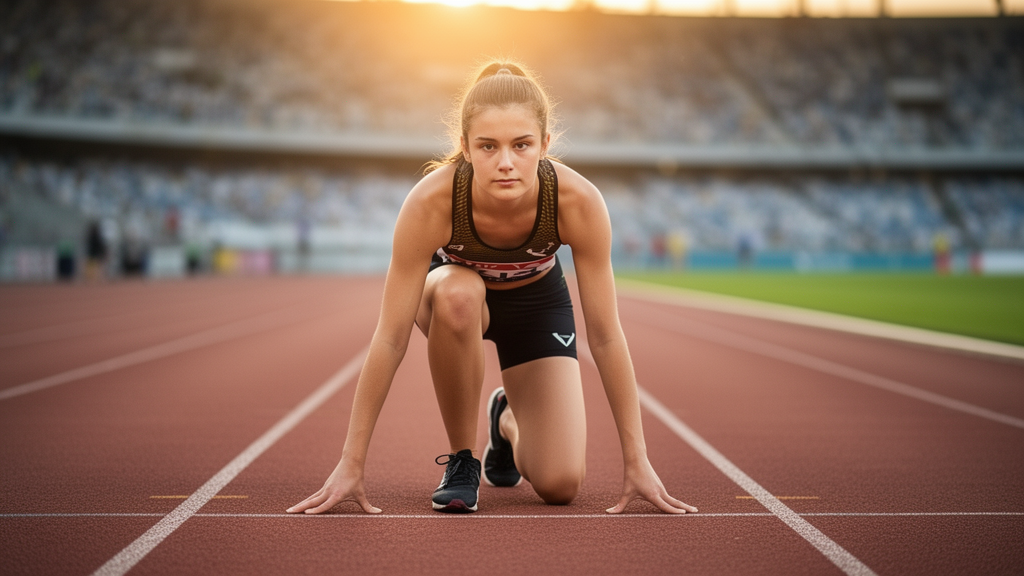
Image Credits: AI Generated
DOI: 10.3389/fpsyg.2026.1934680
Keywords: self-management, athletic performance, psychological resilience, competitive spirit, track and field, chain mediation, structural equation modeling, sport psychology, cross-sectional survey, bootstrap analysis, Chinese athletes, Exploring
Cite Scienmag News
Glenn Wilkins. (October 26, 2026). Self-Management Linked to Better Track Performance Through Resilience and Competitive Spirit. Scienmag. https://scienmag.com/self-management-linked-to-better-track-performance-through-resilience-and-competitive-spirit/
Glenn Wilkins. "Self-Management Linked to Better Track Performance Through Resilience and Competitive Spirit." Scienmag, 26 October 2026, https://scienmag.com/self-management-linked-to-better-track-performance-through-resilience-and-competitive-spirit/. Accessed 26 October 2026.
Glenn Wilkins. "Self-Management Linked to Better Track Performance Through Resilience and Competitive Spirit." Scienmag. October 26, 2026. https://scienmag.com/self-management-linked-to-better-track-performance-through-resilience-and-competitive-spirit/


