


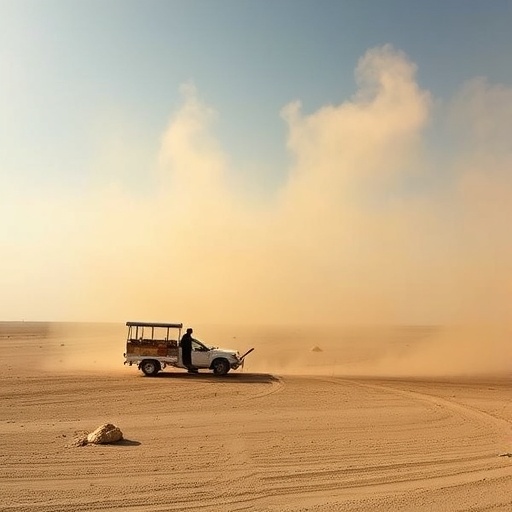
In a groundbreaking new study poised to reshape our understanding of Earth’s climate system, researchers have uncovered that desert dust contributes twice the amount of longwave radiative heating than current climate models estimate. This revelation unravels a critical miscalculation in how the cooling and warming effects of atmospheric particles are represented in climate projections, promising significant implications for future forecasting and mitigation strategies.
Desert dust, tiny particles lifted from arid landscapes and carried across continents, has long been recognized for its complex role in Earth’s energy balance. Traditionally, climate models have placed a stronger emphasis on the dust’s ability to reflect incoming solar radiation, thereby producing a net cooling effect. However, the new research led by Johan F. Kok and his international team indicates that the warming effect, specifically due to longwave radiation trapping by dust aerosols, has been substantially underestimated.
Utilizing advanced observational data combined with refined radiative transfer techniques, the team meticulously analyzed dust’s interaction with thermal infrared radiation. Their findings indicate that the longwave radiative heating—the process by which dust absorbs and re-emits Earth’s outgoing infrared radiation—is about double what has previously been incorporated into coupled climate models. This discrepancy points toward a critical gap in how dust aerosol feedbacks are integrated within both regional and global climate simulations.
One striking aspect of this research is the implication for the atmospheric energy budget. Desert dust’s enhanced longwave warming effect strengthens the greenhouse-like characteristics of aerosols and implies that dust can contribute considerably to atmospheric warming. This effect may intensify temperature gradients and alter atmospheric circulation patterns that play a significant role in weather and climate systems worldwide.
Moreover, deserts, particularly those of the Sahara, the Arabian Peninsula, and Central Asia, are among the largest natural sources of mineral dust aerosols. As global temperatures rise and desertification expands, the volume of airborne dust is predicted to increase further. The newfound understanding of the greater heating effect suggests that these dust aerosols could amplify regional warming, potentially fueling feedback loops that exacerbate droughts, heatwaves, and disruptions in monsoon systems.
The study also addresses an ongoing challenge in climate science: accurately quantifying aerosol-radiation interactions across different wavelengths. Previous models primarily emphasized the dust’s direct shortwave scattering and absorption effects, which cool the planet by reflecting sunlight back to space. Conversely, the absorption and re-emission of longwave radiation have been notoriously difficult to parameterize due to the complex optical properties of dust particles, which vary with size, composition, and shape.
By integrating satellite observations from multiple missions with ground-based measurements and state-of-the-art modeling frameworks, Kok and colleagues refined their estimates of dust aerosol optical properties in the thermal infrared spectrum. This multidisciplinary approach resolved critical uncertainties and enabled them to quantify how dust particles absorb and emit longwave radiation more precisely.
The consequences of this enhanced radiative warming extend beyond the atmosphere alone. Increased atmospheric heating caused by dust can modify surface energy exchanges, influence evapotranspiration rates, and alter the dynamics of cloud formation downwind of dust source regions. These cascading effects underscore the need for incorporating improved dust radiative properties into Earth system models for risk assessments and climate adaptation planning.
These findings urge the scientific community to revisit aerosol forcing estimates in climate projections. As atmospheric dust’s radiative impact is far more pronounced than accounted for, existing climate models may have systematically underestimated anthropogenic and natural warming potentials, particularly in arid and semi-arid regions. This could recalibrate predicted temperature trajectories, precipitation patterns, and extreme weather event frequencies under future greenhouse gas emission scenarios.
The research further opens new pathways for refining climate intervention strategies. For instance, if dust aerosols exert greater warming than previously known, geoengineering concepts that rely on injecting particles into the atmosphere for cooling purposes must consider potential unintended longwave heating effects to avoid counterproductive outcomes.
Furthermore, this study highlights the importance of continuous improvements in aerosol monitoring networks, with a call for enhanced instrumentation capable of resolving fine-scale dust optical properties and their evolution over time. The advent of new Earth observation satellites equipped with infrared sensors will be pivotal in further validating these results and extending monitoring capabilities globally.
While desert dust’s dual role in simultaneously cooling through sunlight reflection and warming through thermal radiation complicates its climate impact, the balance, as now demonstrated, tilts more prominently toward warming than recognized. This realization transforms our conceptual models of aerosol-cloud-climate interactions, emphasizing the nuanced and sometimes paradoxical behavior of natural particles in the atmosphere.
In summary, the study by Kok et al. underscores a critical need to recalibrate climate models by integrating more accurate representations of desert dust’s longwave radiative effects. Doing so could yield more realistic climate sensitivities and better inform policymaking aimed at mitigating climate change impacts, especially in vulnerable dryland regions where dust emissions are both a symptom and driver of environmental change.
As the scientific community digests these findings, the immediate challenge lies in translating enhanced physical understanding into practical model updates and climate risk assessments. The profound implications of underestimated aerosol warming effects necessitate swift action to refine predictive tools and guide adaptive responses amidst a rapidly warming world.
This pivotal study represents a compelling leap forward in climate science, revealing how even the smallest grains of desert sand wield a powerful influence on the global climate system—one that has been hiding in plain sight, obscured by the complexity of aerosol physics and the vastness of the atmosphere.
Cite Scienmag News
Russell Cooper. (April 29, 2026). Desert Dust Warms Atmosphere Twice Climate Estimates. Scienmag. https://scienmag.com/desert-dust-warms-atmosphere-twice-climate-estimates/
Russell Cooper. "Desert Dust Warms Atmosphere Twice Climate Estimates." Scienmag, 29 April 2026, https://scienmag.com/desert-dust-warms-atmosphere-twice-climate-estimates/. Accessed 3 September 2026.
Russell Cooper. "Desert Dust Warms Atmosphere Twice Climate Estimates." Scienmag. April 29, 2026. https://scienmag.com/desert-dust-warms-atmosphere-twice-climate-estimates/


