


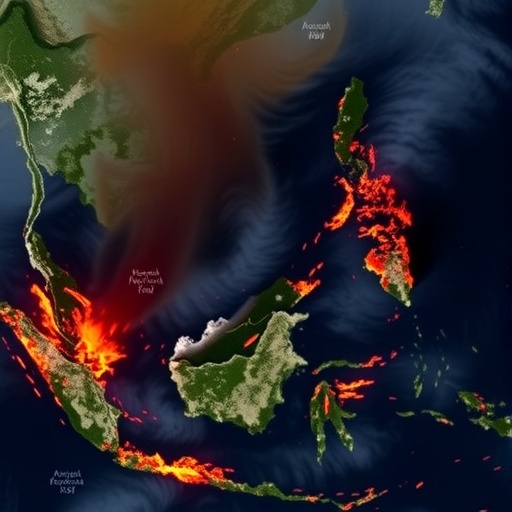
In a groundbreaking study set to reshape our understanding of fire dynamics in Southeast Asia, researchers have unveiled the subtle yet expansive increase in fire activity across continental tropical Asia. The study, published in Nature Communications (2026), meticulously dissects the multifaceted natural and anthropogenic drivers behind this phenomenon, revealing a complex interplay that has quietly altered the region’s ecological and atmospheric landscapes. Unlike the dramatic wildfires seen in other parts of the world, the expansion here has been less conspicuous but equally transformative.
Tropical Asia, a biodiverse and climatically complex region, has traditionally experienced fire regimes governed largely by seasonal patterns and natural vegetation cycles. However, this nuanced research by Cai, Chen, Yu, and their colleagues documents a persistent increase in fire occurrences that contradicts previous assumptions of stability. Their detailed analysis integrates satellite data, ground observations, and climate modeling to paint a comprehensive picture of this silent expansion, which has largely eluded the spotlight until now.
One of the study’s remarkable revelations is the identification of subtle anthropogenic influences that amplify fire frequency and intensity. Human activities such as agricultural burning, land clearance, and infrastructural development contribute synergistically with climatic factors to extend fire seasons and increase ignition hotspots. The scientists harnessed advanced algorithms to differentiate between fires ignited by natural causes and those induced by human actions, affirming that anthropogenic forces are not just appendages but key drivers in the observed trends.
The natural factors influencing fire activity, including prolonged dry spells and shifts in monsoonal patterns, also received extensive attention. The researchers demonstrate how climate variability and gradual warming trends create conducive conditions for fires to ignite and spread more readily. These alterations in weather patterns, driven in part by global climate change, exacerbate pre-existing vulnerabilities in tropical ecosystems, leading to a feedback loop that intensifies fire regimes further.
This study offers technical insights into the mechanisms by which fire activity escalates in tropical Asia’s distinct ecological zones. Using high-resolution remote sensing data from satellites like MODIS and VIIRS, the research team delineated fire perimeters and pyro-cumulative effects across different biomes—from dense evergreen forests to dry deciduous woodlands. Such granularity allows for a better understanding of fire distribution patterns and the underlying vegetation characteristics that influence fire behavior.
Furthermore, the research highlights the interplay between fire and carbon dynamics within the region. Fires act as considerable sources of carbon emissions, undermining efforts for climate mitigation. Yet, in some biomes, fire also plays a role in nutrient cycling and regeneration. Balancing these ecological roles against the detrimental impacts of increased fire frequency presents a significant management challenge, one that the study addresses through an integrated assessment framework combining ecological, atmospheric, and socio-economic data.
Importantly, the work underscores how the silent expansion of fire activity has systemic consequences. Beyond localized ecological damage, heightened fire regimes affect air quality, public health, and regional weather. The episodic haze events that periodically blanket major urban centers in tropical Asia have roots linked intimately to this quiet but persistent fire proliferation. The research draws connections to respiratory health crises and economic disruptions, emphasizing the urgent need for targeted fire management policies.
The team employed machine learning models to predict future fire trends under varying climate and land-use scenarios. These predictive models suggest that without intervention, fire activity will continue to increase, potentially reaching unprecedented levels by mid-century. This modeling integrates various forcing factors, including demographic growth, agricultural intensification, and climate projections from the latest CMIP6 datasets, offering policy-makers valuable foresight for mitigation strategies.
From a methodological standpoint, the article stands out for its rigorous use of cross-validation techniques to ensure data reliability and avoid overfitting in predictive analyses. The researchers’ commitment to open data principles has enabled the development of an accessible fire monitoring platform that stakeholders across governments, NGOs, and academia can utilize in real-time. This technological advancement bridges the gap between science and actionable decision-making.
The paper also delves into historical fire occurrence patterns, juxtaposing paleoecological data with contemporary observations. This longitudinal approach reveals how ancient human civilizations and climatic shifts previously influenced fire regimes, placing current trends in a broader temporal context. Such insights highlight the resilience and vulnerability of tropical Asia’s ecosystems to sustained fire perturbations.
In addressing solutions, the study advocates for integrated fire management approaches that incorporate traditional ecological knowledge held by indigenous and local communities. These communities’ practices, often overlooked in mainstream conservation efforts, offer sustainable fire control methods attuned to the region’s unique social and environmental fabric. Collaborative governance models appear vital in reconciling development goals with ecological preservation.
On the policy front, the scientific evidence presented supports calls for stricter regulations on land conversion practices and improved monitoring of agricultural fire use. The authors argue for the harmonization of regional efforts, as fire and smoke pollution transcend national boundaries, affecting millions. Enhanced cross-border cooperation and investment in fire prevention infrastructure are thus posited as crucial steps forward.
The broader scientific community has responded enthusiastically to this study’s comprehensive scope and methodological rigor. It sets a new standard for integrating multi-disciplinary data streams to unravel complex environmental phenomena. The findings are anticipated to catalyze further inquiry into tropical fire ecology, climate-fire feedbacks, and ecosystem management under global change pressures.
Ultimately, this seminal work underscores a pressing reality: the silent expansion of fire activity in continental tropical Asia is an emergent environmental crisis shaped by intertwined natural and human forces. Addressing it requires holistic approaches encompassing science, policy, and community engagement. As tropical Asia stands at the crossroads of ecological change, this research provides a crucial scientific foundation for safeguarding its forests, air quality, and the health of millions who depend on them.
Cite Scienmag News
Violet Maxwell. (May 19, 2026). Rising Fire Activity in Tropical Asia Uncovered. Scienmag. https://scienmag.com/rising-fire-activity-in-tropical-asia-uncovered/
Violet Maxwell. "Rising Fire Activity in Tropical Asia Uncovered." Scienmag, 19 May 2026, https://scienmag.com/rising-fire-activity-in-tropical-asia-uncovered/. Accessed 4 September 2026.
Violet Maxwell. "Rising Fire Activity in Tropical Asia Uncovered." Scienmag. May 19, 2026. https://scienmag.com/rising-fire-activity-in-tropical-asia-uncovered/


