


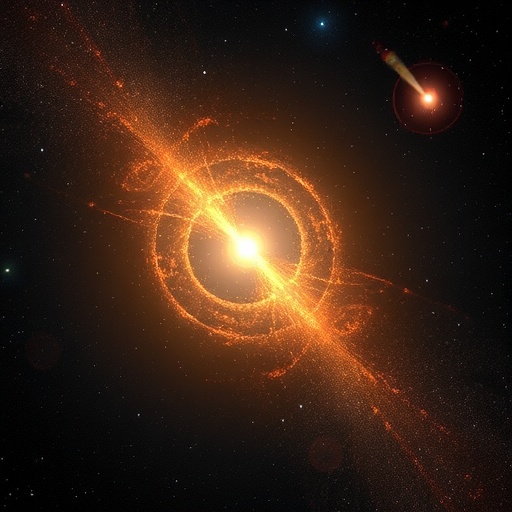
Astronomers have made a groundbreaking discovery deep in the cosmos, unveiling the flickering behavior of a quasar from the dawn of the universe. This finding, made by a team including researchers from the Massachusetts Institute of Technology (MIT), unravels pivotal clues about the earliest epochs of supermassive black hole formation and challenges long-standing theories about how these enigmatic giants evolve in the cosmic infancy. The quasar’s subtle variations in brightness, observed from a time just 850 million years after the Big Bang, offer an unprecedented window into the physical structure of its accretion disk, reshaping our understanding of black hole maturation at cosmic dawn.
Supermassive black holes, often billions of times the mass of our Sun, serve as the gravitational anchors at the centers of most galaxies, including our own Milky Way. When actively accreting matter, these cosmic behemoths blaze as quasars, some of the brightest and most energetic objects observable in the universe. Quasars emit copious radiation as gas and dust spiral inward, heated to extreme temperatures in their accretion disks. This light flickers irregularly as the black hole feeds, a phenomenon providing key insights into the dynamics of accretion and black hole growth. The detection of such flickering from one of the universe’s earliest quasars marks a significant milestone in astrophysics.
The quasar flicker detected by the MIT-led team represents the earliest known variability observed from such an object, emerging from what astronomers term the “cosmic dawn.” This period, occurring roughly 850 million years post-Big Bang, was thought to host only nascent galaxies and immature black holes. Contradicting previous assumptions, the observed quasar exhibited variability patterns similar to those found in more contemporary quasars, suggesting that the physical processes governing black hole accretion were already established at these primordial times.
Gene Leung, a postdoctoral researcher at MIT’s Kavli Institute for Astrophysics and Space Research, explains that prior detections of quasars from the early universe showed bright, steady light sources but lacked the tell-tale flickering patterns that reveal underlying accretion processes. The detection of flicker is critical because it directly relates to fluctuations in how material is ingested by the black hole. Such fluctuations imprint themselves in the light output, encoding information about the accretion disk’s geometry and the feeding mechanisms at work.
Unexpectedly, the flickering quasar’s accretion disk appeared surprisingly flat and thin, resembling a “pancake” rather than the puffier, chaotic structures anticipated for black holes at such early stages of growth. This finding puzzles astronomers, as conventional wisdom suggests that youthful black holes in the young universe should exhibit turbulent, unstable accretion disks, reflecting ongoing rapid growth phases. Instead, this quasar’s disk mirrors the more orderly structures typically associated with mature, settled black holes.
Anna-Christina Eilers, an assistant professor of physics at MIT and a co-author on the study, interprets this evidence as suggesting that the tumultuous, rapid growth stages of supermassive black holes precede the luminous quasar phase visible to current telescopes. In other words, the messy early feeding epochs might occur so swiftly and early that by the time we observe the quasar’s brilliant light, the black hole’s accretion disk has already stabilized into a flat, well-organized structure.
This revelation adds to one of cosmology’s deepest enigmas: How did supermassive black holes form and reach immense mass so quickly in the early universe? The presence of such sophisticated accretion disks at cosmic dawn implies that significant growth and structural organization happened on remarkably short timescales, challenging existing models of black hole evolution and opening new avenues for theoretical and observational research.
Detecting flickering from such a distant quasar was a formidable technical challenge. Owing to cosmic expansion, the quasar’s emitted light is not only stretched to longer, infrared wavelengths — a phenomenon known as redshift — but its temporal flickering expands correspondingly. What might be a variation over weeks in the quasar’s frame becomes a gradual fluctuation observed over many months or years from Earth. This necessitated infrared observations over extended durations with high sensitivity.
The team turned to data collected by NASA’s NEOWISE mission, a space-based infrared survey telescope with a 14-year archive monitoring the entire sky at infrared wavelengths. High-quality, time-resolved infrared data provided the ideal dataset to detect the subtle, long-term flickering signal from the distant quasar. Utilizing refined data processing techniques developed by former MIT postdoc Kishalay De, now at Columbia University, the researchers extracted the earliest evidence of quasar variability from the cosmic dawn.
The flickering exhibited stochastic variations in brightness by up to 20 percent, equivalent to luminosity shifts of approximately 2 trillion times that of our Sun. Such variations imply fluctuating accretion rates and provide a rare glimpse into the black hole’s feeding habits in an epoch close to the universe’s infancy. By analyzing flicker behavior across multiple wavelengths, the researchers could infer temperature gradients within the disk, enabling them to map its structure and confirm its thin, flat morphology.
This discovery not only underscores that the physical mechanics of black hole accretion recognized in the modern universe were already in place shortly after the Big Bang but also poses profound implications for models of galaxy and black hole coevolution. Supermassive black holes exert powerful influence on their host galaxies, regulating star formation and galactic growth through energetic feedback processes. Understanding how early black holes matured thus impacts our grasp of galaxy formation and evolution across cosmic time.
Looking ahead, the team aims to push observational boundaries even further, seeking to identify flickering quasars at even earlier times. Capturing the nascent stages of black hole development promises to unravel the initial phases of black hole assembly and accretion disk formation. Such insights will illuminate the conditions prevailing in the first billion years and potentially solve the mystery of how black holes achieved such enormous masses so rapidly after the dawn of the universe.
Funded in part by NASA, this study represents a collaborative effort between MIT Kavli and multiple global institutions. It advances our cosmic understanding through innovative reuse of archival data and sets a benchmark for future infrared time-domain surveys. The insights gained from this flickering quasar discovery herald a new era in the study of black hole physics, galaxy evolution, and the earliest chapters of cosmic history.
Written by Jennifer Chu, MIT News
News Publication Date: 2024
Web References: http://dx.doi.org/10.1038/s41550-026-02897-4
Keywords
Quasar flickering, supermassive black holes, cosmic dawn, accretion disk, early universe, NEOWISE, infrared astronomy, black hole growth, galaxy evolution, cosmic redshift, astrophysics, variability detection
Cite Scienmag News
Grant Pearson. (June 8, 2026). MIT astronomers identify the universe’s earliest flickering quasar. Scienmag. https://scienmag.com/mit-astronomers-identify-the-universes-earliest-flickering-quasar/
Grant Pearson. "MIT astronomers identify the universe’s earliest flickering quasar." Scienmag, 8 June 2026, https://scienmag.com/mit-astronomers-identify-the-universes-earliest-flickering-quasar/. Accessed 4 September 2026.
Grant Pearson. "MIT astronomers identify the universe’s earliest flickering quasar." Scienmag. June 8, 2026. https://scienmag.com/mit-astronomers-identify-the-universes-earliest-flickering-quasar/


