


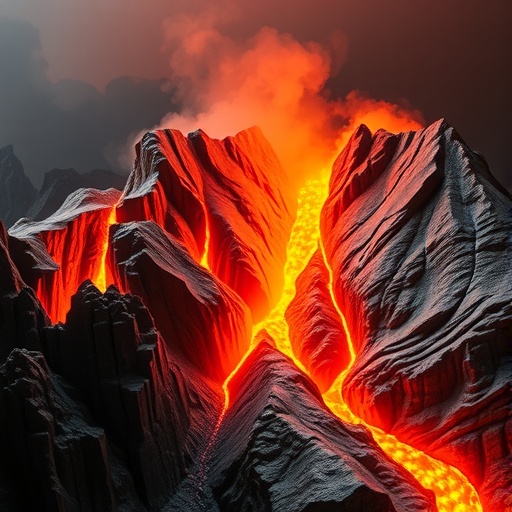
In a groundbreaking study published in Nature Communications, researchers have unveiled a critical mechanism governing the ascent dynamics of mafic magmas: the phenomenon of superheating and its impact on clinopyroxene nucleation delay. This revelation provides a pivotal advance in understanding how magma behaves beneath the Earth’s surface, shedding light on volcanic eruption processes and potentially improving eruption forecasting models.
Mafic magmas, characterized by their relatively low silica content and high temperatures, have long intrigued volcanologists due to their complex crystallization behaviors that directly influence eruption style and intensity. Traditionally, the crystallization of clinopyroxene, a common mafic mineral, was thought to proceed systematically as magma cools. However, this new study reveals that under certain conditions, mafic magmas exhibit superheating: a state where the temperature exceeds the liquidus temperature without immediate crystallization. This delay in clinopyroxene nucleation can drastically alter magma ascent dynamics, facilitating faster rises and more violent eruptions.
The research team, led by Bonechi, Arzilli, and Polacci, employed innovative experimental techniques coupled with state-of-the-art analytical methods to recreate the natural conditions of magma ascent in controlled laboratory settings. By meticulously monitoring the temperature, pressure, and chemical environment, they observed that superheating extends the liquidus stability field and suppresses early clinopyroxene nucleation. This discovery challenges longstanding paradigms within petrology and volcanic science, where the timing of crystal nucleation is considered a key driver for magma viscosity and flow behavior.
One of the critical insights emerging from the research is how superheating modulates the rheological properties of magmas. When clinopyroxene nucleation is delayed, the magma remains more homogenous and less viscous than previously expected, which allows it to ascend more swiftly through the crust. This has profound implications for the interpretation of geophysical signals associated with volcanic unrest. Faster magma ascent often correlates with more explosive volcanic activity, thus understanding superheating enhances our capability to model eruption precursors.
Moreover, the study emphasizes the delicate balance between thermal and chemical influences in magma evolution. As magma ascends, decompression and cooling typically induce crystal formation. However, superheating temporarily inhibits these processes by elevating the temperature above the crystallization threshold, creating metastable conditions that favor a rapid transition once nucleation kicks in. This metastability underscores the intricacy of magmatic processes, linking microscale mineral behaviors to macroscale volcanic phenomena.
The experimental data show that the delay in clinopyroxene nucleation can vary significantly depending on the initial magma composition, ascent rate, and pressure regimes, highlighting the variable nature of volcanic systems worldwide. This variability explains the diversity in eruption styles observed among volcanoes that produce mafic magmas, from effusive lava flows to sudden explosive events. Consequently, superheating must be integrated into volcanic hazard assessment models for more accurate predictions.
In addition to its geophysical ramifications, the study provides new perspectives on the petrogenesis of mafic magmas. The extended superheated state allows for enhanced mixing and homogenization within the magma chamber prior to eruption, potentially impacting the geochemical signatures observed in erupted materials. This opens new avenues for interpreting volcanic rock records and reconstructing the pre-eruptive history of volcanic systems.
The researchers also discuss the broader implications of their findings for the global volcanic landscape. Mafic magmas are prevalent in many tectonic settings, including mid-ocean ridges, hotspot volcanoes, and continental flood basalts. Hence, superheating-induced nucleation delay could be a universal process influencing volcanic activity across diverse environments. This universality elevates the importance of incorporating superheating mechanisms into global volcanic monitoring networks.
Furthermore, advances in analytical techniques were crucial for this discovery. The utilization of high-resolution electron microscopy and synchrotron-based imaging allowed for the detailed characterization of initial clinopyroxene crystallites, enabling the researchers to pinpoint the precise moment of nucleation onset. Such technology underscores the synergy between experimental petrology and modern instrumentation, driving forward our comprehension of volcanic processes.
Critical also is the interdisciplinary approach taken by the research team, combining insights from mineral physics, geochemistry, and geodynamics. This holistic methodology allowed the team to link microscale experimental observations to large-scale volcanic phenomena, creating a comprehensive picture of how superheating impacts magma ascent and eruption behavior. Their integrative model serves as a blueprint for future volcanic research.
The study’s implications extend beyond academic curiosity, as understanding superheating dynamics could improve hazard mitigation strategies for populations living near mafic volcanoes. Faster and more explosive eruptions directly relate to risks posed by pyroclastic flows, lava fountains, and ash dispersal. Incorporating nucleation delay into predictive models enhances the reliability of early warning systems, potentially saving lives and infrastructure.
Moreover, the research opens questions on how superheating influences other mineral phases in mafic magmas and whether similar nucleation delays occur with plagioclase, olivine, or other common volcanic minerals. Future studies building on this work can refine our understanding of magma crystallization pathways and their effects on eruption dynamics.
It is also noteworthy that superheating impacts not only natural volcanic systems but could inform industrial applications involving silicate melts and crystallization processes. Understanding nucleation kinetics under superheated conditions might optimize manufacturing processes in metallurgy and materials science, showcasing the broader relevance of geological research.
The timing of this discovery aligns with increased global volcanic activity observed in the 21st century, making it particularly pertinent. As volcano monitoring improves with satellite remote sensing and ground-based sensors, incorporating fundamental physical processes like superheating into these frameworks is essential for advancing predictive capabilities.
In summary, this landmark study on superheating in mafic magmas heralds a paradigm shift in volcanic science. By elucidating how delayed clinopyroxene nucleation affects magma ascent rates and eruption styles, Bonechi and colleagues provide a crucial missing link in the chain of volcanic processes. Their work underscores the complex interplay between temperature, pressure, and mineral kinetics that shapes the Earth’s fiery manifestations, holding promise for improved hazard assessment and deeper scientific understanding.
Cite Scienmag News
Violet Maxwell. (June 8, 2026). Superheating Delays Clinopyroxene, Alters Mafic Magma Ascent. Scienmag. https://scienmag.com/superheating-delays-clinopyroxene-alters-mafic-magma-ascent/
Violet Maxwell. "Superheating Delays Clinopyroxene, Alters Mafic Magma Ascent." Scienmag, 8 June 2026, https://scienmag.com/superheating-delays-clinopyroxene-alters-mafic-magma-ascent/. Accessed 3 September 2026.
Violet Maxwell. "Superheating Delays Clinopyroxene, Alters Mafic Magma Ascent." Scienmag. June 8, 2026. https://scienmag.com/superheating-delays-clinopyroxene-alters-mafic-magma-ascent/


