


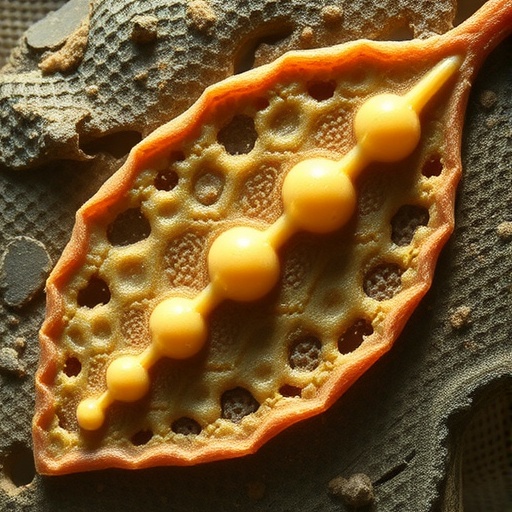
A 360-million-year-old fossil plant from China has revealed the earliest known example of seed-bearing leaves crowded with ovules, providing an unprecedented glimpse into one of the most important turning points in plant evolution. The fossil, named Ganiopteris phylla, lived during the early Carboniferous and carried hundreds of tiny ovules directly on the undersides of broad reproductive leaves. Its discovery pushes the origin of leaf-borne ovules back by at least 40 million years and may also illuminate the deep ancestry of the Permian glossopterids, an extinct group that once dominated the landscapes of Gondwana.
The fossils were recovered from the Huashanling Formation at three localities in northern Jiangxi Province, China. Led by Professor De-Ming Wang of Peking University, the study documents a plant whose reproductive organs were arranged in loose helices and whose individual megasporophylls could reach 11.8 centimeters in length. A megasporophyll is a specialized structure that bears megaspores or ovules in seed plants. In Ganiopteris, these organs were scutum-shaped, with an expanded lamina that supported an extraordinary concentration of reproductive structures.
The most striking feature lies on the lower surface of each leaf. Hundreds of ovules, each approximately 2.6 millimeters long and 1.4 millimeters wide, were attached directly to the underside. The upper surface was marked by a distinctive radial network of veins, while wing-like lobes extended along the margins. Together, these features show that the leaf was not merely a passive support structure. It was a functional photosynthetic platform that likely supplied energy and nutrients to a dense population of developing ovules.
This arrangement represents a major departure from the reproductive architecture of earlier seed plants. Late Devonian and early Carboniferous seed plants generally produced ovules at the ends of leafless, three-dimensional axes. Those exposed ovules may have depended partly on their own limited photosynthetic capacity or on surrounding cupules—protective structures that could also have contributed to nutrient exchange. Ganiopteris instead integrated reproduction with a broad, photosynthetically active leaf, creating a system capable of supporting many small ovules at once.
The evolutionary transition from axial ovules to leaf-borne ovules has long been considered a key stage in the history of seed plants, but the fossil record has offered few direct examples of how it happened. The researchers interpret Ganiopteris through the lens of telome theory, which proposes that complex plant organs evolved as branching systems became divided, flattened, fused and specialized. The fossil appears to preserve an intermediate architectural condition: a laminate, leaf-like organ carrying numerous ovules across its surface rather than a simple axis bearing isolated reproductive units.
The timing of the discovery is especially significant. Until now, the earliest convincing evidence of ovules attached directly to leaves came from the late Carboniferous. Ganiopteris, from the beginning of the Carboniferous, demonstrates that this reproductive strategy had already evolved far earlier than previously recognized. The finding suggests that seed plants began experimenting with highly integrated leaf-based reproductive systems soon after the Devonian, when terrestrial ecosystems were undergoing profound ecological and evolutionary expansion.
The fossil may also provide a clue to the origins of glossopterids, the iconic seed plants that flourished across Gondwana during the Permian. Glossopterid fossils are famous not only for their abundance but also for their historical role in supporting Alfred Wegener’s theory of continental drift. Their leaves and pollen are found across landmasses that are now separated by oceans, yet the group’s pre-Permian macrofossil history has remained almost completely unknown. Ganiopteris offers a possible early chapter in that story.
The reproductive leaves of Ganiopteris resemble those of Permian glossopterids in several important ways, raising the possibility that the Chinese plant represents an early precursor. During the early Carboniferous, the South China Block was positioned in the Southern Hemisphere near the eastern margin of Gondwana and within the tropics. Its warm, humid setting could have supported the evolution of large, productive leaves bearing numerous exposed ovules. However, the comparison is not exact: glossopterid reproductive leaves were typically subtended and protected from below by a separate vegetative leaf, whereas Ganiopteris lacked this protective structure.
That difference may reflect the ecological conditions of the South China Block. The early Carboniferous coincided with two intervals known for unusually sparse terrestrial animal communities: Romer’s gap among early land vertebrates and the Hexapoda gap among insects. In addition, the region’s tropical climate was likely wet enough to reduce the danger of desiccation. With fewer herbivores capable of damaging its reproductive organs and limited risk of water loss, Ganiopteris may not have needed a second leaf to shield its ovules. Its exposed, underside-bearing reproductive surface could therefore have functioned effectively in an environment with relatively low biological and climatic stress.
By revealing a plant that combined broad photosynthetic leaves with densely packed ovules, the fossil transforms scientists’ understanding of early seed-plant reproduction. It shows that the evolutionary innovation of leaf-borne ovules was already established roughly 360 million years ago and suggests that the architectural foundations of later glossopterid plants may have appeared much earlier than their Permian fossils indicate. The study, published in National Science Review, was led by De-Ming Wang with collaborators from several Chinese institutions and supported by China’s National Natural Science Foundation and National Key Research and Development Program.
Web References: https://doi.org/10.1093/nsr/nwag429
References: National Science Review, DOI: 10.1093/nsr/nwag429
Cite Scienmag News
Violet Maxwell. (August 7, 2026). Ancient Chinese fossil reveals earliest leaf-borne ovules, illuminating glossopterid origins. Scienmag. https://scienmag.com/ancient-chinese-fossil-reveals-earliest-leaf-borne-ovules-illuminating-glossopterid-origins/
Violet Maxwell. "Ancient Chinese fossil reveals earliest leaf-borne ovules, illuminating glossopterid origins." Scienmag, 7 August 2026, https://scienmag.com/ancient-chinese-fossil-reveals-earliest-leaf-borne-ovules-illuminating-glossopterid-origins/. Accessed 3 September 2026.
Violet Maxwell. "Ancient Chinese fossil reveals earliest leaf-borne ovules, illuminating glossopterid origins." Scienmag. August 7, 2026. https://scienmag.com/ancient-chinese-fossil-reveals-earliest-leaf-borne-ovules-illuminating-glossopterid-origins/


