


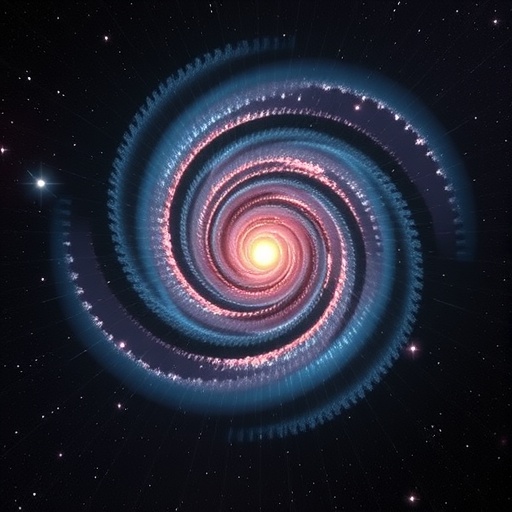
In a landmark breakthrough for astrophysics, researchers have unveiled the first evidence of multiwavelength variability in a quasar shining a mere 850 million years after the Big Bang. This discovery sheds new light on the enigmatic processes feeding supermassive black holes (SMBHs) during the early stages of galaxy formation, providing unprecedented insight into accretion physics at cosmic dawn. While quasars in the nearby universe are well established to exhibit flickering brightness caused by dynamic accretion processes, detecting such variability in primordial quasars has been a formidable challenge—until now.
Quasars, the immensely luminous nuclei powered by gas spiraling into SMBHs, have historically been recognized as cosmic beacons, charting the growth of black holes across cosmic time. In the local universe, it has been well documented that their brightness changes over time across multiple wavelengths, frequently linked to turbulent accretion flows and the physical conditions of their accretion disks and coronae. Observing this behavior at early epochs, close to the universe’s infancy, has remained elusive due to limited observational sensitivity and the faintness of these objects billions of light-years away.
The recent study overcomes these challenges by leveraging state-of-the-art infrared and X-ray telescopes, enabling a detailed examination of a quasar that thrived within less than a billion years from the universe’s beginning. Infrared observations covered five distinct filters, effectively probing the quasar’s rest-frame ultraviolet and optical emission. These wavelengths emanate primarily from the accretion disk itself, where matter spirals inward before ultimately plunging into the black hole. In tandem, X-ray data explored variability emanating from the quasar’s corona—an extremely hot, diffuse plasma enveloping the disk and responsible for high-energy emission.
Crucially, the team’s multiwavelength approach offers a rare glimpse into the spatial structure of the accretion flow. The variability spectrum reveals that, even in these early epochs marked by rapid mass accretion at high Eddington ratios, the disk retains a geometrically thin but optically thick form—a fundamental characteristic predicted by classical accretion disk theory. This finding challenges alternative models proposing more chaotic or thick disk geometries under such extreme conditions, thus refining our theoretical understanding of early SMBH fueling mechanisms.
Moreover, the signature of variability provides a powerful diagnostic tool, opening avenues to estimate SMBH masses directly during these formative epochs. Until now, mass measurements of early SMBHs primarily relied on indirect scaling relations or assumptions anchored in local analogues. The ability to track brightness fluctuations across wavelengths enables dynamic modeling of the accretion disk structure and its physical parameters, marking a pivotal step toward constructing an empirical census of SMBH growth across cosmic history.
From a broader perspective, this discovery exemplifies the increasing synergy between observational astronomy and theoretical models in unraveling the mysteries of the early universe. The findings not only affirm the existence of stable, thin accretion disks at high redshift but also validate variability as a promising observable in the study of primordial quasars. Observational constraints emerging from these data impose stringent limits on black hole feeding mechanisms operating under intense gravitational and radiative environments at the dawn of cosmic time.
In anticipation of next-generation observatories, such as the Rubin Observatory and the Roman Space Telescope, which promise to identify thousands of high-redshift quasars through sensitive time-domain surveys, the implications of this study are profound. These facilities will enable population-level investigations into the variability patterns of early SMBHs, exponentially increasing the statistical leverage to refine accretion physics models and improve SMBH mass estimates across cosmic epochs.
Understanding the nature of early quasar variability also has bearings on the broader cosmological landscape, where growing SMBHs influence galaxy evolution through energetic feedback processes. The heating and ionization of surrounding gas mediated by quasar emission impact star formation and the intergalactic medium, connecting SMBH growth to large-scale cosmic structure. Hence, observationally deciphering the accretion dynamics at cosmic dawn paves the way for more accurate models of galaxy formation and evolution.
Conventional wisdom had posited that early quasar accretion disks might be unstable or geometrically distorted due to the copious inflows feeding these nascent SMBHs at near-Eddington or super-Eddington rates. However, the detected variability and spectral signatures support a scenario where classical thin disk models remain valid, implying relatively orderly accretion despite the quasar’s extreme luminosity and young cosmic age. This clarification tightens the link between local and distant quasar phenomena, underscoring a universal mechanism governing SMBH growth.
Furthermore, the disentanglement of emission components from the disk and corona through simultaneous infrared and X-ray variability measurements offers a comprehensive portrait of the accretion environment. This dual-wavelength approach not only helps characterize the geometry and physical conditions in each region but also constrains the energy transfer processes between the disk and corona, crucial for explaining quasar emission mechanisms across the electromagnetic spectrum.
Intriguingly, the study’s results highlight the importance of variability as a complementary probe alongside traditional spectroscopic and photometric techniques. While spectral line studies remain indispensable for redshift and chemical composition determinations, variability provides temporal information that can uniquely inform us about dynamical processes in the quasar vicinity. As a consequence, time-domain astrophysics emerges as an increasingly central methodology for unlocking cosmic evolution’s secrets.
The timing and amplitude of the variability trends observed challenge theoretical uncertainties regarding the stability and lifetime of accretion disks in burgeoning quasars. They suggest persistent, coherent accretion episodes capable of sustaining rapid black hole growth over extended periods, a finding critical to explaining how SMBHs attained billion-solar-mass scales in under a billion years after the Big Bang.
This advance also opens important questions about the interplay of environmental factors shaping early SMBH evolution. The influence of intense radiation, inflows from surrounding dense gas reservoirs, and potential interactions with nascent stars and galaxies all factor into regulating accretion variability patterns. Future surveys targeting large samples will be paramount in disentangling these complex dependencies.
In conclusion, the detection of multiwavelength infrared and X-ray variability in one of the earliest-known quasars stands as a landmark achievement in observational cosmology. It crystallizes the utility of variability studies as a direct window into SMBH feeding processes, enabling precise constraints on accretion disk properties at epochs hitherto inaccessible. With a rapidly expanding arsenal of space- and ground-based observatories on the horizon, these pioneering measurements lay the groundwork for a new era in our quest to understand the formation and growth of the universe’s most enigmatic giants.
The implications of this discovery reverberate through multiple domains—from theoretical astrophysics to cosmology—ultimately enriching our comprehension of the universe’s formative years. As observational capabilities continue to advance, we can anticipate an explosion of discoveries that will illuminate the lifecycle of early SMBHs and their profound influence on cosmic history, transcending previous limitations and transforming our cosmic perspective forever.
Cite Scienmag News
Grant Pearson. (June 8, 2026). Quasar Variability and Accretion Disks Unveiled Early. Scienmag. https://scienmag.com/quasar-variability-and-accretion-disks-unveiled-early/
Grant Pearson. "Quasar Variability and Accretion Disks Unveiled Early." Scienmag, 8 June 2026, https://scienmag.com/quasar-variability-and-accretion-disks-unveiled-early/. Accessed 5 September 2026.
Grant Pearson. "Quasar Variability and Accretion Disks Unveiled Early." Scienmag. June 8, 2026. https://scienmag.com/quasar-variability-and-accretion-disks-unveiled-early/


