


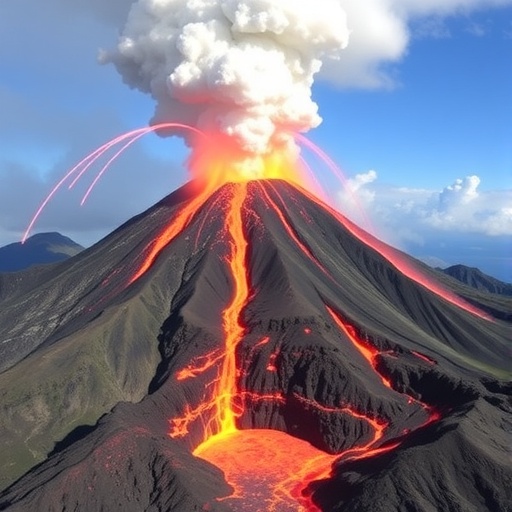
In groundbreaking research conducted by an international team led by The University of Manchester, scientists have unveiled critical insights into the thermal dynamics of magma that could redefine our understanding of volcanic eruptions. Their study focused on magma from the 2021 Tajogaite eruption on La Palma, Canary Islands, revealing a previously underappreciated phenomenon known as “superheating.” This process, wherein magma exceeds the temperature thresholds that normally allow crystal stability, alters the very fabric of volcanic behavior, potentially explaining why similar volcanic systems can unleash dramatically different types of eruptions.
Superheating fundamentally disrupts the nucleation and growth of crystals within ascending magma. Typically, as magma rises towards the Earth’s surface, it cools and crystals begin to form around microscopic “seeds” that catalyze this process. However, the researchers found that superheating can dissolve these pre-existing crystalline seeds, effectively delaying the onset of crystallization. This delay profoundly impacts both the internal structure and physical properties of magma, maintaining it in a uniform, less viscous state, which in turn affects how it ascends through the Earth’s crust.
Published in the prestigious journal Nature Communications, the study employed cutting-edge experimental techniques to observe these crystallization processes live under conditions resembling those inside an active volcano. Utilizing an advanced X-ray transparent pressure vessel combined with synchrotron X-ray microtomography at the Diamond Light Source in the UK, the team was able to visualize the transformation of magma at high temperature and pressure in real time. This novel approach represents a quantum leap in volcanology, providing direct observation of phenomena previously inferred only indirectly.
One of the pivotal discoveries was the stark difference in crystallization timelines between superheated magma and magma that had not been superheated. In their controlled laboratory settings, magma samples that had not undergone superheating began crystallizing within approximately twenty minutes. In contrast, those subjected to significant superheating delayed crystallization for more than eight hours. This extended window of fluidity allows magma to ascend more rapidly towards the surface, fundamentally altering eruption dynamics.
The implications of these findings extend far beyond laboratory walls. The researchers integrated their experimentally determined nucleation delays into sophisticated numerical models simulating magma ascent dynamics. The models predicted that delayed crystallization facilitates faster magma movement, maintaining lower viscosity and potentially triggering explosive lava fountain eruptions, as was observed during the Tajogaite event. Conversely, magma that crystallizes earlier becomes increasingly viscous, ascends at a more languid pace, and allows volcanic gases to escape gradually, favoring more subdued effusive eruptions.
This thermal history-induced variability in eruption styles challenges traditional volcanic hazard models, which have historically focused predominantly on magma chemistry, gas content, and pressure changes. The new research suggests that magma’s pre-eruptive thermal conditions and crystallization kinetics are equally crucial, offering a more nuanced mechanistic framework for understanding how eruptions unfold. This paradigm shift holds promise for improving real-time volcanic hazard assessments and eruption forecasting, potentially saving lives and mitigating damage.
Dr. Barbara Bonechi, the study’s lead investigator and Research Associate at The University of Manchester, emphasized the transformative potential of these observations. She explained that the interplay between crystal and bubble growth significantly governs magma viscosity, a key determinant of eruptive vigor. Yet, until this research, the dynamics of crystal growth in superheated magmas remained elusive. By harnessing synchrotron imaging technology, the team attained unprecedented temporal and spatial resolution, capturing crystallization kinetics ‘in situ’—a first in experimental volcanology.
The study also underscores the complex role of magma’s internal microstructure. Superheating homogenizes the magma, breaking down the heterogeneous microenvironments necessary for nucleation. This homogenization suppresses the formation of new crystals and modifies gas exsolution pathways, thereby influencing the ascent regime. Such a subtle internal restructuring could mean the difference between a violent explosive eruption and a gentler outpouring of lava.
Researchers complemented their in situ synchrotron observations with longer-duration ex situ experiments conducted in Prague, extending the temporal scope of crystallization studies. These combined methodologies allowed for a comprehensive chronicle of nucleation phenomena across multiple timescales, strengthening the robustness of their conclusions. The dual-laboratory strategy exemplifies how international collaboration leverages diverse expertise and specialized instrumentation to tackle intricate geophysical problems.
Furthermore, the Tajogaite eruption provided a serendipitous natural analogue. Prior evidence suggested the erupted magma experienced varied degrees of superheating during its ascent. Studying this specific event lent the experiments real-world context, linking laboratory observations with natural processes. This connection enhances confidence that the discovered mechanisms are indeed pivotal in shaping volcanic behaviors globally, not confined to isolated laboratory curiosities.
Co-author Dr. Margherita Polacci of The University of Manchester highlighted the study’s significance for volcanic monitoring and hazard prediction. She noted that incorporating thermal history and crystallization delays into eruption models could refine interpretations of monitoring data such as seismicity, gas emissions, and ground deformation. These insights could empower volcanologists to detect precursors of specific eruption styles earlier and with greater accuracy, thereby informing emergency responses more effectively.
This pivotal research thus represents a watershed moment in volcanology, merging experimental innovation with computational rigor to elucidate the enigmatic processes governing magma behavior. By spotlighting the transformative effect of superheating on clinopyroxene nucleation delay and magma ascent dynamics, the study paves the way for rethinking volcanic hazard frameworks. As climate change and population growth increase communities’ exposure to volcanic risk, such advances carry profound societal relevance.
Looking ahead, the team envisions expanding their investigations to other magma compositions and volcanic settings, testing the universality of superheating effects. These future studies may explore interactions with different crystal phases, volatile contents, and ascent rates, building a comprehensive, predictive theory of volcanic eruptions. The emerging interdisciplinary toolkit, blending real-time imaging, numerical modeling, and natural case studies, promises continued breakthroughs in decoding Earth’s fiery underworld.
News Publication Date: 8 June 2026
Web References: https://doi.org/10.1038/s41467-026-73352-1
Cite Scienmag News
Violet Maxwell. (June 8, 2026). Scientists Reveal How Magma Heating Shapes Volcanic Eruptions. Scienmag. https://scienmag.com/scientists-reveal-how-magma-heating-shapes-volcanic-eruptions/
Violet Maxwell. "Scientists Reveal How Magma Heating Shapes Volcanic Eruptions." Scienmag, 8 June 2026, https://scienmag.com/scientists-reveal-how-magma-heating-shapes-volcanic-eruptions/. Accessed 3 September 2026.
Violet Maxwell. "Scientists Reveal How Magma Heating Shapes Volcanic Eruptions." Scienmag. June 8, 2026. https://scienmag.com/scientists-reveal-how-magma-heating-shapes-volcanic-eruptions/


