


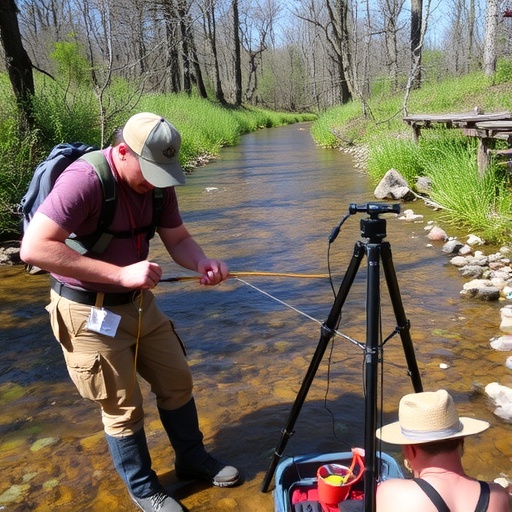
In the vast and ecologically critical Cerrado biome of Brazil, a groundbreaking study reveals promising strides toward more cost-effective and efficient monitoring of freshwater streams. These waterways, weaving across the landscape, are essential to the health of biodiversity and human communities alike. Historically, assessing their ecological status has relied on labor-intensive and resource-heavy methods. However, recent research published in Water Biology and Security demonstrates that it’s possible to substantially reduce sampling efforts without compromising the accuracy of rapid ecological assessments.
Scientists have traditionally depended on comprehensive fieldwork involving physical habitat measurements, fish community surveys, and benthic macroinvertebrate sampling to gauge stream health. These protocols, heavily influenced by guidelines from the U.S. Environmental Protection Agency (EPA), typically require extensive time in the field and laboratory, with some sites necessitating the sampling of eleven transects. This approach, while thorough, poses significant logistical and financial burdens—especially in tropical nations like Brazil, where continuous monitoring is vital but often underfunded.
The research team launched an ambitious experiment across 160 stream sites spanning four hydrological units in Brazil—São Simão, Volta Grande, Nova Ponte, and Três Marias. They categorized these sites based on an Integrated Disturbance Index (IDI) into least-disturbed, moderately disturbed, and severely disturbed groups. The crux of their investigation was to determine whether halving the number of transects from eleven to six could retain the diagnostic power to classify stream conditions reliably.
To their surprise, critical habitat indicators, particularly human disturbance markers and fine sediment levels, exhibited remarkable stability despite the lower sampling intensity. These physical parameters are essential proxies for understanding anthropogenic impacts such as land use changes, erosion, and pollution. The robustness of these variables under reduced sampling conditions implies that streamlined protocols do not sacrifice ecological sensitivity.
Equally compelling was the persistence of biological indices derived from macroinvertebrate communities, including the Average Score Per Taxon (ASPT) and multimetric indices (MMI). These indices are cornerstone tools in biomonitoring, reflecting ecosystem health through species assemblage composition and diversity. Even with fewer transects, these metrics continued to discriminate effectively between disturbed and preserved streams, underscoring the resilience of biological monitoring frameworks to sampling constraints.
Corresponding author Ricardo Solar emphasized that this streamlined strategy can vastly enhance monitoring efficiency. Reducing the number of transects almost halved the average fieldwork duration per site from six hours to three hours. Simultaneously, processing times for macroinvertebrate samples contracted from approximately fifteen days to ten days. This dual reduction in field and laboratory time translates directly into cost savings and facilitates the coverage of a larger number of sites within limited research budgets.
Yet, the findings also highlight some caveats. Taxonomic richness—a measure of species variety—declined noticeably as sampling effort waned, particularly among fish assemblages. While such diminutions in species counts are predictable when sampling intensity is curtailed, the researchers noted that the overall capacity to discern ecological disturbance gradients remained broadly intact, especially when relying on macroinvertebrate data.
These nuanced outcomes reflect the broader balancing act inherent in ecological monitoring: optimizing efficiency without forfeiting critical information. By adopting reduced-effort sampling, agencies and researchers, particularly in resource-constrained regions, can amplify their monitoring scope and frequency, thereby enhancing conservation outcomes and management responsiveness.
Financial analyses provided further justification for protocol optimization. Fieldwork expenditures decreased drastically, representing merely 1.6% of total project costs in 2023 compared to 5.1% in 2010. Such fiscally prudent approaches are vital where long-term biomonitoring is essential but perennially challenged by limited funding.
Co-author Marcos Callisto reinforced the practical benefits of the new protocol perspective, stating that more efficient sampling methodologies enable expanded spatial and temporal monitoring coverage. This broadened approach is critical not only for timely detection of environmental degradation but also for informing adaptive management strategies to mitigate impacts from agriculture, urbanization, and other human pressures.
Nonetheless, the authors caution that the reduced sampling model is principally suited for rapid, large-scale ecological assessments rather than exhaustive species inventories or studies focusing on rare and specialist taxa. Such targeted research still demands comprehensive sampling methodologies to capture the full complexity and idiosyncrasies of freshwater ecosystems.
This pioneering work effectively challenges the long-held notion that extensive and exhaustive sampling is an absolute prerequisite for reliable stream health assessments. Instead, it advocates for adaptive, resource-sensitive methodologies that maintain scientific rigor while advancing operational feasibility. As global environmental challenges mount, such innovations in biomonitoring protocols can empower conservationists and policymakers alike to act with greater knowledge, agility, and impact.
Looking ahead, the implications of this study resonate beyond Brazil’s Cerrado. They underscore a paradigm shift toward smarter, leaner ecological monitoring applicable to diverse biomes and freshwater systems worldwide. Embracing such cost-effective strategies holds transformative potential for sustaining the vitality of aquatic ecosystems amidst escalating environmental pressures.
Web References: http://dx.doi.org/10.1016/j.watbs.2026.100607
Cite Scienmag News
Violet Maxwell. (May 19, 2026). Efficient and Affordable Stream Surveys Unlock Powerful Biomonitoring Insights. Scienmag. https://scienmag.com/efficient-and-affordable-stream-surveys-unlock-powerful-biomonitoring-insights/
Violet Maxwell. "Efficient and Affordable Stream Surveys Unlock Powerful Biomonitoring Insights." Scienmag, 19 May 2026, https://scienmag.com/efficient-and-affordable-stream-surveys-unlock-powerful-biomonitoring-insights/. Accessed 3 September 2026.
Violet Maxwell. "Efficient and Affordable Stream Surveys Unlock Powerful Biomonitoring Insights." Scienmag. May 19, 2026. https://scienmag.com/efficient-and-affordable-stream-surveys-unlock-powerful-biomonitoring-insights/


