


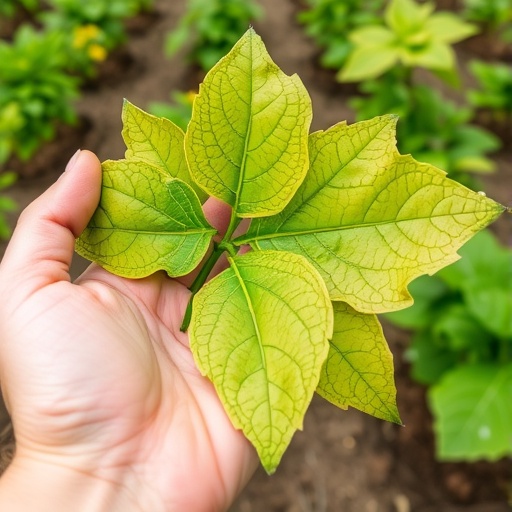
In the ever-evolving field of agricultural technology, a groundbreaking development has emerged that promises to revolutionize the way plant diseases are detected and managed. Researchers Palei, Mohapatra, Mallick, and colleagues have introduced an innovative approach combining advanced computational intelligence algorithms with deep learning methodologies to tackle the critical issue of multi-class leaf disease identification. Their pioneering work, detailed in a recent publication in Scientific Reports, unveils the Hybrid IGWO-Dingo optimized DeMoHybridNet model, a system that significantly enhances accuracy and efficiency in diagnosing plant leaf diseases, an advancement that could have profound implications for global agricultural productivity and sustainability.
The challenge of accurately identifying leaf diseases in plants has long been a bottleneck in plant pathology and precision agriculture. Traditional methods, which heavily rely on manual inspection and expert knowledge, are inherently time-consuming, prone to human error, and often insufficient for large-scale agricultural operations. This predicament has paved the way for the adoption of machine learning and deep neural networks in plant disease recognition tasks. However, the complexity increases when the system must distinguish among multiple classes of diseases with subtle and overlapping visual symptoms. Recognizing this hurdle, the research team has moved beyond conventional models by integrating a hybrid optimization algorithm into a customized neural network architecture.
At the core of this novel system lies the fusion of two nature-inspired metaheuristic optimization techniques—the Improved Grey Wolf Optimizer (IGWO) and the Dingo Optimizer. Grey Wolf Optimizer, inspired by the social hierarchy and hunting behavior of grey wolves, is renowned for its robustness and exploitation-exploration balance in solving complex optimization problems. The team leveraged an improved variant of GWO to enhance convergence speed and avoid premature stagnation during training. Complementing this, the Dingo Optimizer draws inspiration from the cooperative hunting mechanism of dingoes, aiding in global search capabilities and fine-tuning model parameters to prevent local minima entrapment. Combining these two algorithms creates a synergistic optimization strategy that adapts dynamically during the learning process.
The neural network architecture that benefits from this powerful hybrid optimization is termed DeMoHybridNet, a deep convolutional model tailored for multi-class classification tasks in plant pathology. DeMoHybridNet integrates modular convolutional blocks designed to extract diverse and hierarchical feature representations from leaf images, crucial for capturing subtle differences in disease morphology and texture. Unlike standard convolutional networks, this model employs adaptive feature recalibration layers, which enhance the network’s sensitivity to disease-specific patterns while suppressing irrelevant background noise. This architectural innovation plays a pivotal role in improving the discriminative capabilities of the model.
Training such a sophisticated deep learning model demands an effective optimization scheme to tune hyperparameters like learning rates, layer weights, and regularization factors. The hybrid IGWO-Dingo algorithm provides an intelligent search mechanism across the hyperparameter space, balancing exploration of new parameter sets with exploitation of promising configurations. This results in a robust training regime that accelerates convergence and improves overall model generalization. Moreover, this hybrid optimization approach helps mitigate overfitting, a common pitfall in deep learning models dealing with class imbalance or limited datasets.
An extensive dataset encompassing images of leaves afflicted by multiple disease categories formed the foundational basis for this research. These datasets included high-resolution images of various crop species, each annotated by expert pathologists to ensure ground truth accuracy. The dataset’s diversity in terms of disease types, severity levels, leaf orientations, and lighting conditions posed a significant challenge, one that the model was specifically engineered to overcome. Preprocessing techniques such as image augmentation, normalization, and segmentation were employed to further enhance the model’s ability to generalize across varied real-world conditions.
Validation of the Hybrid IGWO-Dingo optimized DeMoHybridNet model revealed striking performance improvements over existing state-of-the-art methods. The model achieved superior accuracy, precision, recall, and F1-scores across multiple disease classes, highlighting its effectiveness in differentiating diseases that often display confounding visual characteristics. Importantly, the system demonstrated remarkable resilience in handling images affected by noise, varying illumination, and partial occlusions, conditions frequently encountered during in-field diagnostics. These findings underscore the model’s practical applicability for real-time disease identification in diverse agricultural environments.
Beyond empirical performance, the interpretability of the model was also rigorously examined. The research incorporated visualization techniques such as class activation mapping to highlight the specific leaf regions that guided the model’s decision-making process. This transparency not only facilitates trust among end-users, such as farmers and agronomists, but also provides insights into disease symptomatology that could inform further biological research and disease management strategies.
The development of this hybrid optimized deep learning framework aligns with the broader trend of employing artificial intelligence in precision agriculture, where timely and accurate disease diagnosis is vital to reducing crop losses and minimizing the reliance on chemical treatments. By enabling early and accurate detection of multiple diseases from leaf imagery alone, the system offers a potent tool to enhance crop monitoring, optimize resource use, and improve yield quality, particularly in resource-constrained regions where expert agronomic services may be limited.
Moreover, the modular design of DeMoHybridNet and the adaptability of the hybrid IGWO-Dingo optimizer offer flexibility for transfer learning and customization to other plant species or novel disease categories. This transferability is crucial given the dynamic nature of plant pathogens and the emergence of new diseases driven by changing climatic conditions. The ability to rapidly retrain and deploy updated models can facilitate proactive disease management and mitigate epidemic outbreaks that threaten food security.
In terms of computational efficiency, the integration of hybrid optimizers not only enhances predictive performance but also streamlines the training pipeline, reducing computational overhead. This efficiency makes the model more viable for deployment in edge devices like mobile smartphones and drones, which are increasingly used in field-based agricultural monitoring. Leveraging this technology can empower farmers with immediate disease diagnosis capabilities, enabling swift decision-making without dependence on centralized laboratories or internet connectivity.
Ethical and ecological implications also form part of the conversation around this technology. By promoting precise identification of diseases, the model may contribute to targeted pesticide application, lowering chemical usage and its attendant environmental impacts. This targeted approach aligns with sustainable agricultural practices and supports global efforts to reduce ecological footprints while maintaining food production.
The researchers have made strides in accessibility by designing the system with open-source components and user-friendly interfaces in mind. This approach encourages adoption by agricultural extension services, researchers, and developers aiming to customize and scale the technology. Additionally, collaborations with local farming communities during the model’s testing phase ensured that the system’s outputs were intuitive and actionable, facilitating smooth integration into existing farming workflows.
Looking ahead, the integration of this model with IoT platforms and real-time sensing devices could create comprehensive plant health monitoring systems. Combining multispectral imaging, environmental sensors, and weather data with the predictive power of Hybrid IGWO-Dingo optimized DeMoHybridNet could offer holistic disease management solutions that anticipate outbreaks and recommend preventive interventions.
The legacy of this research will likely inspire further innovation at the intersection of AI, plant pathology, and sustainable agriculture. It exemplifies how interdisciplinary approaches leveraging bio-inspired optimization and advanced neural architectures can address pressing global challenges. As climate variability and population growth intensify the demand for resilient food systems, technologies like this offer a beacon of progress.
In conclusion, the Hybrid IGWO-Dingo optimized DeMoHybridNet model represents a transformative leap in automated plant disease diagnosis. Its sophisticated blend of metaheuristic optimization algorithms and deep learning frameworks delivers unparalleled accuracy, efficiency, and interpretability in multi-class leaf disease identification. This advancement not only enhances agricultural productivity but also contributes to sustainable farming practices, positioning itself as a vital tool for food security in the decades to come.
Cite Scienmag News
Blake Davidson. (May 19, 2026). Hybrid IGWO-Dingo Optimized DeMoHybridNet for Leaf Disease. Scienmag. https://scienmag.com/hybrid-igwo-dingo-optimized-demohybridnet-for-leaf-disease/
Blake Davidson. "Hybrid IGWO-Dingo Optimized DeMoHybridNet for Leaf Disease." Scienmag, 19 May 2026, https://scienmag.com/hybrid-igwo-dingo-optimized-demohybridnet-for-leaf-disease/. Accessed 4 September 2026.
Blake Davidson. "Hybrid IGWO-Dingo Optimized DeMoHybridNet for Leaf Disease." Scienmag. May 19, 2026. https://scienmag.com/hybrid-igwo-dingo-optimized-demohybridnet-for-leaf-disease/


