


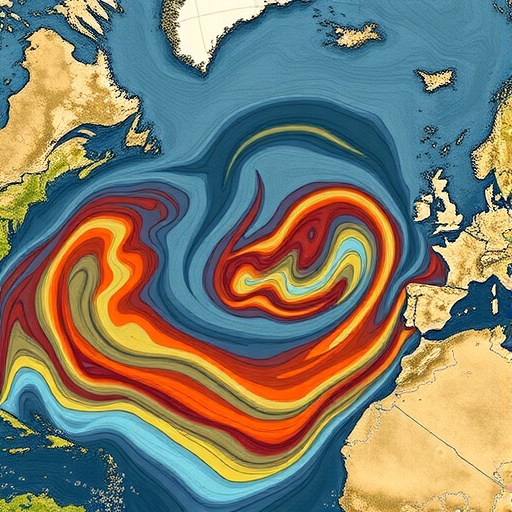
In a groundbreaking study poised to reshape our understanding of oceanic climate patterns during the last glacial period, researchers have uncovered compelling evidence of centennial-scale intensifications in the Atlantic Meridional Overturning Circulation (AMOC) during Heinrich Stadial 1. This pivotal research, led by Jena, P.S., Chiessi, C.M., Beese, I., and colleagues, was recently published in Nature Communications, shedding unprecedented light on the complex dynamics of one of Earth’s most influential ocean currents during a time of profound climatic upheaval.
The Atlantic Meridional Overturning Circulation is a critical component of the global climate system, responsible for the northward transport of warm, salty waters in the upper Atlantic and the return flow of colder, denser waters at depth. Its stability and intensity directly influence regional climates, biogeochemical cycles, and even the carbon storage potential of the oceans. The new findings suggest that instead of a gradual weakening or uniform slowdown, the AMOC underwent several pronounced intensifications over centuries during Heinrich Stadial 1—a cold period marked by massive iceberg discharges into the North Atlantic roughly 17,000 to 14,000 years ago.
These insights emerged from high-resolution proxies extracted from sediment cores collected across strategic Atlantic Ocean locations. By analyzing isotopic compositions and sedimentary evidence, the team reconstructed past ocean circulation patterns with remarkable precision. Of particular importance was the identification of abrupt shifts in neodymium isotopic ratios and grain size distributions, indicating episodic strengthening of deep water formation and enhanced overturning events that lasted on the order of centuries. Such variability reflects dynamic feedback loops between freshwater input, sea surface temperatures, and oceanic convection mechanisms that were previously underappreciated.
Historically, Heinrich Stadial 1 has been understood primarily as a time of AMOC weakening due to the influx of glacial meltwater disrupting salinity-driven thermohaline circulation. However, this study’s revelation that the overturning circulation also experienced phased intensifications challenges this simplistic narrative. It implies a more complex interplay where episodes of transient reinvigoration could have modulated the overall climate impacts. These periodic pulses in AMOC strength might have contributed to temporary warming intervals in the North Atlantic region, influencing not only ocean temperatures but also atmospheric circulation patterns and precipitation regimes across the Northern Hemisphere.
The implications of these findings extend beyond paleoceanography, as they provide vital analogs for understanding how current and future AMOC variability might unfold under ongoing anthropogenic climate change. The century-scale pulses identified offer a cautionary tale about the potential for nonlinear and abrupt responses within key ocean circulation systems. This could translate into unexpected shifts in climate zones, alterations of marine ecosystems, and variability in carbon sequestration processes. Understanding these mechanisms in the past helps refine predictive models that seek to anticipate the AMOC’s trajectory over the coming centuries.
Methodologically, the research integrated multidisciplinary approaches combining geochemical tracers, sedimentology, and advanced modeling techniques. The use of radiogenic isotope systems, especially neodymium, alongside sortable silt parameters, enabled differentiation between changes driven by water mass sourcing versus alterations in current vigor. Moreover, coupling these empirical proxies with transient climate model simulations allowed the team to test plausible scenarios that replicate observed intensification patterns. This synthesis of data and modeling marks a significant advancement in deciphering past ocean circulation events and their climate ramifications.
One of the crucial insights is the spatial heterogeneity of AMOC intensity changes during Heinrich Stadial 1. The study highlights that while some Atlantic sectors witnessed vigorous overturning pulses, others displayed subdued responses, indicating regional modulation by factors such as local freshwater fluxes, wind stress patterns, and topographical influences on deep water formation sites. This heterogeneous behavior underscores the importance of incorporating regional variability into global ocean circulation reconstructions, a nuance that could explain discrepancies in earlier studies.
Furthermore, the discovery of these transient intensifications alters interpretations of sediment records used as climate proxies. The presence of alternating sedimentary layers correlated with intensified overturning events suggests that such centennial-scale oceanic oscillations left measurable imprints on depositional environments. This has profound implications for the calibration of paleoenvironmental reconstructions, demanding a reevaluation of time-series data to account for abrupt variations rather than assuming monotonic trends.
Beyond the geological and climatic sciences, the findings resonate with marine biologists and ecologists interested in how shifts in ocean circulation affect nutrient cycling and habitat distributions. Periods of intensified AMOC could have intermittently enhanced nutrient upwelling in the North Atlantic, fostering bursts of phytoplankton productivity and altering food web structures. Thus, the research offers a unifying lens through which to view multidisciplinary changes spanning physical oceanography, climate science, and ecosystem dynamics during glacial-interglacial transitions.
In light of these discoveries, the role of freshwater forcing during Heinrich Stadial 1 appears far more complex and perhaps more episodic than previously conceptualized. The study proposes that episodic reductions in meltwater input or temporary stabilizations in ice sheet discharge could have allowed transient resumption of deep convection, triggering the observed AMOC intensifications. This assumes a quasi-pulsatory mechanism modulated by glacial dynamics, ocean-atmosphere feedbacks, and internal ocean circulation inertia, pointing towards intricate climate-ocean interdependencies.
Another intriguing aspect is the study’s contribution to debates on the potential for abrupt climate tipping points. The centennial-scale AMOC intensifications may represent early indicators of thresholds in ocean circulation resilience, suggesting that the system’s response to external forcings involves not only degradation but also intermittent recoveries. This nuanced conceptual framework challenges linear paradigms and encourages the scientific community to explore nonlinear dynamics and feedbacks governing oceanic and climatic systems.
Looking forward, the research team advocates for expanded sediment core sampling coupled with higher resolution geochemical analyses across different Atlantic sectors to further characterize the temporal and spatial recurrence of these intensifications. Integration with ice core records, terrestrial proxies, and marine biodiversity archives could richly contextualize these findings, enhancing the holistic understanding of Heinrich Stadial 1 and its global repercussions.
In sum, this landmark study revitalizes our comprehension of AMOC behavior under glacial climatic stress, revealing a previously hidden rhythm of centennial-scale intensifications that punctuated a period traditionally viewed as uniformly cold and oceanographically subdued. These revelations are pivotal for climate history, model refinement, and strategies anticipating future ocean circulation changes amidst accelerating global warming. The research not only deepens our grasp of Earth’s past but also fortifies the scientific foundation required to confront impending climatic uncertainties.
Cite Scienmag News
Violet Maxwell. (May 19, 2026). Centennial Surges in Atlantic Overturning During Heinrich Stadial. Scienmag. https://scienmag.com/centennial-surges-in-atlantic-overturning-during-heinrich-stadial/
Violet Maxwell. "Centennial Surges in Atlantic Overturning During Heinrich Stadial." Scienmag, 19 May 2026, https://scienmag.com/centennial-surges-in-atlantic-overturning-during-heinrich-stadial/. Accessed 4 September 2026.
Violet Maxwell. "Centennial Surges in Atlantic Overturning During Heinrich Stadial." Scienmag. May 19, 2026. https://scienmag.com/centennial-surges-in-atlantic-overturning-during-heinrich-stadial/


