


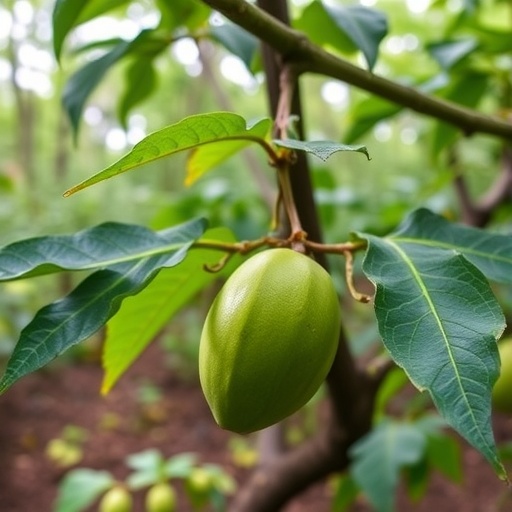
In the heart of the Amazon basin, cocoa cultivation faces a formidable adversary: witches’ broom disease. This devastating fungal ailment, caused by Moniliophthora perniciosa, brought cocoa production in Brazil’s southern Bahia state to a near collapse during the 1990s. The epidemic was so pervasive that it permeated local culture and media, underscoring the severity of its impact. The disease continues to pose a significant threat to cocoa crops throughout the Amazon, complicating efforts to sustain and increase output in this globally crucial agricultural sector. Yet recent scientific advances promise a new direction, presenting a path forward that minimizes reliance on chemical fungicides and fertilizers while enhancing productivity.
A groundbreaking study, supported by the São Paulo Research Foundation (FAPESP) and executed at the Frederico Afonso Experimental Station (CEPLAC) in Rondônia state, has evaluated a diverse array of 25 cocoa cultivars, identifying two that demonstrate remarkable resilience and productivity. These cultivars—identified as clones EEOP 63 and EEOP 65—exhibit an exceptional ability to maintain yield amidst the dual challenges of mineral-deficient soils and fungal attack. The significance of this finding is amplified by their capacity to increase production by up to 32% when compared with more vulnerable varieties, illuminating an agricultural breakthrough that leverages genetic robustness paired with environmental adaptability.
The study represents a collaborative triumph involving experts from São Paulo State University (UNESP), the Brazilian Agricultural Research Corporation (EMBRAPA) in Porto Velho, as well as the Federal Universities of Rondônia (UNIR) and Amazonas (UFAM). This interdisciplinary partnership underscores the multifaceted nature of combating witches’ broom disease, integrating expertise from genetics, plant physiology, and agronomy to formulate a holistic strategy. Importantly, this approach embraces the unique environmental context of the Amazon—characterized by intense rainfall, high temperatures, and elevated humidity levels—which both fosters fungal proliferation and imposes distinct challenges on crop cultivation.
Professor Renato de Mello Prado, coordinator of the research and an authority in plant sciences at UNESP, highlights the fundamental insight gained: sustainable cocoa cultivation in the Amazon is contingent upon the exploitation of genetic improvement synergized with meticulous nutritional management. He emphasizes that altering the inherent climatic conditions favoring fungal activity is impractical; instead, deploying cultivars with enhanced adaptability, supported by balanced nutrition to fortify plant vigor, forms the cornerstone of future resilience. This paradigm shift moves cocoa production away from dependence on chemical interventions, advocating for a system rooted in the natural strengths of the plant combined with optimized soil chemistry.
The superior performance of clones EEOP 63 and EEOP 65 is intricately tied to their mineral uptake profiles. Detailed analyses revealed high concentrations of essential macronutrients including phosphorus, potassium, calcium, and magnesium. These elements play pivotal roles in strengthening cellular structures, enabling enzymatic functions, and fueling metabolic pathways that govern both growth and defense mechanisms. The plants’ ability to allocate resources effectively between growth demands and immune responses—particularly under sustained pathogenic pressure—is critical. This energy partitioning, modulated by genetics and nutrient availability, forms a biological balancing act that these clones execute more proficiently than their susceptible counterparts.
Notably, the insights from this research underscore the notion that tolerance to witches’ broom is not merely a singular genetic trait but inherently linked to the plant’s nutritional status. This integrative understanding informs agronomic practices that prioritize the correction of micronutrient deficiencies commonly observed in Amazonian soils. Boron deficiency, in particular, was identified as a recurrent limiting factor. Given boron’s essential role in maintaining cell wall integrity and facilitating reproductive processes such as pollen tube growth and fruit set, its deficiency can markedly weaken plant structure and yield potential. Parallelly, an excess of nitrogen was detected, a condition which paradoxically exacerbates fungal proliferation by providing substrates favorable to pathogen growth.
These findings advocate for the refinement of fertilization protocols, emphasizing balanced nutrition that addresses both macro- and micronutrient availability. Such strategies not only enhance productivity but also bolster the intrinsic defense systems of cocoa plants, reducing the need for external agrochemical inputs. This nutritional balance acts as a shield, enabling simultaneous growth and pathogen resistance—effectively enabling the plant to “have its cake and eat it too.” This approach offers a paradigm of sustainable intensification, where optimizing soil health and plant nutrition synergistically mitigates disease impacts while enhancing yield stability.
The study further reveals the nuanced dynamics of the Amazon’s complex agroecosystem. The region’s acid soils, marked by low base saturation and mineral imbalances, challenge plant performance and dictate cultivar selection criteria. The hot and humid climate ensures that fungal pathogens find ideal conditions to thrive, necessitating crop varieties that perform robustly under these stressors. The robustness of EEOP 63 and EEOP 65 to these abiotic and biotic stresses sets a precedent for breeding programs aiming to develop clones adapted to the Amazon’s harsh yet fertile environment.
Beyond the immediate agricultural gains, this research highlights the critical role of genetic diversity within farms as a sustainable defense mechanism against pervasive diseases. By cultivating multiple clones with complementary adaptive traits, farmers can reduce the vulnerability of their crops to pathogen outbreaks and environmental fluctuations. This mosaic of genetic resilience constitutes an essential pillar in sustainable cocoa production, promoting ecosystem stability and enhancing long-term economic viability for the region’s agricultural communities.
The interdisciplinary nature of this research—encompassing plant pathology, soil science, genetics, and agronomy—provides a comprehensive approach to tackling the complex challenge of witches’ broom disease. This synergy of disciplines illustrates the necessity of multifactorial solutions that transcend traditional, single-factor interventions. The confluence of genetic improvement aligned with optimized nutrient management constitutes the most cost-effective, ecologically sound, and efficient strategy available, offering a replicable model for other regions grappling with similar phytopathological threats.
This pioneering research charts a new course for Amazonian cocoa cultivation, demonstrating how scientific innovation can harness the region’s inherent biological assets while mitigating its ecological vulnerabilities. Moving forward, the imperative remains to expand such studies to encompass a broader genetic base and diverse ecological zones within the Amazon. Doing so will equip farmers with a spectrum of clones capable of thriving in varied conditions, presenting flexible and adaptive options to secure the future of cocoa production amidst escalating environmental challenges.
In conclusion, the integration of genetic resilience with strategic nutritional management emerges as a beacon of hope for an industry long beleaguered by witches’ broom disease. This dual approach not only enhances cocoa yield and quality but also pioneers a sustainable agricultural model that respects and leverages the delicate interplay between plant genetics and their environmental context. In an era where food security and sustainable agriculture converge as global priorities, these findings exemplify the potential of science-driven solutions to harmonize productivity with ecological stewardship in one of the world’s most dynamically challenging landscapes.
News Publication Date:
20-Feb-2026.
Web References:
https://www.nature.com/articles/s41598-026-40483-w
References:
São Paulo Research Foundation (FAPESP) – Research supported at Frederico Afonso Experimental Station (CEPLAC), in collaboration with UNESP, EMBRAPA, UNIR, and UFAM.
Cite Scienmag News
Alan Morgan. (May 19, 2026). New Research Develops Strategy to Shield Amazonian Cocoa from Witches’ Broom Disease. Scienmag. https://scienmag.com/new-research-develops-strategy-to-shield-amazonian-cocoa-from-witches-broom-disease/
Alan Morgan. "New Research Develops Strategy to Shield Amazonian Cocoa from Witches’ Broom Disease." Scienmag, 19 May 2026, https://scienmag.com/new-research-develops-strategy-to-shield-amazonian-cocoa-from-witches-broom-disease/. Accessed 3 September 2026.
Alan Morgan. "New Research Develops Strategy to Shield Amazonian Cocoa from Witches’ Broom Disease." Scienmag. May 19, 2026. https://scienmag.com/new-research-develops-strategy-to-shield-amazonian-cocoa-from-witches-broom-disease/


