


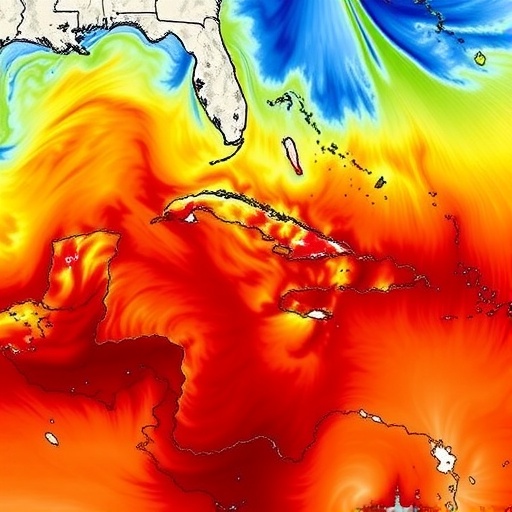
In a groundbreaking discovery poised to revolutionize our understanding of marine climate dynamics, researchers have uncovered a compelling link between marine heatwaves in the Caribbean Sea during the spring and summer months and preceding heatwave events in the Indian Ocean during winter. This novel insight, articulated by Li Z. and Li J. in their forthcoming Nature Communications article, elucidates an intricate global oceanic teleconnection that challenges traditional confines of regional climate studies and emphasizes an unprecedented level of interoceanic climatic dependency.
Marine heatwaves—prolonged periods of anomalously high sea surface temperatures—have garnered intense scientific scrutiny over the last decade due to their devastating ecological and socio-economic impacts. Such events disrupt marine ecosystems by inducing coral bleaching, altering species distributions, and impairing fisheries. Understanding the genesis and propagation pathways of these heatwaves is essential for enhancing predictive capabilities and developing adaptive mitigation strategies. The current study pioneers this endeavor by interlinking the Indian Ocean’s wintertime thermal anomalies with the Caribbean Sea’s spring-summer heatwave occurrences, thereby proposing a cascading oceanic influence that spans hemispheric boundaries.
The study leverages advanced climate modeling techniques, combined with comprehensive satellite sea surface temperature datasets spanning multiple decades, to detect and quantify the temporal and spatial relationships between the Indian Ocean’s winter heatwave intensity and the subsequent Caribbean Sea heatwave manifestations. Crucially, the analyses reveal a statistically significant positive correlation, suggesting that strong marine heatwaves initiating in the Indian Ocean during boreal winter set oceanic and atmospheric precursors that propagate westward and into the Atlantic basin months later, manifesting as heatwaves in the Caribbean during spring and summer.
Mechanistically, the research posits that anomalous heating in the Indian Ocean perturbs atmospheric circulation patterns, especially modulating the Madden-Julian Oscillation and Walker Circulation. These changes influence surface wind stresses that subsequently adjust oceanic currents and thermocline depth in distant basins. Such large-scale dynamic atmospheric responses establish a teleconnection, where energy and thermal anomalies effectively “travel” through coupled ocean-atmosphere systems to influence sea surface temperatures thousands of kilometers away. This complexity underscores the necessity of integrating multidisciplinary climate system processes to delineate the evolution of remote marine heatwaves.
Beyond oceanic teleconnections, the study delves into notable impacts on ocean biogeochemistry and marine life. The delayed heat wave effect observed in the Caribbean likely disrupts nutrient upwelling and phytoplankton productivity during critical growth seasons, potentially triggering trophic cascades affecting fisheries, coral reefs, and broader biodiversity. Such ecological consequences highlight the need for marine conservation policies to incorporate these teleconnections for more holistic ecosystem management and protection.
The implications for climate forecasting are profound. Incorporating interoceanic precursors into predictive models could extend the lead time for anticipating Caribbean marine heatwaves, affording regional stakeholders enhanced preparedness. Traditional seasonal forecasting often concentrates on local or regional drivers, but this research underscores the role of remote ocean basins in seeding anomalous thermal conditions, advocating for integrated global ocean-atmosphere coupled models that dynamically simulate these linkages for better accuracy.
Moreover, the study’s findings may resonate in the broader context of climate change adaptation. With global sea surface temperatures rising and marine heatwaves expected to increase in frequency and severity, understanding how events in one ocean basin influence distant regions offers a new dimension to assessing climate vulnerability and resilience. This networked perspective on marine climate disturbances necessitates international cooperation in monitoring and mitigating the transboundary impacts of ocean warming.
Technical methodologies employed through the study include sophisticated statistical tools such as empirical orthogonal function analysis and wavelet coherence methods to tease apart time-frequency relationships in heatwave occurrences across the Indian and Caribbean Oceans. These tools reveal a dominant mode of variability that encapsulates the teleconnection pattern. The ensemble of climate models used also allow for rigorous testing against observational data to validate the robustness of the inferred linkages, setting a new standard for analyzing global oceanic heat events.
Emerging questions from this research focus on identifying how other ocean basins might similarly influence regional marine heatwaves through global teleconnections. Could the Pacific Ocean play a comparable role affecting different parts of the Atlantic? Are the identified teleconnection mechanisms consistent across varying climate scenarios? Understanding these dimensions would provide a more complete framework for anticipating marine heatwave risks in the coming decades.
The study additionally prompts a reconsideration of marine heatwave classification schemes. Presently, such events are often evaluated in isolation within single ocean basins or regions. This research advocates for a paradigm shift towards a more interconnected classification system that factors in antecedent oceanic conditions on a global scale, improving the predictive skill and risk assessment methodologies.
Furthermore, this pioneering work resonates with the increasing recognition that the climate system’s complexity transcends traditional boundaries defined by ocean basins or atmospheric layers. The evidence of antecedent Indian Ocean thermal anomalies influencing Caribbean Sea warming exemplifies the concept of a coupled Earth system, where disturbances propagate and amplify through ocean-atmosphere feedbacks, reinforcing the value of Earth system science approaches in climate research.
Scientists working on marine ecosystems and coastal communities stand to benefit significantly from these insights. Advancing the understanding of marine heatwave precursors enables better timing and targeting of adaptation measures, such as fisheries management, habitat restoration, and early warning systems, ultimately aiming to reduce economic losses and preserve biodiversity.
Given the urgency of addressing the ecological crises triggered by marine heatwaves, the research by Li and Li could prove instrumental in shaping the next generation of climate adaptation policies. Governments and resource managers could leverage forecast models enriched by this teleconnection knowledge to implement proactive interventions, ranging from temporary fishing restrictions during predicted heatwaves to enhancing coral reef resilience using restoration techniques timed with predicted climatic windows.
Overall, the discovery of a winter-to-spring-summer teleconnection between the Indian Ocean and Caribbean Sea marine heatwaves sheds light on the intricate and far-reaching fabric of Earth’s climate system. It also highlights the power of integrating observational data with cutting-edge climate models and statistical analyses to unravel complex patterns that were previously obscured. As marine heatwaves continue to threaten oceanic life and human livelihoods, this research marks a critical step forward in foreseeing and mitigating their impacts, heralding a new era of global marine climate science.
Cite Scienmag News
Violet Maxwell. (May 19, 2026). Winter Indian Ocean Heatwaves Trigger Caribbean Summer Events. Scienmag. https://scienmag.com/winter-indian-ocean-heatwaves-trigger-caribbean-summer-events/
Violet Maxwell. "Winter Indian Ocean Heatwaves Trigger Caribbean Summer Events." Scienmag, 19 May 2026, https://scienmag.com/winter-indian-ocean-heatwaves-trigger-caribbean-summer-events/. Accessed 3 September 2026.
Violet Maxwell. "Winter Indian Ocean Heatwaves Trigger Caribbean Summer Events." Scienmag. May 19, 2026. https://scienmag.com/winter-indian-ocean-heatwaves-trigger-caribbean-summer-events/


