


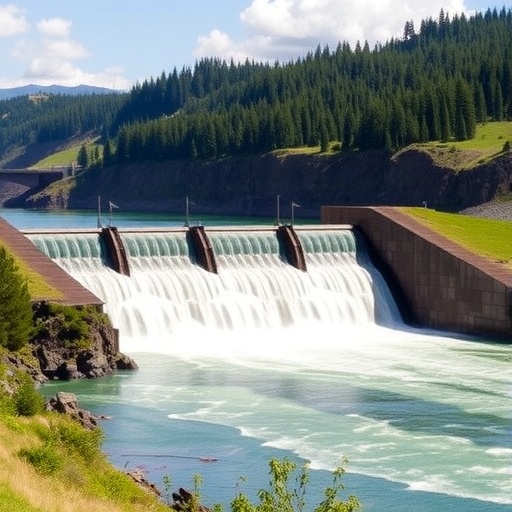
A groundbreaking study emerging from Oregon State University casts new light on the complex social and environmental dynamics involved in the largest dam removal project in United States history, situated on the Klamath River. This ambitious endeavor, crossing the Oregon-California border, marks a pivotal moment in river restoration as it seeks not only ecological rejuvenation but also reconciliation amidst decades-long water conflicts. The research unravels the intricate interplay between agricultural stakeholders and conservation advocates, revealing surprisingly shared priorities that could reshape collaborative management and policy approaches to river ecosystems nationwide.
The Klamath River, spanning over 250 miles through diverse ecological zones—including high desert, temperate rainforests, and coastal redwoods—has long been an epicenter of ecological controversy and resource competition. Between 1912 and 1963, four hydropower dams were erected along its course, altering natural flow regimes and fragmenting critical salmon habitats. These infrastructural relics have recently been subjected to systematic removal during 2023 and 2024, in a historic restoration effort designed to rejuvenate native fish populations and improve water quality metrics throughout the basin. The project embodies not just an engineering feat but a profound social experiment in resolving entrenched stakeholder conflicts.
The study, led by Bryan Tilt, an anthropology professor at Oregon State, utilized a cultural anthropology framework to dissect the shared and divergent worldviews underpinning two primary stakeholder groups: agricultural producers reliant on irrigation from the basin and diverse conservation organizations dedicated to ecosystem and salmon restoration. Employing a rigorous qualitative methodology, the research team interviewed fifty-five key informants in lengthy, in-depth conversations, seeking to excavate the cognitive models that inform their approaches to water and land management. This robust dataset provided unprecedented insight into the collective values, fears, and aspirations driving each group’s river restoration vision.
Critically, the research revealed four salient themes of convergence that transcend traditional conflict narratives. First, both farmers and conservationists acknowledge the growing uncertainty imposed by climate change, especially concerning water availability, wildfire prevalence, and drought frequency. Farmers expressed longstanding anxieties about the reliability of seasonal irrigation water deliveries, while conservationists recognized parallel vulnerabilities exacerbated by climate-driven ecosystem stressors. This shared recognition underscores the multi-scalar risks facing the basin and highlights the need for adaptive management frameworks resilient to ecological volatility.
A second convergence point is a profound commitment among both groups to improved collaboration and trust-building, which historically has been undermined by fractured governance structures and competing regulatory regimes. The study participants lamented the dissolution of prior cooperative arrangements governing the basin and agreed that socio-economic community well-being must be integrated into future decision-making processes. This suggests an emerging ethos valuing inclusivity and mutual respect, which may serve as fertile ground for rebuilding durable partnerships between agriculture and conservation sectors.
Third, respondents from both camps voiced frustration with the perceived narrow focus of existing management strategies, particularly the tendency to prioritize a single species—namely endangered salmon—under the Endangered Species Act. Farmers articulated concerns about the neglect of broader habitat needs, such as those for migratory birds, reflecting a desire for holistic, landscape-scale ecological considerations. Conservationists meanwhile echoed calls for ecosystem-based management approaches that transcend species-specific agendas to consider integrated watershed health, ecological connectivity, and multifunctional resource stewardship.
Finally, the willingness to embrace innovative, non-traditional management models emerged as a significant point of agreement. Conservation groups highlighted the promise of non-consumptive economic activities like ecotourism, which leverage natural resource assets—such as wildlife and water—without degrading them. Farmers, too, expressed openness to creative water management techniques and community-driven approaches that could sustain agricultural productivity while enhancing ecological outcomes. This convergence hints at fertile potential for pilot projects that redefine economic incentives aligned with environmental sustainability.
The broader ecological and policy context of this study situates it at the forefront of a national trend toward dam decommissioning. The U.S. currently hosts over two thousand documented dam removals, most occurring in the past twenty years, reflecting shifting priorities toward free-flowing rivers and restored habitats. The Klamath dam removal is particularly consequential given its scale, complexity, and emblematic representation of competing uses for water—a finite and increasingly contested resource in an era marked by climate instability and ecological degradation.
This research not only advances academic understanding of stakeholder dynamics but offers pragmatic implications for river restoration science and policy. By mapping the junctions where cultural models overlap, resource managers can more strategically facilitate dialogues that transcend adversarial binaries, enabling co-created management frameworks that balance ecological integrity with human livelihoods. The study’s anthropological lens thus serves as a critical tool for navigating the socio-ecological complexity that defines modern environmental governance.
The findings emphasize the necessity of interdisciplinary approaches that blend social sciences, ecology, hydrology, and economics to foster resilient river systems. River restoration is as much about reestablishing relational trust and social capital as it is about reconfiguring physical infrastructure. This study exemplifies how nuanced qualitative insights can complement biophysical data, fostering a comprehensive understanding essential for adaptive governance amid uncertainty.
As the Klamath basin continues to transition away from entrenched conflict toward collaborative stewardship, this research signals a hopeful trajectory. It envisions a future where diverse stakeholders harness shared priorities and innovative management paradigms to revitalize river ecosystems. Such integrative frameworks may serve as templates for similar restoration efforts globally, highlighting the universal importance of marrying ecological science with cultural understanding in the Anthropocene.
In conclusion, the Klamath River dam removal project stands as a beacon of both environmental and social transformation. Through deep exploration of stakeholder perspectives, researchers at Oregon State University have illuminated pathways for overcoming historical divisions. By fostering trust, embracing ecosystem-based approaches, confronting climate risks, and welcoming management innovation, the Klamath basin’s story transcends regional significance to inspire broader paradigms for sustainable river restoration and water resource governance worldwide.
News Publication Date: Not specified in the content
Web References:
- Original study link: https://www.tandfonline.com/doi/full/10.1080/08941920.2026.2663270
- American Rivers Dam Removal Database: https://www.americanrivers.org/threats-solutions/restoring-damaged-rivers/dam-removal-map/
- Oregon Sea Grant feature: https://seagrant.oregonstate.edu/feature/oregon-sea-grant-funds-study-envision-klamath-river-after-dam-removal
References: Study funded by Oregon Sea Grant through NOAA’s National Sea Grant College Program, U.S. Department of Commerce, award no. NA24OARX417C0023.
Cite Scienmag News
Alan Morgan. (May 19, 2026). Study Finds Shared Benefits for Agriculture and Conservation Following Klamath Dam Removals. Scienmag. https://scienmag.com/study-finds-shared-benefits-for-agriculture-and-conservation-following-klamath-dam-removals/
Alan Morgan. "Study Finds Shared Benefits for Agriculture and Conservation Following Klamath Dam Removals." Scienmag, 19 May 2026, https://scienmag.com/study-finds-shared-benefits-for-agriculture-and-conservation-following-klamath-dam-removals/. Accessed 6 September 2026.
Alan Morgan. "Study Finds Shared Benefits for Agriculture and Conservation Following Klamath Dam Removals." Scienmag. May 19, 2026. https://scienmag.com/study-finds-shared-benefits-for-agriculture-and-conservation-following-klamath-dam-removals/


