


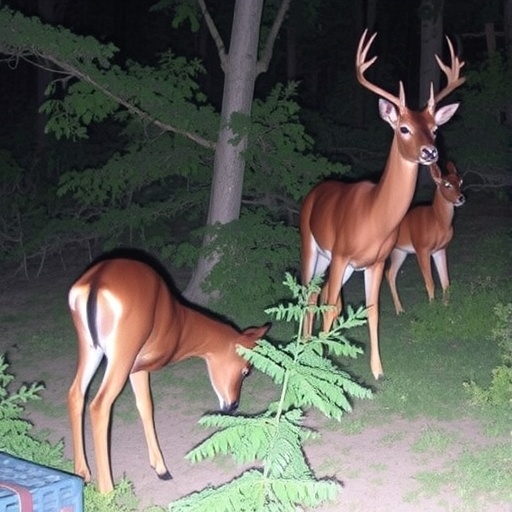
Camera trapping has emerged as an innovative technique in wildlife research, particularly for estimating animal population densities. In a remarkable study by Foca, Visscher, Becker, and colleagues, the effectiveness of this method is evaluated in comparison to more traditional aerial surveys. This work, set for publication in “Environmental Monitoring and Assessment,” showcases a significant advancement in ecological monitoring, setting the stage for future wildlife management policies and conservation efforts worldwide.
The researchers employed a TIFC (Total Inferred Density via Camera Traps) model to assess multiple ungulate species across various habitats. This model stands out for its ability to refine density estimations through camera trapping, a method that has gained traction due to its non-invasive nature and lower cost compared to aerial surveys. The benefits of camera trapping extend beyond simple numbers; the technology incorporates behavioral insights that are crucial for effective conservation strategies.
Traditional methods of estimating wildlife populations often require aerial surveys which can be labor-intensive and costly. These methods are not only limited by weather conditions but also by the high-altitude vantage point that can miss critical ground-level observations. The methodology employed in the present study reveals that the TIFC model not only embraces the advancements in camera technology but utilizes a structured approach to analyze the data captured from camera traps more effectively.
Foca et al. conducted their study across diverse landscapes, ensuring they captured data that is reflective of real-world scenarios. Each camera trap was strategically placed in high-traffic areas of ungulate species, allowing the researchers to compile a robust dataset that would contribute to density estimation through the TIFC model. This systematic placement of traps maximizes the likelihood of detecting individuals from the target species and thus improves statistical accuracy.
The authors noted that while both methodologies—camera trapping and aerial surveys—have their merits, the integration of camera trap sequences can reveal patterns of wildlife behavior over time, an aspect often overlooked in aerial assessments. Animals are not static; they interact with their environment, and the TIFC model accounts for these dynamics, providing a more comprehensive picture of population health and distribution.
The significance of the study lies in its potential applications for conservation efforts. Wildlife managers face the challenge of maintaining healthy populations of ungulates, which are vital to ecological balance. A definitive method of density estimation that is cost-effective, reliable, and insightful can empower conservationists to make data-driven decisions that impact habitats globally.
Not only does the TIFC model present a formidable tool for researchers, but it also enhances collaborations with organizations focused on wildlife conservation. The ability to provide detailed feedback on population dynamics enables stakeholders to implement targeted protection strategies, thus fostering healthier ecosystems.
In an age where technology continues to evolve at a rapid pace, the implications of this research offer exciting prospects for integrating artificial intelligence in wildlife monitoring. Machine learning algorithms could further refine data analysis, leading to discoveries that might have previously eluded researchers. As the field of wildlife biology continues to embrace technological innovations, the fidelity of population estimates will undoubtedly improve.
Furthermore, the comparisons made by the authors highlight critical differences in the outcomes of both methodologies. Aerial surveys may reveal population numbers, but the nuances captured through camera traps provide richer insights into animal interactions, movement patterns, and, importantly, social structures. This multifaceted approach not only lends weight to the necessity of varied methods but exemplifies a paradigm shift in how wildlife research is conducted and understood.
The research team, driven by the ethos of conservation, emphasizes the need for rigorous testing of new methodologies before they can be widely adopted. By documenting their findings, they contribute to the scientific dialogue regarding the best practices for wildlife density estimation, thus playing an integral role in shaping future research.
In summary, the integration of camera trapping with innovative models like TIFC marks a pivotal shift in wildlife density estimation techniques. Foca, Visscher, Becker, and their collaborators showcase how these advancements can bountifully contribute to the understanding of ungulate populations and potentially inform conservation strategies worldwide. The findings underscore an important message: technology, when applied thoughtfully, can bridge the gap between research and conservation, amplifying efforts to preserve our natural world.
As the study moves toward publication, it is clear that the implications for wildlife management are significant. This research not only opens avenues for improved methods but also calls for an interdisciplinary approach to conservation. Governments, NGOs, and local communities alike must engage in facilitating such transformative research, ensuring that technological advancements unlock new means of protecting the planet’s biodiversity.
With camera trapping poised to play an increasingly prominent role in ecological studies, the future of wildlife density estimation looks promising. The joint efforts of researchers and conservationists will foster a deeper understanding of the complex dynamics within ecosystems, reinforcing the vital need to act responsibly and sustainably towards wildlife preservation.
Foca, J.M., Visscher, D.R., Becker, M. et al. Camera trapping for density estimation: comparing the TIFC model to aerial surveys for multiple ungulate populations.
Environ Monit Assess 197, 1129 (2025). https://doi.org/10.1007/s10661-025-14581-7
Cite Scienmag News
Margaret Porter. (September 21, 2025). Comparing Camera Traps and Aerial Surveys for Ungulates. Scienmag. https://scienmag.com/comparing-camera-traps-and-aerial-surveys-for-ungulates/
Margaret Porter. "Comparing Camera Traps and Aerial Surveys for Ungulates." Scienmag, 21 September 2025, https://scienmag.com/comparing-camera-traps-and-aerial-surveys-for-ungulates/. Accessed 4 September 2026.
Margaret Porter. "Comparing Camera Traps and Aerial Surveys for Ungulates." Scienmag. September 21, 2025. https://scienmag.com/comparing-camera-traps-and-aerial-surveys-for-ungulates/


