


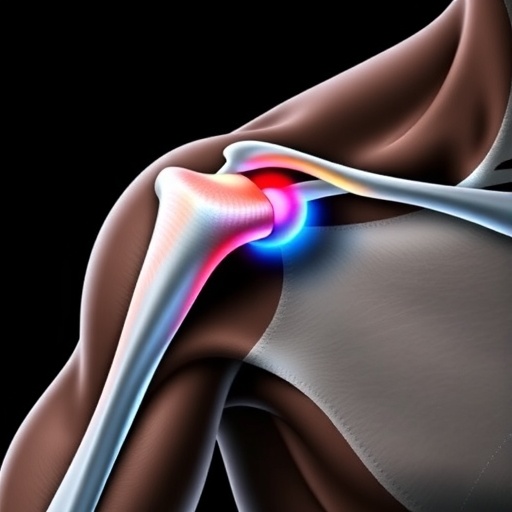
Recent advancements in quantitative magnetic resonance imaging (MRI) have paved the way for revolutionary insights into the mechanics and structure of the rotator cuff, particularly in the context of rotator cuff tears. This critical area of research focuses on understanding how such injuries impact not only the immediate function of the shoulder but also the long-term integrity of the associated tendons. The work undertaken by Garcia and colleagues provides a comprehensive examination of these changes, highlighting the essential connection between mechanical properties and structural modifications in tendon tissues post-injury.
At the heart of this research is the rotator cuff, a complex of muscles and tendons that play a fundamental role in shoulder stability and mobility. When tears occur within this structure, the repercussions can be significant, leading to pain, dysfunction, and a reduced quality of life. Previous studies have largely relied on subjective assessments and standard imaging techniques that do not fully capture the nuances of tendon pathology. This study leverages quantitative MRI to deliver a more complete picture, utilizing state-of-the-art imaging protocols to precisely quantify tendon alterations resulting from rotator cuff tears.
The essence of the problem lies in understanding both the microstructural and mechanical changes that occur in tendons following a rotator cuff injury. Tendons, being comprised of densely packed collagen fibers, rely on their structural integrity to maintain function. When a tear occurs, this delicate architecture is disrupted, leading to a cascade of biomechanical alterations. Garcia et al. meticulously explore these changes, outlining how quantitative MRI can be used to visualize and measure such modifications with remarkable accuracy, providing a clearer understanding of the tendon’s health and functionality.
One of the significant findings from this research is the identification of specific changes in the tendon’s mechanical properties due to rotator cuff tears. Using the latest MRI technology, the researchers were able to assess the elastic modulus and tensile strength of the affected tendons. This data is critical as it elucidates how the injury alters the biomechanical performance of the tendon, which may inform rehabilitation strategies and surgical interventions. By assessing these properties, clinicians can make more informed decisions regarding treatment plans tailored to the unique demands of their patients.
Moreover, the integration of quantitative MRI in this context opens up new avenues for research. For instance, understanding the relationship between tendon structure and patient outcomes following rotator cuff repair is a key area necessitating further exploration. If we are better equipped to visualize and quantify the changes occurring in tendon structure, we can begin to correlate these changes with functional outcomes post-surgery. This might lead to improved prognostication and an evolution in how healthcare professionals approach rotator cuff repair procedures.
In addition to the technical advancements provided by quantitative MRI, this study also illustrates the importance of interdisciplinary collaboration in medical research. Garcia and colleagues come from diverse backgrounds that blend engineering, medicine, and biology, allowing for a more holistic approach to the complexities of tendon injuries. This collaboration underscores the need for diverse expertise when tackling multifaceted health issues, as it fosters innovation and accelerates the translation of research findings into clinical practice.
The potential implications of these findings extend beyond the realm of orthopedics and sports medicine. As rotator cuff tears are increasingly recognized as a common ailment affecting various populations—particularly older adults—the insights gained here could reshape preventative strategies, rehabilitation protocols, and postoperative care. By implementing standardized quantitative MRI assessments in clinical settings, practitioners could adopt a more proactive approach, identifying at-risk individuals before catastrophic injuries occur.
Furthermore, this research paves the way for future studies aimed at interrogating other orthopedic injuries and conditions. By establishing a framework that utilizes advanced imaging technology to quantify and correlate mechanical properties with structural integrity, researchers can apply this methodology to a variety of tendon and ligamentous injuries, ultimately broadening the scope of knowledge surrounding musculoskeletal health and injury prevention.
In summary, the work conducted by Garcia and colleagues represents a significant advancement in our understanding of rotator cuff tears, offering a fresh perspective through the lens of quantitative MRI. By utilizing this cutting-edge technology, the study not only elucidates the biomechanical changes that accompany such injuries but also sets the stage for enhanced clinical practices. The journey toward improving treatment outcomes continues as we embrace these novel methodologies, and the hope is to translate these findings from the lab to the clinic, significantly enhancing patient care in the orthopedic field.
As we reflect on the implications of Garcia et al.’s findings, one must consider the broader picture. Research like this not only enriches our understanding of rotator cuff pathology but also emphasizes the increasingly important role of advanced imaging techniques in modern medicine. From improved diagnosis to tailored treatment plans, the impact of quantitative MRI extends far beyond merely assessing structural changes. It heralds a new era of personalized medicine, where therapies align closely with individual patient needs and anatomical intricacies.
This innovative research embodies the spirit of discovery that lies at the core of scientific inquiry, propelling us toward a future where musculoskeletal injuries—such as those affecting the rotator cuff—are met with precision and care. With the turnover of newer technologies, the quest to unlock the mysteries of human biology continues unabated, promising to revolutionize how we approach health and disease management for all.
Cite Scienmag News
Ophelia Keating. (September 20, 2025). Revealing Tendon Changes from Rotator Cuff Tears. Scienmag. https://scienmag.com/revealing-tendon-changes-from-rotator-cuff-tears/
Ophelia Keating. "Revealing Tendon Changes from Rotator Cuff Tears." Scienmag, 20 September 2025, https://scienmag.com/revealing-tendon-changes-from-rotator-cuff-tears/. Accessed 4 September 2026.
Ophelia Keating. "Revealing Tendon Changes from Rotator Cuff Tears." Scienmag. September 20, 2025. https://scienmag.com/revealing-tendon-changes-from-rotator-cuff-tears/


