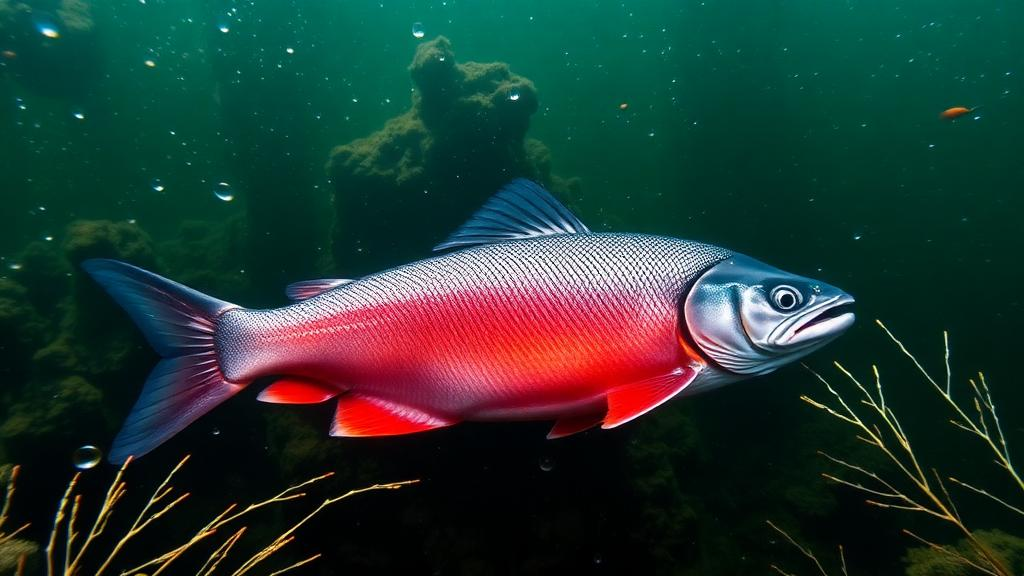
Every summer, five species of Pacific salmon return to the rivers of British Columbia, Canada, in one of the great migrations of the natural world. Chinook, chum, coho, pink and sockeye surge back to the streams where they were born, sustaining fisheries, forests and food webs along thousands of kilometres of coastline. For decades, ecologists have understood that this diversity of species and populations acts like a financial portfolio: when one stock crashes, another booms, and the total returns remain remarkably steady. A new study published in PLOS Ecosystems now shows that this stabilising effect does not stop at the water’s edge. It ripples all the way through the fishing boats, markets and prices that depend on the fish, revealing for the first time how ecological insurance becomes economic insurance.
The research, led by Flavio Affinito of McGill University together with Marie-Josée Fortin of the University of Toronto and Andrew Gonzalez of McGill, tackles a question that has long puzzled scientists working at the boundary of ecology and economics. Biodiversity is known to stabilise ecosystems through what biologists call the portfolio effect, a concept borrowed directly from modern portfolio theory in finance. Just as an investor spreads risk across assets with different risk profiles, an ecosystem spreads risk across species whose populations fluctuate independently. When the dynamics of individual components are asynchronous, meaning weakly or negatively correlated, their ups and downs cancel out, and the aggregate becomes far less volatile than any of its parts. But whether this ecological stability actually propagates into the socio-economic dimensions of an ecosystem service, such as the income generated by a commercial fishery, has remained poorly understood.
To answer it, the team turned to the Essential Ecosystem Service Variables framework, a relatively new approach that organises monitoring data into distinct classes describing the full life cycle of an ecosystem service. For the salmon fishery, they assembled twenty-seven years of data, from 1996 to 2022, covering five dimensions: ecological supply, measured as the abundance of returning salmon; use, measured as catch; demand, measured as price per kilogram; instrumental value, measured as landed value; and anthropogenic contribution, measured as fishing effort. The abundance data came from the Pacific Salmon Foundation, which processes government escapement records into time series for genetically distinct salmon stocks, while catch and effort data came from the Department of Fisheries and Oceans and economic figures from the British Columbia provincial government.
At the provincial scale, the results were strikingly clear. Every single dimension of the ecosystem service showed a portfolio effect, meaning the aggregate time series was more stable than the volatility of its individual species components would predict. The strongest buffering appeared in the catch data, where the portfolio effect reached its highest value, while the weakest, though still present, appeared in demand, the price dimension. In practical terms, this means that the diversity of salmon species is not merely keeping ecosystems steady; it is smoothing the revenues, prices and fishing activity of an entire provincial industry. Biodiversity, in effect, is functioning as an insurance policy that pays out not only to fish and forests but to fishing communities and markets.
Yet beneath that reassuring provincial average, the analysis uncovered a more complicated and, in places, more troubling picture. By calculating synchrony indices and examining which pairs of species tend to boom and bust together, the researchers found that the sources of risk differ dramatically across dimensions. In the ecological supply data, Chinook and coho salmon were strongly synchronised, rising and falling together in ways that suggest a shared vulnerability, likely tied to their similar life histories and the mounting pressures on their stocks. But when the researchers looked at landed value, the synchrony shifted to an entirely different pairing, coho and pink, and in the price data yet another pattern emerged. This cross-dimensional decoupling is significant: it suggests that social and economic processes, such as market substitution and fleet behaviour, provide an additional layer of buffering that can mask ecological risk.
The species-level analysis drove this point home. When the team examined each salmon species across the six major watersheds of British Columbia, the Nass, Skeena, Haida Gwaii, Central Coast, Vancouver Island and Mainland Inlets, and the Fraser, they found enormous variation in how well regional diversity stabilised each fishery. Pink salmon emerged as the star performer, maintaining a strong portfolio effect across every dimension of the service, with regional populations fluctuating asynchronously so that poor years in one watershed were reliably offset by better years elsewhere. Chinook salmon, by contrast, showed the weakest regional portfolio effect in ecological supply, barely distinguishable from no buffering at all, with multiple regions peaking simultaneously in several years. This synchrony means that when Chinook decline, they tend to decline everywhere at once, a pattern that aligns with widespread conservation concern for the species.
The timing of synchronous events also revealed moments of systemic vulnerability that would otherwise remain hidden. A widespread, high-magnitude trough event in 2019 and 2020 was visible across multiple species and dimensions, coinciding with a record marine heatwave and river warming in the North Pacific. Four out of five species experienced simultaneous abundance troughs in both 2008 and 2012, and fishing effort spiked in 2020 and 2022 following years of low catches. These episodes suggest that while the multi-species portfolio is generally stable, particular years can expose the entire system to correlated shocks, precisely the kind of risk that climate change is expected to amplify as environmental drivers become more extreme and more global in reach.
The study also highlights how human behaviour generates its own synchrony, independent of ecology. Fishing effort was most synchronised among geographically adjacent management areas, particularly around Vancouver Island, pointing to fleet mobility, licensing structures and operational constraints as key drivers. Licence stacking, which concentrates fishing opportunities among fewer vessels, may allow some fishers to exploit the broad-scale portfolio by moving between species and grounds, while others constrained to specific areas cannot. This means the provincial stability celebrated in the aggregate statistics may obscure substantial risk experienced by localised or less mobile fishing communities, a distributional question that aggregate analyses alone cannot answer.
The implications reach well beyond commercial fisheries. Chinook salmon are the primary prey of the endangered southern resident killer whales, which themselves anchor a significant tourism industry, and they are a prized target for recreational anglers. If the ecological stability of Chinook continues to erode, the vulnerability will cascade into these cultural and recreational ecosystem services as well. The authors also acknowledge important limitations: ecological and socio-economic data were collected at mismatched spatial scales, effort data are not species-specific, economic figures exist only at the provincial level, and no longitudinal data exist for relational values, the cultural and spiritual significance of salmon, particularly for First Nations communities whose food, social and ceremonial fisheries take priority over commercial harvests.
What makes this study a milestone is its demonstration that ecosystem service risk analysis must move beyond ecology alone. The stability that British Columbia’s salmon fishery enjoys emerges from both ecological and socio-economic asynchrony, and these patterns are not consistent across the system. As climate change, habitat destruction and hatchery production continue to increase synchrony among salmon populations, the portfolio effect that has quietly underwritten a century of fisheries may be weakening in ways that provincial averages cannot detect. The researchers argue that integrated social-ecological monitoring, organised through frameworks like the one they employed, is urgently needed to identify where vulnerabilities lie and to give managers the tools to act on risk in an increasingly uncertain world. In the end, the lesson is one that any investor would recognise: diversification protects value, but only as long as the assets remain genuinely different.
Subject of Research: Social-ecological portfolio effects stabilising ecosystem service provision in commercial Pacific salmon fisheries in British Columbia, Canada
Article Title: Social-ecological portfolio effects in ecosystem service provision, the case of commercial Pacific salmon fisheries in Canada
Article References: Affinito, F., Fortin, M.-J., & Gonzalez, A. (2026). Social-ecological portfolio effects in ecosystem service provision, the case of commercial Pacific salmon fisheries in Canada. PLOS Ecosystems, 1(2), e0000029. https://doi.org/10.1371/journal.pesy.0000029
Image Credits: AI Generated
DOI: 10.1371/journal.pesy.0000029
Keywords: portfolio effect, ecosystem services, Pacific salmon, biodiversity, fisheries, synchrony, British Columbia, social-ecological systems, EESV framework, Chinook salmon, climate change, stability
Cite Scienmag News
Margaret Porter. (October 8, 2026). Biodiversity’s Financial Logic Keeps Canada’s Salmon Fisheries Stable, Study Finds. Scienmag. https://scienmag.com/biodiversitys-financial-logic-keeps-canadas-salmon-fisheries-stable-study-finds/
Margaret Porter. "Biodiversity’s Financial Logic Keeps Canada’s Salmon Fisheries Stable, Study Finds." Scienmag, 8 October 2026, https://scienmag.com/biodiversitys-financial-logic-keeps-canadas-salmon-fisheries-stable-study-finds/. Accessed 8 October 2026.
Margaret Porter. "Biodiversity’s Financial Logic Keeps Canada’s Salmon Fisheries Stable, Study Finds." Scienmag. October 8, 2026. https://scienmag.com/biodiversitys-financial-logic-keeps-canadas-salmon-fisheries-stable-study-finds/